
Listen to this podcast in the app for free: Download for free in the App Store
radio.net
Sleep timer
Save favourites
973 episodes

The Julius Caesar Health Debate
27/10/2026 | 13 mins.In ancient Rome, a seizure during a public assembly could shut down the government — it was read as an omen from the gods. So what happens when the most powerful man in Rome is the one who keeps falling? In this episode, we look at what Plutarch and Suetonius actually said about Julius Caesar's "falling sickness," why modern doctors now suspect something else entirely, and why, in Caesar's Rome, an illness was never just an illness.
🎙️ History Shorts is a daily history podcast hosted by historian and author of Eight Days in August, Peter Zablocki. New episodes every day.
⭐ Leave a review on Apple Podcasts: https://podcasts.apple.com/us/podcast/history-shorts/id1717345209?action=write-review
🎵 Follow on Spotify: https://open.spotify.com/show/4CnKo8pKZNR63aMyNuRz4D
☕ Support on Patreon: https://www.patreon.com/c/HistoryShortsPodcast
▶️ Subscribe: https://www.youtube.com/@HistoryShortsPodcast
🔗 Website: https://www.historyshortspodcast.comIncident on Hill 192
26/10/2026 | 12 mins.In November 1966, five American soldiers set out on patrol in Vietnam's Central Highlands. Four of them kidnapped and murdered a young Vietnamese woman named Phan Thi Mao. The fifth refused to take part — and then refused to stay quiet. In this episode, we follow Private Robert Storeby as he reported the crime to commanders who looked away, stood up to defense lawyers who called him a liar, and watched the sentences shrink. A story about what courage looks like when the enemy is the silence around you.
🎙️ History Shorts is a daily history podcast hosted by historian and author of Eight Days in August, Peter Zablocki. New episodes every day.
⭐ Leave a review on Apple Podcasts: https://podcasts.apple.com/us/podcast/history-shorts/id1717345209?action=write-review
🎵 Follow on Spotify: https://open.spotify.com/show/4CnKo8pKZNR63aMyNuRz4D
☕ Support on Patreon: https://www.patreon.com/c/HistoryShortsPodcast
▶️ Subscribe: https://www.youtube.com/@HistoryShortsPodcast
🔗 Website: https://www.historyshortspodcast.comThe House of Medici
25/10/2026 | 12 mins.Easter Mass, 1478. Assassins strike inside Florence's cathedral, and their targets are two brothers from a family of bankers. The plot has the backing of the Pope himself. In this episode, we tell the story of the Medici — the moneylenders who ran a republic without a crown, bankrolled Botticelli and Michelangelo, and watched their bank collapse in 1494. Most families would have been finished. The Medici went on to produce popes, queens of France, and grand dukes. Their secret: turning money into something that lasts longer than money.
🎙️ History Shorts is a daily history podcast hosted by historian, author, and Smithsonian Magazine contributor Peter Zablocki. New episodes every day.
⭐ Leave a review on Apple Podcasts: https://podcasts.apple.com/us/podcast/history-shorts/id1717345209?action=write-review
🎵 Follow on Spotify: https://open.spotify.com/show/4CnKo8pKZNR63aMyNuRz4D
☕ Support on Patreon: https://www.patreon.com/c/HistoryShortsPodcast
▶️ Subscribe: https://www.youtube.com/@HistoryShortsPodcast
🔗 Website: https://www.historyshortspodcast.comAthens vs. Sparta: The Original Superpower Rivalry
24/10/2026 | 11 mins.At Thermopylae and Salamis, Sparta and Athens fought side by side and beat the largest empire on earth. Fifty years later, they spent twenty-seven years trying to destroy each other. One was a seafaring democracy that built the Parthenon partly with other Greeks' money. The other was a warrior state built on fear of its own enslaved population. In this episode, we explore the original superpower rivalry — how Sparta finally won with Persian gold, and why the real winners were the powers watching from the sidelines.
🎙️ History Shorts is a daily history podcast hosted by historian, author, and Smithsonian Magazine contributor Peter Zablocki. New episodes every day.
⭐ Leave a review on Apple Podcasts: https://podcasts.apple.com/us/podcast/history-shorts/id1717345209?action=write-review
🎵 Follow on Spotify: https://open.spotify.com/show/4CnKo8pKZNR63aMyNuRz4D
☕ Support on Patreon: https://www.patreon.com/c/HistoryShortsPodcast
▶️ Subscribe: https://www.youtube.com/@HistoryShortsPodcast
🔗 Website: https://www.historyshortspodcast.comWho Was the Real William Howard Taft? w/ Walter Stahr
23/10/2026 | 34 mins.William Howard Taft is the only person who has been both president and chief justice, and he is still usually filed under mediocre. He called his own administration humdrum. Theodore Roosevelt made him president, then ran against him and helped drive him from office.
Walter Stahr thinks that verdict is too small. The New York Times bestselling biographer of Seward, Stanton, and John Jay joins the show to talk about William Howard Taft: A Great American Life (Simon & Schuster). Five decades of public service: judge, governor of the Philippines, Roosevelt's secretary of war, president from 1909 to 1913, and then chief justice from 1921 to 1930, when Taft helped give the Supreme Court the power to choose its own cases.
We get into the charge that Taft had no political skill, the 1904 campaign speeches Roosevelt asked him to give, the 1912 split and a two-state defeat, Payne-Aldrich and the tariff, the Philippines, and the White House bathtub that was never the stuck-president story the children's books tell.
William Howard Taft: A Great American Life is out November 10, 2026.
Walter Stahr: https://walterstahr.com
🎙️ History Shorts is a daily history podcast hosted by historian, author, and Smithsonian Magazine contributor Peter Zablocki. New episodes every day.
⭐ Leave a review on Apple Podcasts: https://podcasts.apple.com/us/podcast/history-shorts/id1717345209?action=write-review
🎵 Follow on Spotify: https://open.spotify.com/show/4CnKo8pKZNR63aMyNuRz4D
☕ Support on Patreon: https://www.patreon.com/c/HistoryShortsPodcast
▶️ Subscribe: https://www.youtube.com/@HistoryShortsPodcast
🔗 Website: https://www.historyshortspodcast.com
More History podcasts


Trending History podcasts












About History Shorts
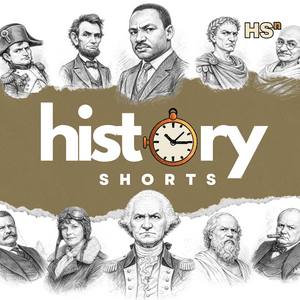
Dive into the past with award-winning historian Peter Zablocki in this captivating daily podcast! Uncover hidden stories you never knew existed. And don't miss Friday Conversations where Peter teams up with top experts for riveting, in-depth discussions that bring history to life.
Podcast websiteListen to History Shorts, British Scandal and many other podcasts from around the world with the radio.net app
Get the free radio.net app
- Stations and podcasts to bookmark
- Stream via Wi-Fi or Bluetooth
- Supports Carplay & Android Auto
- Many other app features
Get the free radio.net app
- Stations and podcasts to bookmark
- Stream via Wi-Fi or Bluetooth
- Supports Carplay & Android Auto
- Many other app features

History Shorts
Scan code,
download the app,
start listening.
download the app,
start listening.
History Shorts: Podcasts in Family
 New Zealand