

Listen to this podcast in the app for free: Download for free in the App Store
radio.net
Sleep timer
Save favourites
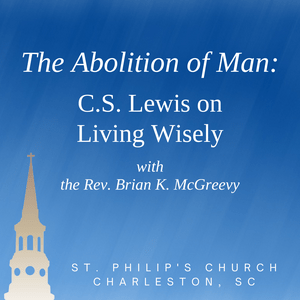
The Abolition of Man: C.S. Lewis on Living Wisely
St. Philip's Church: Charleston, SC
Latest episode
7 episodes
Episode 7
10/11/2021Following a review of Lewis's argument in the first two chapters, this week we delved into the eponymous third chapter, where Lewis expounds how what we call Man’s power over Nature turns out to be a power exercised by some men over others with Nature as its instrument. "Human nature will be the last part of Nature to surrender to Man. The battle will indeed be won--but who precisely will have won it? For the power of Man to make himself what he pleases means…the power of some men to make other men what they please.”Episode 6
27/10/2021This week we look at how some of Lewis's predictions in "Men Without Chests" about the results of the loss of objective value were fulfilled in the 20th century by the work of Jacques Derrida and Michel Foucault, which has spawned a cultural revolution in academia. We also begin our journey into Chapter 2, "The Way," where Lewis explains the role of the Tao.Episode 5
20/10/2021One of the beauties of this book is the way that Lewis marshals evidence for his argument from sources as diverse as Shelley's Aeolian harp to Plato's Republic. In this episode, we unpack some of that imagery and also take a look through a parallel lens at the way that Lewis expresses this same argument in the first section of Mere Christianity, "Right and Wrong as a Clue to the Meaning of the Universe."Episode 4
13/10/2021"Men Without Chests" focuses on the concept and critical importance of objectivity of value. In this episode, we explore that concept through some thematic analysis and through looking at the Tao of sentiment, with a quick trip to Narnia to look at Eustace Scrubb and Experiment House.Episode 3
06/10/2021"Men Without Chests" is the first chapter in The Abolition of Man; Lewis focuses on what he views as a dangerous assumption about feelings as opposed to objective value as reflected in educational materials. In this episode we look at Gaius and Titius and The Green Book and discuss Lewis's use of the image of the waterfall as a sort of proxy for the beauty of Natural Law.
More Religion & Spirituality podcasts
 Tara BrachBuddhism, Health & Wellness, Mental Health, Religion & Spirituality
 Unbelievable?Christianity, Religion & Spirituality
 The Bible in a Year (with Fr. Mike Schmitz)Christianity, History, Religion & Spirituality
 BibleProjectChristianity, Religion & Spirituality
 Timothy Keller Sermons Podcast by Gospel in LifeChristianity, Religion & Spirituality
 Joel Osteen PodcastReligion & Spirituality
 Sounds True: Insights at the EdgeReligion, Religion & Spirituality, Spirituality
 Live Free with Josh HowertonChristianity, Religion & Spirituality
 Lakepointe Church with Josh HowertonChristianity, Religion & Spirituality
 Kids Corner "Liz and Friends"Christianity, Kids & Family, Religion & Spirituality
Trending Religion & Spirituality podcasts
 Derek Prince Ministries PodcastChristianity, Religion & Spirituality
 Deepen with Pastor Joby MartinChristianity, Religion & Spirituality
 2819 ChurchChristianity, Religion & Spirituality
 Sunday Sanctuary with Petra BagustChristianity, Religion & Spirituality
 Ms. Adventure‘s Treehouse: Christian Stories for KidsChristianity, Kids & Family, Religion & Spirituality, Stories for Kids
- Sounds True: Insights at the EdgeReligion, Religion & Spirituality, Spirituality
 The J.John PodcastChristianity, Education, Religion & Spirituality, Self-Improvement
 Beyond Death Near Death Experience (NDE) StoriesReligion & Spirituality
 Behold IsraelChristianity, News, News Commentary, Religion & Spirituality
 The Remnant Radio's PodcastChristianity, Philosophy, Religion & Spirituality, Society & Culture
 Snarky FaithChristianity, News, Politics, Religion & Spirituality, Spirituality
 Life-Study of Exodus with Witness LeeChristianity, Religion & Spirituality
 Latimer: ListenReligion & Spirituality
 The Bible RecapChristianity, Religion & Spirituality
 The Gospel TruthChristianity, Religion & Spirituality
 WHOA That's Good PodcastBusiness, Christianity, Religion & Spirituality, Society & Culture
 1 Year Daily Audio BibleChristianity, Religion & Spirituality, Spirituality
 The Upward WayReligion & Spirituality
 followHIMChristianity, Courses, Education, Religion & Spirituality
 Life-Study of Isaiah with Witness LeeChristianity, Religion & Spirituality
 The Grove PodcastChristianity, Religion & Spirituality
About The Abolition of Man: C.S. Lewis on Living Wisely
Originally given as lectures to academic philosophers in 1943, "The Abolition of Man" was considered by Lewis to be one of his most important works. His analysis of the fallout that would occur with the abandonment of Objective Value ( the idea that Truth, Beauty, and Goodness are real and definable, rather than determined by individual taste or opinion) is incisive and prophetic. Join us as we unpack this very relevant book!
Podcast websiteListen to The Abolition of Man: C.S. Lewis on Living Wisely, Tara Brach and many other podcasts from around the world with the radio.net app
Get the free radio.net app
- Stations and podcasts to bookmark
- Stream via Wi-Fi or Bluetooth
- Supports Carplay & Android Auto
- Many other app features
Get the free radio.net app
- Stations and podcasts to bookmark
- Stream via Wi-Fi or Bluetooth
- Supports Carplay & Android Auto
- Many other app features

The Abolition of Man: C.S. Lewis on Living Wisely
Scan code,
download the app,
start listening.
download the app,
start listening.
The Abolition of Man: C.S. Lewis on Living Wisely: Podcasts in Family
 New Zealand