

Listen to this podcast in the app for free: Download for free in the App Store
radio.net
Sleep timer
Save favourites
64 episodes
From Immigrant Outsider to Inner Healer: Teda Kokoneshi on Writing, Therapy, and Reclaiming Your Story
15/09/2026 | 22 mins.In this episode, Catherine sits down with Teda Kokoneshi, a licensed mental health counselor and self-published memoirist, to trace her winding path from immigrating to the United States at 18 through a green card lottery, to studying continental philosophy in Boston, chasing a publishing career in New York City, and ultimately finding her calling in clinical mental health counseling. Teda opens up about the disorientation of adapting to a radically different culture, the burnout that brought her back to Florida, and how discovering Carl Jung's analytical psychology became a turning point in understanding her own mind. She walks through how she uses active imagination, dreamwork, and art therapy with clients, and shares why she believes true social justice work has to be rooted in personal healing. Teda also talks about her memoir, Living to Tell the Story: A Memoir and a Map of Reconstruction After the Dark Night of the Soul, and the writing projects — poetry, short stories, essays — she has percolating next.
Connect with Teda - Website - Instagram - Substack
Connect with Catherine - Website - Substack
Prentiss Hemphill PodcastA Midwife for Voices: Grief, the Five Elements, and Reclaiming Your Full Range with Barbara McAfee
06/09/2026 | 38 mins."You can't change your voice without your life coming along for the ride." — Barbara McAfee
What if your voice already knows what part of you needs attention — you just have to make the sound and listen? In this episode of The Curious Empath, I sit down with Barbara McAfee: singer, songwriter, voice teacher, author of two books on voice work, and the leader of a "comfort choir" of volunteers who sing for people who are dying, sick, or grieving.
We start at the threshold — literally. Barbara talks about the retreats she leads on music, death, and dying, how she stumbled into death doula work at her father's bedside at 31, and why she believes grief and joy have always lived in the same room. We talk about a grief ritual she helped hold for hundreds of people at a singing camp in Iowa, and the collective grief so many of us are carrying right now.
From there we go into Barbara's Five Elements Framework — a way of understanding the voice through Earth, Fire, Water, Metal, and Air, each with its own archetype, gift, and shadow side. We talk about the parts of our voices that go "offline" under trauma, culture, and gender norms; how reclaiming a silenced part of your voice is really a form of soul retrieval; and how Barbara can often hear someone's deepest gift — calm under pressure, seeing the future, cutting insight — just by the way they talk.
This is a conversation about sound, grief, gender, gifts, and what it means to let your whole voice — and your whole self — come home.
Connect with Barbara - Website - Ted Talks - Instagram - Patreon - "Oh For Crying Out Loud" Song
Connect with Catherine - Website - Substack - Soul Retrieval
I'm Catherine — counselor, mystic, and neurodiverse adventurer living on the Emerald Coast of Florida. I help people define their neurodiversity, trust themselves, and live fully connected to Self and Source. I’d love to hear from you and walk alongside you on your journey.
With a full heart,
CatherineMeeting our Well of Emotions: Cristine Hull on Anger, Fear, Sadness, and Guilt
24/08/2026 | 24 mins.Catherine sits down with Cristine Hull, PhD — founder of the Zero Point Meridian Technique and creator of Frequency Formulas — for a wide-ranging conversation about the road from living entirely "in her head" to becoming a practitioner of energy psychology and quantum healing. She and Catherine dig into brain integration and heart rate coherence, the neuroscience of different neurodivergent minds, Gretchen Rubin's Four Tendencies, and Cristine's Love Solve method for processing the four core negative emotions — anger, fear, sadness, and guilt — including some delightfully practical ways to actually get anger out of the body.
Join Cristine for a free webinar 8/26/26!
Contact Cristine - Website - Instagram - LinkedIn - YouTube
Contact Catherine - Website - SubstackThe Frequency of Truth: Divination, Intention & Energy with Demi Pietchell
05/08/2026 | 37 mins.What is divination really for — predicting the future, or understanding the energy you're working with right now? In this episode, investigative metaphysician and certified Monroe Institute trainer Demi Pietchell joins me to unpack her eclectic toolkit (tarot, runes, shufflemancy, sound medicine) and the throughline beneath all of it: intention. We talk about how she tunes into collective energy from a distance, the discernment required to hold that kind of sensitivity, and how ancient sites like Malta's Oracle Chamber may have been built to resonate at frequencies that shift consciousness. A conversation about using insight to empower choice — not to hand over your agency to fate.
Contact Demi: Website
Sign up for her Manifestation Training Aug 7-9 (use code 20ce20 for a 20% discount)
Contact Catherine: Website - Substack
Editing and Logo by Catherine QuiringThe Invisible Wounds: Understanding Spiritual Abuse with Katherine Spearing
29/01/2026 | 33 mins.In this conversation, Katherine Spearing discusses her new book, 'A Thousand Tiny Papercuts,' which explores the complexities of spiritual abuse and the journey to reclaim autonomy after leaving high-control religious environments. The discussion delves into the insidious nature of spiritual abuse, the confusion experienced by individuals trying to navigate their faith, and the emotional turmoil that often follows leaving such systems. The conversation also highlights the importance of understanding the BITE model of control and the potential for thriving after leaving these environments, emphasizing the need for healing and self-acceptance.
More Education podcasts
 The Jefferson Fisher PodcastEducation, Relationships, Self-Improvement, Society & Culture
 Keep The ChangeBusiness, Education, Self-Improvement
 6 Minute EnglishEducation, Language Learning
 The Mel Robbins PodcastEducation, Health & Wellness, Mental Health, Relationships, Self-Improvement, Society & Culture
 Begin Again with Davina McCallEducation, Health & Wellness, Mental Health, Self-Improvement, Society & Culture
 Luke's ENGLISH Podcast - Learn British English with Luke ThompsonComedy, Education, Language Learning
 All Ears English PodcastBusiness, Education, Language Learning
 The Rich Roll PodcastEducation, Health & Wellness, Self-Improvement, Society & Culture
 How to Be a Better HumanEducation, Self-Improvement
 Learning English ConversationsEducation, Language Learning
Trending Education podcasts
 Kiwi EnglishEducation, Language Learning
 The Tony Robbins ChannelBusiness, Education, Marketing
 The Daily MotivationEducation, Self-Improvement
 Culips Everyday English PodcastCourses, Education, Language Learning, Self-Improvement
 Confident Business EnglishEducation, Language Learning, Self-Improvement, Tutorials
 Whakamīere - Reo Māori StoriesArts, Books, Education, Kids & Family, Language Learning, Stories for Kids
 The Jordan Harbinger ShowBusiness, Education, Science
 Work + Life Harmony | Time Management, Organization and Planning for Overwhelmed WomenBusiness, Education, Entrepreneurship, Kids & Family, Self-Improvement, Society & Culture, Tutorials
 The Tamsen ShowEducation, Health & Wellness, Self-Improvement, Society & Culture
 Easy German: Learn German with native speakers | Deutsch lernen mit MuttersprachlernCourses, Education, Language Learning
 Clutterbug - Real-Life Hacks and Tips to Declutter, Organize and Clean your Home FastEducation, Home & Garden, Kids & Family, Leisure, Self-Improvement
 醍醐WAYBusiness, Careers, Comedy, Education, Health & Wellness, Investing, Language Learning, Management, Marketing, Self-Improvement, Stand-Up Comedy, Tutorials
 Dreaming Spanish Podcast – Chats in Beginner SpanishEducation, Language Learning
 Trauma RewiredEducation, Life Sciences, Science, Self-Improvement
 Beginner Portuguese PodcastEducation, Language Learning
 Write MedicineBusiness, Education, Entrepreneurship, Health & Wellness, Medicine, Tutorials
 Pride and Prejudice by Jane Austen - Free AudiobookEducation, Fiction
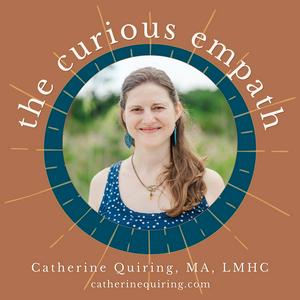
About The Curious Empath (Formerly: Who We Are & What We Need)
The Curious Empath is a podcast for those who experience life with unusual depth — and want to explore it that way. Host Catherine Quiring follows genuine curiosity wherever it leads: healing and transformation, self-trust and sovereignty, spirituality and psychology, channeling and dreamwork, art, beauty, love, liberation, and the ongoing project of making the world a better place for all of us.
Honest, wide-ranging conversation with fascinating people and ideas — and the belief that depth of feeling is a gift worth understanding.
Podcast websiteListen to The Curious Empath (Formerly: Who We Are & What We Need), The Jefferson Fisher Podcast and many other podcasts from around the world with the radio.net app
Get the free radio.net app
- Stations and podcasts to bookmark
- Stream via Wi-Fi or Bluetooth
- Supports Carplay & Android Auto
- Many other app features
Get the free radio.net app
- Stations and podcasts to bookmark
- Stream via Wi-Fi or Bluetooth
- Supports Carplay & Android Auto
- Many other app features

The Curious Empath (Formerly: Who We Are & What We Need)
Scan code,
download the app,
start listening.
download the app,
start listening.
 New Zealand