
Listen to this podcast in the app for free: Download for free in the App Store
radio.net
Sleep timer
Save favourites
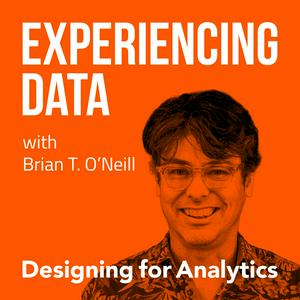
Experiencing Data w/ Brian T. O’Neill
Brian T. O’Neill from Designing for Analytics
Latest episode
206 episodes
205 - Everyone Says They’re the Missing Layer in Enterprise AI, So I Asked Solid’s CEO How He Proves That in a POC
20/10/2026 | 45 mins.Yoni Leitersdorf's company, Solid, sells a semantic layer: the plumbing that helps AI agents understand an enterprise's data well enough to do effective, valuable work that passes a customer's evals. As platform software, this is about as invisible as a product gets, and by Yoni's count there are probably 100 semantic layers a buyer can choose from right now, including the ones Snowflake and Databricks already ship. So I wanted to know how a startup like Solid can get market share in a crowded category, and how it decides which deals are worth chasing. One of his answers: the prospect who shows up saying "we know we need a semantic layer" is not the deal he's hoping for.
We also got into:What a POC has to prove before a data leader can take it through the finance/procurement gauntlet
Why Yoni thinks startup speed stopped being a moat against Snowflake and Databricks given how fast bigger companies are now shipping features
What he'd change about his customer discovery process if he started a third company
If your product is a horizontal platform or infrastructure your buyer can't see, I hope this episode sheds some light on the overlap between product, UX, and GTM for enterprise AI.
LinksGetSolid.ai
Yoni on LinkedIn
Full transcript and show notes: designingforanalytics.com/resources/episodes/205204 - Showing ROI in 30 Minutes, Not Your AI: How Datalogz’s CEO Built a Sticky Enterprise Analytics Product
06/10/2026 | 43 mins.Logan Havern's company, Datalogz, sits on top of an enterprise's BI platforms (Power BI, Tableau, Qlik, Databricks Genie, and the SharePoint spreadsheets nobody admits to) and finds the duplicated, conflicting, and unused reports that AI is now generating faster than anyone can clean up. At one large pharma customer, executives "talking to their data" get wrong answers and then argue with the data team, because they believe Claude over the humans. The product that fixes that, which Logan calls semantic intelligence, is the one he thinks makes Datalogz a multibillion-dollar company. However, this is not what he sells first—and this is the topic we dug into today on this episode of Experiencing Data.
What Logan sells first is a 30-minute connection and a cost-savings business case finance can sign off on. That wedge took him a long time to find, and it sets him apart from other companies trying to sell “better AI answers” and “talk to your data” solutions. We also dove into the manual work [of 5-to-30-person admin teams] his product replaces, and my skepticism that usage data on a dashboard can tell you anything about whether it delivered value. If your analytics product's biggest value is also the hardest to explain, this one is for you.
Links
datalogz.io
Linkedin: https://www.linkedin.com/in/loganhavern/203 - Engineering Is 6x Faster. Sales Isn't. Here's What Your Team Never Defined.
17/09/2026 | 40 mins.What happens when your product team suddenly moves six times faster at delivering features, but your sales and business traction is unchanged? AI, and particularly AI for coding, has made it easier than ever to ship features, but faster development doesn’t automatically create better products or better outcomes. The real question is whether what you’re building changes anything for the people who buy, use, and benefit from your product.
Today, I get into why AI evals and acceptance criteria measure the product, not its impact, and why your buyers are probably judging your POC on success metrics your team never wrote down. Toward the end, I make the concepts concrete by applying them to a fictional AI-powered pricing tool to show what defining quality looks like for both the fiscal buyer and the end user, and what to do with all that extra engineering velocity instead.
Your goal? Better; not just faster.
Links
Episode 192: Analytics Product Usage Does Not Equal Value
Episode 202: Surface Tension202 - Surface Tension: The 5 Essential Control Surfaces to Make Your Analytics Product Sell Itself
02/09/2026 | 31 mins.What makes an analytics or intelligence product indispensable when technical sophistication alone isn’t enough to drive adoption, renewals, or sales? Why do POCs stall, why does adoption stay flat, and why aren’t prospects nearly as excited about your (impressive) analytics tech as you are?
It’s that the value never becomes obvious to the humans in the loop who do the buying, using, and justifying.
In this episode, I provide a framework for identifying the personas (roles) and experiences that can turn sophisticated analytical capability into perceived value. We’ll explore the five essential control surfaces you’ll need to address in your product and why founders and product leaders need to look beyond technical development (e.g., the delivery of AI models, dashboards, MCP connectors, agentic capabilities, and traditional interfaces).
I also examine the tensions that can emerge when incentives and goals for end users are not aligned with those of management and executive/fiscal buyers. Why does the efficiency ROI you sell to a management champion get read as a job threat to the operator/user whose adoption you need to succeed? I’ll answer this, plus the reasons AI can complicate those dynamics, how to prevent your product from creating an Invisible Intelligence Gap for customers, and why one past podcast guest’s “shipping the meter” matters much more than another feature. (That will also explain why I don’t think dashboards are dead in the age of AI.)
Highlights / Skip to:
Short-term stakeholders you shouldn’t forget to satisfy (particularly during POCs/Demos) such as legal, compliance, and the game of defense “value be damned” they are playing (4:14)
Not every mouth is equally hungry: deciding which personas deserve the most product attention (8:23)
End users of your product such as developers, analysts, business users (often ICs) operating your product daily—and why the real bar is whether they would complain to the C-suite if your product went away (9:12)
How managers of ICs (e.g., sales directors, customer service managers, VPs of data, etc.) might need something very different than end users, and why the manager’s needs might be a threat to those very IC users. The 3-part fix? Making all parties look successful to their superiors; improving the lives of those stakeholders; and arming champions with the evidence fiscal buyers need (11:08)
The unique needs of executive and financial stakeholders who might have the most decision power while using your product the least (15:59)
Why “shipping the meter” and the Invisible Intelligence Gap decide whether your product survives the next budget cut (17:07)
The “AI Agent” as a “user” of your product: Why I think agents ride in a sidecar attached to humans and what you need to do to enable your customers and their AI agents to be successful (21:23)
Why figuring out what control surfaces/UIs/UXs you may need to improve is the easy part if you know what they are a response to (26:37)
Links
197 - Agentic AI Isn't a Moat for Analytics Products.This is. - My episode on viable moats for BI/Analytics products in the age of AI
The Invisible Intelligence Gap
Behavioral Signals CEO Rana Gujral on “Shipping the Meter” is in Episode 198
Need help identifying the 5 control surfaces in your product and satisfying the human users behind them? Schedule a free discovery call with me201 - What Enterprise Buyers Really Want from Analytics Software Companies with David Krauza
18/08/2026 | 29 mins.Recently, I met David Krauza, VP of Enterprise Data Strategy and Products & Governance at Comcast, at the 2026 CDOIQ symposium, and after chatting for a bit, he agreed to come on the show to talk about how he, as an enterprise buyer, thinks about B2B software purchases in the age of AI. As vibe coding makes internal development more accessible, David explains why the buy-versus-build decision isn’t simply about whether a company can build a solution itself. Leaders need to weigh long-term roadmaps, maintenance, integrations, and whether they want to take on the responsibility of becoming a software company. The real question is not just what can be built, but what makes the most strategic sense to own.
David also highlights an important consideration vendors frequently overlook: the data their own products create and the possible importance of that to an enterprise data leader. This is particularly true when the product’s primary intended purpose is not analytics itself. In a complex sales environment, which may include a senior data leader as a champion or decision maker, product metadata, or what you might currently be thinking of as a byproduct, might actually be a primary decision point in an enterprise purchasing conversation. David then outlines the pre-implementation work required before any of this can be evaluated: establishing shared definitions, explicit success metrics, and a documented “before-picture” you can run at renewal time to understand the ROI of the product.
We also explored the hidden costs that can undermine an otherwise compelling product. A polished UI may still create UX friction if users have to constantly move between systems, while complex data integrations can introduce additional labor and operational burdens. This friction should be considered during the evaluation rather than discovered after development. David says vendors can stand out by demonstrating that they understand where a customer’s business is headed and how their roadmap supports that direction. He also dropped some real gold about the difference he sees as a buyer when being pitched by a founder vs. a B2B salesperson—and what the latter is missing when they pitch him.
Highlights / Skip to:
Why buy any products when AI allows you to build them yourself? (2:03)
Allowing use cases and goals to dictate the adoption of internal solutions (4:03)
Making data capture, accessibility, and ecosystem fit part of the buying decision (5:54)
Is data missing in sales conversations due to a lack of marketing or of results? (8:36)
Comcast’s method for deciding to renew when the intelligence is invisible (11:22)
The importance of pre-post analysis when making a renewal argument (14:02)
Where David sees the most time being wasted in the pitch process and why vendors who did _____ win more often (16:36)
The hidden costs that often go undiscussed during the sales process (20:07)
How Comcast evaluates UX friction (back-and-forth of switching between applications to accomplish work) (22:22)
Other hidden factors that can prevent your sale from closing (25:13)
Differences David sees between founder-led sales and sales-led sales (26:41)
David’s advice for founders selling in the analytics and data space right now (28:14)
Links
David Krauza’s LinkedIn
David Krauza’s Substack
More Business podcasts






Trending Business podcasts

















About Experiencing Data w/ Brian T. O’Neill
Your B2B analytics product does the hard technical work. So why aren't sales and adoption keeping up?
I'm Brian T. O'Neill, and my podcast, Experiencing Data, is a Listen Notes top 2% global podcast for founders, CEOs, and product leaders at B2B analytics companies: the ones whose product should be winning deals on technical sophistication alone, but isn't.
Maybe competitors have caught up on features and prospects say you all look the same, so you end up competing on price. Maybe customers never discover your best features and use you "like Excel." Maybe your value is algorithmic, and buyers can't see what they'd be paying for—something I call the Invisible Intelligence Gap.
Through solo episodes and interviews with CEOs, founders, and the enterprise data leaders who buy these products, I draw on my work as a product designer and strategy consultant to help you translate technical complexity into commercial clarity: connecting what your data product does to the outcomes, value, and human factors that still matter, even in the age of AI.
Experiencing Data is the only non-technical show about why technically impressive products don't sell or get used, and what to do about it.
Subscribe today on all major platforms or browse the episode archive.
Get 1-Page Episode Summaries In your Inbox:https://designingforanalytics.com/edAbout Brian:https://designingforanalytics.com/bio/
Podcast websiteListen to Experiencing Data w/ Brian T. O’Neill, The Diary Of A CEO with Steven Bartlett and many other podcasts from around the world with the radio.net app
Get the free radio.net app
- Stations and podcasts to bookmark
- Stream via Wi-Fi or Bluetooth
- Supports Carplay & Android Auto
- Many other app features
Get the free radio.net app
- Stations and podcasts to bookmark
- Stream via Wi-Fi or Bluetooth
- Supports Carplay & Android Auto
- Many other app features

Experiencing Data w/ Brian T. O’Neill
Scan code,
download the app,
start listening.
download the app,
start listening.
 New Zealand
