PodcastsArtsLasers in Skin

Lasers in Skin

Lisa McMahon & Mike Murphy
Lasers in Skin
Latest episode

Available Episodes

5 of 49
  • How Do We Read the Skin?
    In this episode, Mike and Lisa delve into the intricacies of "reading the skin" during various laser treatments. They discuss the importance of understanding skin responses, such as erythema and edema, as indicators of treatment effectiveness, particularly in hair removal, tattoo removal, and pigmentation treatments. KEY TAKEAWAYS Understanding skin responses during treatments is crucial. Indicators such as erythema (redness) and edema (swelling) provide valuable feedback on how the skin is reacting to various laser treatments. The appropriate fluence (energy level) for treatments cannot be predetermined without observing the skin's reaction. Practitioners should start at a lower fluence and gradually increase it based on the skin's response. A certain level of redness and swelling is acceptable and indicates a good reaction. However, excessive redness, bleeding, or broken skin surfaces are signs of over-treatment and should be avoided. Using ice packs or cooling methods before and during treatments can help manage skin temperature and reduce adverse reactions. Proper cooling can prevent ice burns and enhance treatment outcomes. Engaging with clients about their experiences during treatments is essential. Asking for feedback on pain levels and observing their skin reactions can guide practitioners in adjusting their techniques for better results. BEST MOMENTS "The skin is kind of giving us clues and indicators. It's communicating. It does depend on what you're treating and which technology you're using." "If you break the skin whilst treating a tattoo or PMU, then you haven't done it right." "A certain level of redness is good, but if it goes very red, kind of angry red, then that's telling you you've gone too far." "I want to see it crusty, dusty, red and angry, but no bleeding, never, ever, ever bleeding." "Reading the skin is a good skill to develop. Take the time and look at the skin's reaction and think, what is this trying to tell me?" ABOUT THE HOSTS Mike began his career in medical lasers in 1986 with a physics degree and a post-grad in bioengineering. He helped develop the scar-free removal of tattoos using a Q-Switched Ruby Laser in Glasgow, and the world's first IPL system. Known well in the industry for his hard truths, no BS attitude and logical answers. As the author of three books, articles for medical journals, a well read blog, a Laser Protection Advisor and contributor to the BMLA, Mike is the Laser Guru. Lisa's claim to laser fame is being Mike's daughter. Growing up with lasers and never avoiding a physics lesson from her Dad, it was natural to enter the industry. Leaving a corporate career with a baby to jump into self employed life came with challenges. Despite that Lisa has been well recognised for her teaching style, practical tips, bringing the compassion to the science, and laser mentoring. Instagram: @dermalase_lasertraining https://mikemurphyblog.com https://www.dermalasetraining.com This Podcast has been brought to you by Disruptive Media. https://disruptivemedia.co.uk/
    --------  
    36:09
  • Laser Pen
    In this episode, Lisa and Mike dive into the controversial Neat Cell picosecond laser pen device, which claims to remove tattoos without scarring. Mike shares his skepticism about the device's effectiveness, explaining the technical limitations of picosecond lasers and the potential dangers of using such a product without proper safety measures.  KEY TAKEAWAYS Skepticism of Neat Cell Device: The Neat Cell picosecond laser pen device is met with skepticism regarding its claims of being a true picosecond laser, as it is likely just an LED or a low-powered laser diode that cannot effectively remove tattoos. Lack of Safety Measures: The device does not come with safety glasses, which raises concerns about eye safety, especially since the device emits intense blue light that can cause damage. Ineffective Tattoo Removal: Initial tests on the device suggest that while it may cause some disruption to tattoo ink, it also results in significant skin damage and scarring, which may mask the appearance of the tattoo rather than effectively removing it. Regulatory Action: The UK government has issued a product safety report banning the Neat Cell device from entering the UK market due to non-compliance with electrical safety regulations, indicating it is considered unsafe. Home Use Devices for Hair Removal: While skepticism exists around home-use devices for hair removal, some have been found to be effective when used consistently over time, suggesting that they can complement professional treatments rather than replace them. BEST MOMENTS "I am pretty sure this thing is probably not a laser. It's an intense blue light source, which is most likely an LED." "Imagine at the end of all that you said, so I'd recommend you help. No, no." "The UK government has issued a product safety report on this NeatSet device and they've stopped it from entering the UK." "If it looks too good to be true, then it usually is." "Let us know if you've used the IPL at home devices too." ABOUT THE HOSTS Mike began his career in medical lasers in 1986 with a physics degree and a post-grad in bioengineering. He helped develop the scar-free removal of tattoos using a Q-Switched Ruby Laser in Glasgow, and the world's first IPL system. Known well in the industry for his hard truths, no BS attitude and logical answers. As the author of three books, articles for medical journals, a well read blog, a Laser Protection Advisor and contributor to the BMLA, Mike is the Laser Guru. Lisa's claim to laser fame is being Mike's daughter. Growing up with lasers and never avoiding a physics lesson from her Dad, it was natural to enter the industry. Leaving a corporate career with a baby to jump into self employed life came with challenges. Despite that Lisa has been well recognised for her teaching style, practical tips, bringing the compassion to the science, and laser mentoring. Instagram: @dermalase_lasertraining https://mikemurphyblog.com https://www.dermalasetraining.com This Podcast has been brought to you by Disruptive Media. https://disruptivemedia.co.uk/
    --------  
    26:55
  • Hair Popping - What Does It Actually Mean?
    In this episode, Lisa and Mike delve into the intriguing topic of 'jumping hairs', a phenomenon observed during laser hair removal treatments. Inspired by a message from a listener in Germany, Nicole, they discuss the misconception that the rapid ejection of hairs post-laser treatment indicates treatment efficacy. Lisa and Mike clarify that this effect, often referred to as 'popping hairs', is primarily due to steam formation in the hair follicles rather than a sign of successful follicle damage. They emphasise that while visual reactions like swollen follicles or erythema can be appealing, they do not necessarily correlate with treatment success. KEY TAKEAWAYS The phenomenon of 'popping hairs' or 'jumping hairs' observed during laser treatments does not indicate the efficacy of the treatment. It is primarily caused by steam formation in the hair follicle, which can force superficial hairs out but does not necessarily mean the follicle itself has been effectively treated. Commonly cited clinical endpoints, such as swollen follicles or erythema (redness), do not guarantee successful treatment outcomes. Successful hair removal can occur without these visible signs, and their absence does not imply ineffective treatment. As laser hair removal treatments progress, the hair follicles can become synchronised in their growth cycles. This means that after several sessions, more hairs may appear to be growing back at the same time, which can lead to the misconception that the treatment is failing. The goal of laser hair removal is to induce enough damage to the hair follicle without harming surrounding tissue. Chasing visible reactions like folliculitis can lead to unnecessary tissue damage and is not a reliable indicator of treatment success. The hair growth cycle consists of different stages (anagen, catagen, telogen), and effective laser treatments primarily target hairs in the anagen phase. Popping hairs are often in the telogen phase, which are not the target for effective hair removal. BEST MOMENTS "In Germany, they use the term jumping hairs, which refers to the phenomenon of hairs rapidly exploding or being ejected from the follicle immediately after laser irradiation." "Popping hairs are not clinical endpoints. It looks really cool, but it’s not a clinical endpoint." "If you do that and those hairs pop out, that doesn't necessarily mean that the follicle has been sufficiently damaged." "You want to induce enough damage to do the job, but not so much that you're damaging everything else." "If you're not getting popping hairs, do not worry. As long as you're getting results and people are happy, you're great." ABOUT THE HOSTS Mike began his career in medical lasers in 1986 with a physics degree and a post-grad in bioengineering. He helped develop the scar-free removal of tattoos using a Q-Switched Ruby Laser in Glasgow, and the world's first IPL system. Known well in the industry for his hard truths, no BS attitude and logical answers. As the author of three books, articles for medical journals, a well read blog, a Laser Protection Advisor and contributor to the BMLA, Mike is the Laser Guru. Lisa's claim to laser fame is being Mike's daughter. Growing up with lasers and never avoiding a physics lesson from her Dad, it was natural to enter the industry. Leaving a corporate career with a baby to jump into self employed life came with challenges. Despite that Lisa has been well recognised for her teaching style, practical tips, bringing the compassion to the science, and laser mentoring. Instagram: @dermalase_lasertraining https://mikemurphyblog.com https://www.dermalasetraining.com This Podcast has been brought to you by Disruptive Media. https://disruptivemedia.co.uk/
    --------  
    23:00
  • ELI5 - How Are Spot Size, Fluence & Penetration Depth Related?
    In today's episode, Lisa and Mike turn up the energy - literally! They dive into the fascinating world of lasers and IPL treatments, unpacking the science behind spot size, fluence, depth of penetration, and wavelengths. When Emma, a curious Level 4 student, asks about how energy delivery changes with different spot sizes, Lisa and Mike fire back with laughs, analogies, and plenty of light-based wisdom. Along the way, they break down why fluence matters, how scattering shapes results, and why pre-cooling can be the secret to a pain-free zap. KEY TAKEAWAYS Fluence, defined as energy per area (joules per square centimetre), remains constant across different spot sizes. However, the total energy delivered varies significantly based on the spot size, with larger spots delivering more total energy. When light enters the skin, it scatters, which affects the fluence at different depths. The scattering can lead to an increase in fluence just below the skin surface due to backscattering, which can exceed the incident fluence. Different wavelengths penetrate the skin differently, with red light penetrating deeper than blue or green light. However, the presence of scattering in the skin can alter the effectiveness of these wavelengths. Increasing fluence at the skin surface raises the temperature in the epidermis, which can trigger pain receptors. Pre-cooling the skin before treatment can help mitigate pain by lowering the baseline temperature. Understanding fluence is crucial for effective laser treatments, as it directly influences the temperature rise in the target tissue, which is essential for achieving desired treatment outcomes. BEST MOMENTS "When you set up your laser or IPL to deliver a particular fluence, then at every point in that spot the fluence is the same, or it should be the same." "So then how does the small spot work so well? Because it's the fluence that's important, not the total energy." "The fluence is what drives the process. Fluence is directly responsible for the temperature increase in whatever the target is." "Isn't it cool though what happens in your skin when you shoot a laser in there? Or a light, not just lasers." "If you pre-cool the skin before you fire in your light energy, there's a smaller chance of triggering the pain receptors." ABOUT THE HOSTS Mike began his career in medical lasers in 1986 with a physics degree and a post-grad in bioengineering. He helped develop the scar-free removal of tattoos using a Q-Switched Ruby Laser in Glasgow, and the world's first IPL system. Known well in the industry for his hard truths, no BS attitude and logical answers. As the author of three books, articles for medical journals, a well read blog, a Laser Protection Advisor and contributor to the BMLA, Mike is the Laser Guru. Lisa's claim to laser fame is being Mike's daughter. Growing up with lasers and never avoiding a physics lesson from her Dad, it was natural to enter the industry. Leaving a corporate career with a baby to jump into self employed life came with challenges. Despite that Lisa has been well recognised for her teaching style, practical tips, bringing the compassion to the science, and laser mentoring. Instagram: @dermalase_lasertraining https://mikemurphyblog.com https://www.dermalasetraining.com This Podcast has been brought to you by Disruptive Media. https://disruptivemedia.co.uk/
    --------  
    36:36
  • Ask the Physicist Fun Questions!
    In a fascinating deviation from their usual topic, Lisa and Mike delve deep into the world of experimental physics and astrophysics in this episode. Mike tackles a range of mind-bending questions sourced by Lisa from ChatGPT, covering everything from the common misconceptions of relativity and time dilation near the speed of light and black holes, to the immense size of the universe. They also touches on space exploration (Mars colonisation), the mysteries of gravity (gravitational waves), and some truly silly, thought-provoking physics questions about cats, superheroes, and woodchucks. KEY TAKEAWAYS Time does not actually "slow down" for an object approaching the speed of light; it appears to slow down to an external observer due to relative motion and frames of reference. To an external observer, an object (like a spaceship) approaching a black hole would appear to slow down and freeze permanently at the event horizon, never crossing it. However, the person inside the spaceship would simply pass through without noticing the horizon. The universe is "unfathomable" in size, beyond human comprehension. The current estimate for its total lifespan is potentially less than 50 billion years, which is considered a relatively short time in cosmic terms. Gravitational waves, tiny ripples in spacetime caused by massive collisions (like black holes), were eventually measured using extremely precise laser interferometry technology. String theory, the idea that everything is made of vibrating strings of energy, is currently unprovable because we lack the technology to observe or measure these incredibly small units. BEST MOMENTS "This is a common misconception out there. Relativity, it's all about relative motion from one person to another person or whatever." “To me, I can just seal straight on through the black hole's event horizon. I don't see anything, I don't notice that. I'm not even aware that the event horizon is there." “The way I think about time in general is like a river. To quote the great Doctor Who, it's a ‘wibbly-wobbly thing'." "We're small creatures living on a small rock in a small part of this smallish galaxy, and it feels so big." "Gravity is always attractive. Gravity pulls things towards each other. There's no such thing as a negative gravity or repelling." ABOUT THE HOSTS Mike began his career in medical lasers in 1986 with a physics degree and a post-grad in bioengineering. He helped develop the scar-free removal of tattoos using a Q-Switched Ruby Laser in Glasgow, and the world's first IPL system. Known well in the industry for his hard truths, no BS attitude and logical answers. As the author of three books, articles for medical journals, a well read blog, a Laser Protection Advisor and contributor to the BMLA, Mike is the Laser Guru. Lisa's claim to laser fame is being Mike's daughter. Growing up with lasers and never avoiding a physics lesson from her Dad, it was natural to enter the industry. Leaving a corporate career with a baby to jump into self employed life came with challenges. Despite that Lisa has been well recognised for her teaching style, practical tips, bringing the compassion to the science, and laser mentoring. Instagram: @dermalase_lasertraining https://mikemurphyblog.com https://www.dermalasetraining.com This Podcast has been brought to you by Disruptive Media. https://disruptivemedia.co.uk/
    --------  
    40:58

More Arts podcasts

About Lasers in Skin

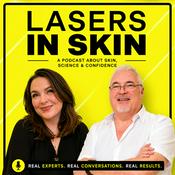
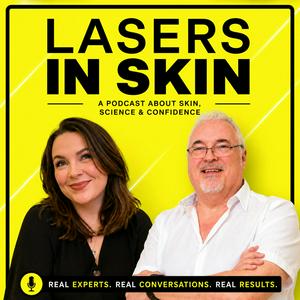
Lasers in Skin Podcast, hosted by "Laser Guru" Mike Murphy, and his daughter Lisa McMahon, dives into the science of lasers in aesthetics. Mike and Lisa delve into the fundamental physics all laser technicians must understand to get the best results, while squashing the myths, the "marketing baloney" and calling out poor training in the industry. Along with unmissable interviews and 'ask us anything' episodes, the Lasers in Skin Podcast is the ultimate podcast for laser geeks!
Podcast website

Listen to Lasers in Skin, Sentimental Garbage and many other podcasts from around the world with the radio.net app
Get the free radio.net app

  • Stations and podcasts to bookmark
  • Stream via Wi-Fi or Bluetooth
  • Supports Carplay & Android Auto
  • Many other app features
Social
v8.1.1 | © 2007-2025 radio.de GmbH
Generated: 12/9/2025 - 11:14:21 AM