

Listen to this podcast in the app for free: Download for free in the App Store
radio.net
Sleep timer
Save favourites
17 episodes
Winter Announcement
27/12/2023 | 4 mins.Hello Friends!
We are taking a little break for the winter, working up some new offerings for you, and lining up some exciting episodes!
Our first digital offering is almost ready for you!
It's the 5-Step process I've used when facilitating teams to design personalized ways to build more trust, encourage vulnerability and lead with compassion.
We've created a robust, visual guide to help your teams follow those same 5 Steps.
The guide helps you and your team identify resistances and barriers to voicing your own authentic voice, and then build actions and practices to support one another.
Its particularly useful for teams
grappling with sensitive subjects
recovering from sudden expansion or contraction
going through times of change and uncertainty
or, any teams looking to explicitly build more trust
If you're interested in receiving the FREE download of our robust visual guide '5 steps to Co-design More Trust in Meetings', here are a few ways to get access as soon as it's available:
Follow Stef on LinkedIn, and 'ring the bell' so all my posts enter your feed.
Follow Dig In UX on Instagram
Request the guide by sending a message via our online form and we'll add you to our list of recipients.
Have a wonderful winter, All!E12: Feminist Design, Built Environment & Inclusion with Nourhan Bassam, Urban Design Innovator in Gender-responsive spaces
29/11/2023 | 38 mins.When designing spaces, why is a feminist lens important?
What might egalitarian social spaces look and feel like?
How might museums, parks and cities be designed differently to include the needs of women, caregivers and girls?
Historically, a male-centric perspective has been dominant in the design of spaces - particularly cities - which has led to a series of decisions and standards with long-term consequences on the experiences of others, including women and girls, people with diverse gender expressions, racial and ethnic minority groups, neurodivergent groups and other under-represented people.
In this episode, we talk with Nourhan Bassam - a leader and innovator in the field of Feminist Urban Design. We discuss safety, ease of mobility, how the 'othered' groups may travel through and across spaces differently and more frequently. Impacts on indoor and outdoor museum, public and parks spaces include navigation, orientation, feeling and experiencing ease and safety.
Some of these measures have been discussed and implemented in museum and cultural spaces, but there is still much to learn from applying a feminist lens the designs of museum buildings, museum experiences, public spaces, cultural spaces, and connection experiences like transportation and arrival to your site.
Nourhan hopes by raising awareness about the barriers faced by women and the many othered groups, her work will inspire individuals, communities, and policymakers to take action and create spaces and cities that are safe, inclusive, and empowering for all.
Nourhan LinkedIn
Nourhan's website
Links to resources:
Bell Hooks book, Feminism is for Everyone.
Vienna applied gender mainstreaming 30 years ago
Vienna, Aspern neighborhood
Vienna and human-centered thinking
Gendered mobility; The 15 minute city
Barcelona's super block (superilla)
Safer Parks Project:
Safer Parks final report
Safer Parks Project, Dr Anna Barker, Leeds University
Safer Parks merges with Make Spaces for Girls
City of Milan, Sex in the City
Milan Gender Atlas - identify accessibility resources
Leslie Kern book, The Feminist City
Book, Cities and Gender by Helen Jarvis, Jonathan Cloke, Paula Kantor
Geo Chicas project, Las Calles de las Mujeres: Map of streets named after women in cities in Latin America and Spain, to make visible the gap that exists in the representation of female figures in cities.
Safetipin - a social organization working to make public spaces safer and more inclusive for women. They collect data using mobile phone applications.
Nourhan Bassam's book, The Gendered City: How today's cities continue to fail women - expected to be published Dec 2023.
Connect With Us
Have questions or topics you'd like us to explore on the podcast? Or a Guest recommendation?
Have a project in mind needing user-, visitor, or community centered research or strategy?
drop us a line with your idea or inqury!E11, Pt 2: Close observation, empathy and compassion with Bonnie Pitman, Director of Art-Brain Innovation at UT Dallas Center for BrainHealth
10/11/2023 | 32 mins.How does close observation lead to empathy and compassion? This week, we're honored to hear from Bonnie Pitman, a national leader in education and the public engagement of art, who has been a thinker and a doer on the bleeding edge of arts education and engagement for 40 years.
After a long career in art museums, Bonnie is now working on ways to cultivate empathy and compassion through viewing art. Her Power of Observation Framework™ was developed in part to guide medical students using a process of close observation leading to a sustainable practice of empathy and compassion for their patients. In this episode, we hear multiple examples of how the Framework may be applied, as well as its uses in museum spaces.
Through this work, Bonnie has also created a daily practice to "Do Something New", which invites the exploration and celebration of making an ordinary day extraordinary while dealing with her own chronic illness.
Links to resources discussed in the episode
1990s watershed report: Excellence and Equity: Education and the Public Dimension of Museums
Book: Igniting the Power of Art
The Power of Observation™ - lecture
The Power of Observation™ - framework
UT Dallas - Center for Brain Health
Edith O'Donnell Institute of Art History at UT Dallas
JAMA - Journal of the American Medical Association, Pharma Art—Abstract Medication in the Work of Beverly Fishman
Sharon Salzberg, Bonnie's teacher for loving kindness meditation
Nasher Museum
Do Something New - Instagram @BonniePitmanE11, Pt1: Close observation, empathy and compassion with Bonnie Pitman, Director of Art-Brain Innovation at UT Dallas Center for BrainHealth
10/11/2023 | 32 mins.How does close observation lead to empathy and compassion? This week, we're honored to hear from Bonnie Pitman, a national leader in education and the public engagement of art, who has been a thinker and a doer on the bleeding edge of arts education and engagement for 40 years.
After a long career in art museums, Bonnie is now working on ways to cultivate empathy and compassion through viewing art. Her Power of Observation Framework™ was developed in part to guide medical students using a process of close observation leading to a sustainable practice of empathy and compassion for patients. In this episode we hear multiple examples of how the Framework may be applied, as well as its uses in museum spaces.
Through this work, Bonnie has also created a daily practice to "Do Something New", which invites the exploration and celebration of making an ordinary day extraordinary while dealing with her own chronic illness.
Links to resources discussed in the episode
1990s watershed report: Excellence and Equity: Education and the Public Dimension of Museums
Book: Igniting the Power of Art
The Power of Observation™ - lecture
The Power of Observation™ - framework
UT Dallas - Center for Brain Health
Edith O'Donnell Institute of Art History at UT Dallas
JAMA - Journal of the American Medical Association, Pharma Art—Abstract Medication in the Work of Beverly Fishman
Sharon Salzberg, Bonnie's teacher for loving kindness meditation
Nasher Museum
Do Something New - Instagram @BonniePitmanE10: Trauma-informed Digital Design with Melissa Eggleston and Carol F Scott, PhD
19/10/2023 | 57 mins.What does a trauma-informed digital experience look like? Or, better said, what does it feel like? Why is trauma-informed design particularly important for today's digital experiences?
We hear answers to these questions and more this week from Melissa Eggleston and Carol F Scott, PhD - the women behind Trauma-informedTech.com. Melissa is an expert in user-experience design and research with a focus on inclusive, trauma-informed technology and design. Carol is a social worker and social welfare expert whose training intersects law, social work, psychology, human-computer interaction (HCI), and health informatics.
Melissa and Carol discuss what trauma is - and how broad our understanding of trauma has needed to become. We hear why it's important - particularly today, and particularly with children in mind - to design digital experiences that are trauma-informed.
Most importantly, we learn about how to approach and the steps to take in order to design a trauma-informed digital experience.
Melissa Eggleston LinkedIn
Carol F Scott LinkedIn
Links to resource discussed in episode:
Aquent's Design for Good grant
Birdcall, Melissa's consulting business
Trauma Informed Tech.com, Carol and Melissa's collaboration providing resources, guidance and consulting on trauma-informed digital design
Carol et al's award-winning paper from ACM Conference on Human Factors in Computing Systems (CHI) on Trauma-Informed Social Media
Recommendation: First, start with the basics of digital design: Usability Principles, Plain Language Principles because if the experience is not easy to use and accessible, it cannot be trauma informed. Next, you must be thinking about mobile - some people are only accessing online resources via mobile, so consider starting your designs for mobile use.
The Six Principles of Trauma-informed Digital Design:
Safety (physical & emotional),
Trust and Transparency,
Collaboration & Mutuality,
Peer Support,
Empowerment voice & choice,
Cultural, historical and gender issues (aka, Intersectionality)
Paper from Michigan State University on trauma-informed Website Heuristics
Equal Justice Initiative and Legacy Museum
SAMHSA - Six Principles of Trauma-Informed Care
CDC - 6 Guiding Principles To A Trauma-Informed Approach
University at Buffalo School of Social Work Institute on Trauma and Trauma-Informed Care they help organizations become trauma informed.
Look at the Learning Area on Melissa & Carol's traumainformedtech.com website to find more books, videos and resources.
Book on 'design gone wrong' Design for Real Life.
Bassetti Architects - Carol says they are doing a good job! Download Bassetti's workbook here.
You can also listen to our episode on Trauma-Informed Spaces with Lorne McConachie from Bassetti Architects on Spotify. It was our first episode!
Connect with us:
Have questions or topics you'd like us to explore on the podcast? Or a recommendation of an expert to interview? Feel free to contact me via the Dig In UX website or my LinkedIn page.
Need help with a user-, visitor- or community-centered project, evaluation or experience design strategy?
Head over to digin-ux.com for info on human and community-centered strategies for your mission-driven institution
Or, contact us via the Dig In UX website about your project or collaboration you've got in mind, or just to say hello!
More Arts podcasts
 This Cultural LifeArts, Personal Journals, Society & Culture
 The Magnus ArchivesArts, Drama, Fiction, Performing Arts, Science Fiction
 Fresh AirArts, Books, Society & Culture, TV & Film
 THEMOVEArts, Sports
 Take Four BooksArts, Books
 The New Yorker: FictionArts, Books
 99% InvisibleArts, Design
 ill-advised by Bill NighyArts, Books, Comedy, Music
Trending Arts podcasts
 一个人睡前听Arts, Books, Health & Wellness, Mental Health, Relationships, Society & Culture
 The Mish and Zach PodcastArts, Comedy, Performing Arts, TV & Film
 Inklings Book ClubArts, Books
 Gay Erotica by Liam WilliamsArts, Books, Fiction, Health & Wellness, Sexuality
 Selected ShortsArts, Books, Fiction, Society & Culture
 ShedunnitArts, Books
 Mess WorldArts, Entertainment News, Fashion & Beauty, News
 The Book ReviewArts, Books
 The Daily PoemArts, Education for Kids, Kids & Family
 Fantasy FangirlsArts, Books
 Gloss AngelesArts, Entertainment News, Fashion & Beauty, News
 Yours Truly, Johnny Dollar | Old Time RadioArts
 A Good ReadArts, Books
 Art SmartArts, Education, Visual Arts
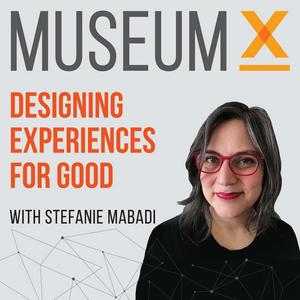
About MuseumX: Designing Experiences for Good
Dig In UX presents MuseumX, where we host conversations at the intersection of experience design and social change to be a resource for heart-centered designers who are called to create experiences that heal our world.
You will hear from professionals inside and outside the museum and cultural sectors whose expertise can inform questions like, How might we design for compassion? Or, Create digital experience accessible for all? Or, how might we create teams primed to foster a sense of belonging for diverse groups?
Together, we'll tackle tough questions, explore complex topics and identify action steps to help us create experiences for the public good - experiences that help, heal, enrich and empower, and connect.
Podcast websiteListen to MuseumX: Designing Experiences for Good, This Cultural Life and many other podcasts from around the world with the radio.net app
Get the free radio.net app
- Stations and podcasts to bookmark
- Stream via Wi-Fi or Bluetooth
- Supports Carplay & Android Auto
- Many other app features
Get the free radio.net app
- Stations and podcasts to bookmark
- Stream via Wi-Fi or Bluetooth
- Supports Carplay & Android Auto
- Many other app features

MuseumX: Designing Experiences for Good
Scan code,
download the app,
start listening.
download the app,
start listening.
 New Zealand