
Listen to this podcast in the app for free: Download for free in the App Store
radio.net
Sleep timer
Save favourites
188 episodes
Do All Obese Horses Get Sick? - The Horse's Advocate Podcast #188
07/10/2026 | 23 mins.In this podcast, I explain why it's important for all of a horse's systems to stay flexible, especially when it comes to body fat. Many horse owners worry when their horses lose "weight" and assume it's a problem. I reassure them that, as long as the horse isn't starving or sick, this can actually be a sign of good health.
Every living thing needs energy to survive. Sometimes, the body needs extra fuel fast, and that's where body fat comes in. For example, if you or your horse had to run to escape danger, you wouldn't have time to stop and eat. Your body would use stored fat to restore energy until you eat. The same thing happens during long stretches without food, like in winter.
A horse's body needs to stay flexible in all its systems to handle extra stress or times when food is hard to find. This flexibility helps horses stay healthy and thrive. Without flexibility, they can get sick or lame. Body fat supports the ebb and flow of energy needs, and even if a horse has a lot of it, the horse can still thrive as long as the fat stays flexible.
Timestamps:
0:00 - Body fat as a buffer.
1:15 - The ebb and flow of food intake.
3:09 - The similarity of body fat to an electrical capacitor.
9:15 - All body fat is the storage of excess food, especially glucose.
10:05 - When body fat is no longer flexible.
13:19 - All body systems flex to accommodate loads applied to them.
15:50 - Summary - The importance of system flexibility.
*******************************
#horses #veterinary #horseteeth #horsecare #equinedentistry
Join us at The Horses Advocate Community page: https://community.thehorsesadvocate.com/yt
Dentistry: https://theequinepractice.com/
Horsemanship Dentistry School: https://www.horsemanshipdentistryschool.com/c/information/
Facebook: https://www.facebook.com/TheHorsesAdvocate
Instagram: https://www.instagram.com/horsesadvocate/
Geoff Tucker is a veterinarian and horseman who has worked with horses since 1973. He earned his Doctor of Veterinary Medicine from Cornell University in 1984. Starting out mucking stalls as a farmhand, Geoff eventually opened his own equine practice. He now uses his experience to Help Horses Thrive In A Human World™ by teaching owners about dentistry, horsemanship, nutrition, and other important topics.Equine Metabolic Syndrome Happens When Cell Engines Get Stuck - The Horse's Advocate Podcast #187
30/09/2026 | 17 mins.Like all animals, horses need energy to survive. That energy comes from fuel, which is why many health issues focus on what horses eat—grains, hay, supplements, and treats are all fuels we can see and buy.
We often ignore how well a horse's cells turn fuel into energy, since we can't see the process or buy a quick fix. We tend to focus on taking action, usually by giving something, rather than changing how we keep them. But for hundreds of thousands of years, horses have adapted to survive on very little fuel when needed.
In this podcast, we talk about why horses need their cell engines—the mitochondria, or MT—to stay flexible in how they use different fuels. Today, horses often get the same type of fuel all the time, which can cause their MT to get stuck. Just like a car engine that loses power, adding more fuel or supplements won't restore full power if the engine itself isn't working right.
Timestamps:
0:00 - How do hay, water, and air make a horse move?
1:28 - Insulin resistance/dysregulation is a distraction from the actual cause of EMS (Equine Metabolic Syndrome).
2:40 - The Cell has an energy budget.
3:30 - What makes a horse thrive?
5:00 - Adding food or supplements can't cause the horse to make more energy.
6:15 - First-principles thinking about energy production in horses.
6:50 - Mitochondrial flexibility.
8:23 - Fructose is unlike glucose in that it drains energy.
9:29 - Body fat is a system that buffers energy use and can also get stuck.
10:10 - Mitochondria manage energy production in several ways.
10:50 - Summary of the energy budget.
12:40 - Mitochondrial flexibility is critical for the horse's health.
14:05 - The Laws of Thermodynamics are the physics behind biology.
15:35 - How can "sugar" be required for life, but also blamed for all diseases?
*******************************
#horses #veterinary #horseteeth #horsecare #equinedentistry
Join us at The Horses Advocate Community page: https://community.thehorsesadvocate.com/yt
Dentistry: https://theequinepractice.com/
Horsemanship Dentistry School: https://www.horsemanshipdentistryschool.com/c/information/
Facebook: https://www.facebook.com/TheHorsesAdvocate
Instagram: https://www.instagram.com/horsesadvocate/
Geoff Tucker is a veterinarian and horseman who has worked with horses since 1973, earning his Doctor of Veterinary Medicine from Cornell University in 1984. Geoff went from mucking stalls as a farmhand to starting his own equine practice. He advocates for horses by educating owners through his extensive experience, emphasizing dentistry, horsemanship, nutrition, and more.What Are The Actual Costs of How We Feed Horses? The Horse's Advocate Podcast #186
25/09/2026 | 26 mins.Horse owners who are watching their budgets often focus on the cost of feeding each horse—hay, grain, supplements, and treats. But what about other expenses, like illness, less work, lost work, or even losing a horse too soon? These can lead to extra costs for vets, farriers, and other care. So, what is the real return on investment?
I'm talking about this on the podcast because many horse owners think extra costs are just part of owning a horse and don't realize some of these expenses can be avoided. Like with all living things, what you put in shapes the life you get—good or bad.
Timestamps:
0:00 - Introduction
2:05 - All food is medicine, which drives an action.
3:09 - Energy is created in a mitochondrion.
5:06 - CORRECTION: The energy is not returned to the origin, but dissipated as light and heat.
6:30 - Eating more food doesn't create more energy.
7:30 - Eating the wrong food prevents horses from fully using the energy created.
9:20 - Reactive Oxygen Species (ROS) come from inflammatory foods.
10:38 - ATP (adenosine triphosphate) is the currency of cells.
11:40 - Clarifying - the energy is transformed into another form of energy that isn't helpful.
15:05 - Every cell has a set energy budget.
19:50 - Remove unnecessary things (inflammatory foods, stress).
20:45 - Changing the horse through improved energy production will take time.
*******************************
#horses #veterinary #horseteeth #horsecare #equinedentistry
Join us at The Horses Advocate Community page: https://community.thehorsesadvocate.com/yt
Dentistry: https://theequinepractice.com/
Horsemanship Dentistry School: https://www.horsemanshipdentistryschool.com/c/information/
Facebook: https://www.facebook.com/TheHorsesAdvocate
Instagram: https://www.instagram.com/horsesadvocate/
Geoff Tucker is a veterinarian and horseman who has worked with horses since 1973, earning his Doctor of Veterinary Medicine from Cornell University in 1984. Geoff went from mucking stalls as a farmhand to starting his own equine practice. He advocates for the horse by educating horse owners through his vast experience, with an emphasis on dentistry, horsemanship, nutrition, and more.Are Drugs And Machines Necessary To Float Horse Teeth? - The Horse's Advocate Podcast #185
03/08/2026 | 20 mins.Since 1983, I have seen horse dentistry shift from hand-floating, done without medication or machines, to a mechanical approach using sedation and motorized tools to remove sharp enamel edges. My main argument is that these newer procedures are not proven to achieve better outcomes, yet are often promoted based on arbitrary goals. As a result, horse owners may become confused or exposed to unnecessary techniques that may not benefit their horses.
Listeners may react strongly to this podcast because horse dentistry divides opinion. My central point is simple: horses should receive dental care, regardless of the technique. Yet debates over various methods overshadow the real issue: many horses get no dental care at all. It's like missing the main purpose of a journey by arguing about driving style, while the real problem is not picking up the passenger.
If horses in rural areas lack access to dental care—whether due to a lack of practitioners or restrictive laws—they continue to suffer. My focus is to explain why I use my methods and to emphasize that it is better for horses to receive reasonable dental care, by any method, than none at all.
Timestamps:
0:00 - Introduction
0:32 - My equine dentistry training and personal beliefs.
2:15 - The history of equine dentistry is obscure and non-memorable.
5:44 - The horse's threshold of pain and their ability to express themselves without sedation.
8:02 - The purpose of medicating horses for dentistry.
11:12 - All areas of every tooth can be addressed with hand floats once the anatomy and position of the teeth within the horse's mouth are learned.
13:12 - The three lies often given to say why hand floating is less effective than power floating with sedation.
14:24 - Horsemanship reasons for not using drugs and power equipment to float horses.
16:25 - Practical reasons for not using drugs and power equipment to float horses.
17:44 - Scientific reasons for not using drugs and power equipment to float horses.
18:25 - Conclusions about floating horses and the method used.
*******************************
#horses #veterinary #horseteeth #horsecare #equinedentistry
Join us at The Horses Advocate Community page: https://community.thehorsesadvocate.com/yt
Dentistry: https://theequinepractice.com/
Horsemanship Dentistry School: https://www.horsemanshipdentistryschool.com/c/information/
Facebook: https://www.facebook.com/TheHorsesAdvocate
Instagram: https://www.instagram.com/horsesadvocate/
Geoff Tucker is a veterinarian and horseman who has worked with horses since 1973, earning his Doctor of Veterinary Medicine from Cornell University in 1984. Geoff went from mucking stalls as a farmhand to starting his own equine practice. He advocates for the horse by educating horse owners through his vast experience, with an emphasis on dentistry, horsemanship, nutrition, and more.How Does Energy Flow Make Your Horse Unhealthy? - The Horse's Advocate Podcast #184
27/07/2026 | 38 mins.In the last podcast (#183 - How Does Energy Flow Keep Your Horse Alive And Healthy?), the energy potential of the cell is its ability to perform all necessary functions, which was the product of supply (energy flow) and demand (energy resistance). The "sweet spot" for the supply and demand is regulated by the individual. But living in the human world has affected the amount of energy available for cellular functions or the cell's ability to use it (energy resistance). The result can be either too much or too little of each, which results in malfunctioning cells, illness, lameness, and even death.
In this podcast, I look at the flow of energy in a way that allows horse owners to see horses as energy containers, with energy flowing through them from food into movement and then into waste (water and carbon dioxide). This simplicity allows us to identify the friction points that cause illness and poor performance.
The concepts given here are actually simpler than how you think about your horse care now. Clarity allows you to look at your horses (and possibly yourself) with a better understanding of how the body works. Health improvements come specifically from reduced stress and inflammation, which can help your horse perform better and stay healthier.
Timestamps:
0:00 - Introduction and review of Podcast 183. Energy Potential (EP) = Energy Flow (EF) x Energy Resistance (ER), the supply and demand theory, and Energy = mass times the speed of light squared, or E = mc²
3:54 - The 3 cell functions that require energy, all cell functions have a cost, and all cells have a finite maximum amount of energy.
7:23 - Resistance and Energy Flow affect the cell's ability to function.
11:44 - Supply and demand within cells, presented as a math problem: disease is when the product of decreased energy flow and increased energy resistance falls outside of the cell's "sweet spot."
12:35 - Colic in terms of energy.
14:32 - Laminitis in terms of energy.
16:28 - All other diseases in horses in terms of energy.
18:00 - Why increasing food intake doesn't increase cell energy.
21:15 - Using diet and exercise to adjust cell energy use to find the "sweet spot."
25:30 - The effect of stress on cellular energy potential.
27:37 - Summary: energy supply x the demand for that energy = the cell's energy potential (health or illness).
*******************************
#horses #veterinary #horseteeth #horsecare #equinedentistry
Join us at The Horses Advocate Community page: https://community.thehorsesadvocate.com/yt
Dentistry: https://theequinepractice.com/
Horsemanship Dentistry School: https://www.horsemanshipdentistryschool.com/c/information/
Facebook: https://www.facebook.com/TheHorsesAdvocate
Instagram: https://www.instagram.com/horsesadvocate/
Geoff Tucker is a veterinarian and horseman who has worked with horses since 1973, earning his Doctor of Veterinary Medicine from Cornell University in 1984. Geoff went from mucking stalls as a farmhand to starting his own equine practice. He advocates for the horse by educating horse owners through his vast experience, with an emphasis on dentistry, horsemanship, nutrition, and more.
More Kids & Family podcasts





Trending Kids & Family podcasts










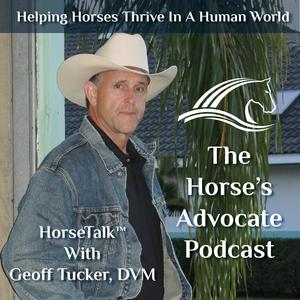
About The Horse's Advocate Podcast
The Horse's Advocate Podcast is about helping horse owners find the missing horse owner's manual for owning and caring for horses. Geoff Tucker, DVM (aka, "Doc T"), brings you wisdom from almost 50 years with horses. But beware - some of this stuff is NOT what you might expect. When the "box to think outside of" was built, he was never included and remained outside! This show aims to Help Horses Thrive In A Human World.
Podcast websiteListen to The Horse's Advocate Podcast, Pop Culture Parenting and many other podcasts from around the world with the radio.net app
Get the free radio.net app
- Stations and podcasts to bookmark
- Stream via Wi-Fi or Bluetooth
- Supports Carplay & Android Auto
- Many other app features
Get the free radio.net app
- Stations and podcasts to bookmark
- Stream via Wi-Fi or Bluetooth
- Supports Carplay & Android Auto
- Many other app features

The Horse's Advocate Podcast
Scan code,
download the app,
start listening.
download the app,
start listening.
 New Zealand
