

Listen to this podcast in the app for free: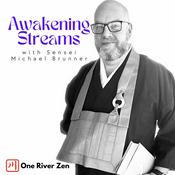 Download for free in the App Store
radio.net
Sleep timer
Save favourites
Awakening Streams: The One River Zen Podcast
Sensei Michael Brunner, One River Zen
Latest episode
67 episodes
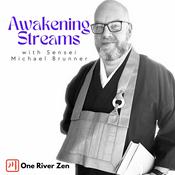
Enter Zen from There | Book of Equanimity Case 81
27/07/2026 | 14 mins.Enter Zen from There
What if grief, uncertainty, longing, and doubt are not obstacles to Zen practice, but the very places where practice begins?
In this episode, Sensei Michael Brunner explores Case 81 of the Shōyōroku, “Gensha Comes to the Province,” and the teaching, “Enter Zen from there.”
We often imagine that spiritual practice begins when our circumstances improve, our minds become quieter, or we finally understand what we are supposed to be doing. Zen offers a different invitation. Practice begins with the life that is already here.
Through the story of Gensha, the sound of a bubbling brook, and the simple gesture of raising the corner of a robe, Sensei Michael examines how the past and future are encountered within the present moment. He reflects on the ways we cling to what is pleasurable, resist what is painful, and divide our lives into what we want to preserve and what we would rather cast away.
When we stop standing apart from our experience, grief, anxiety, memory, joy, and uncertainty can all become entrances into intimacy, compassion, and awakening.
Wherever your life is unfolding, enter Zen from there.
In This Episode
Why Zen practice does not require ideal circumstances
How grief, doubt, and uncertainty become entrances into practice
Gensha’s awakening and the direct intimacy of experience
What it means to encounter the past and future in the present
Why clinging to pleasure and resisting pain create suffering
How koan practice moves beyond intellectual understanding
The relationship between nonseparation and compassion
What it means to become the medicine required by the present moment
The Koan
Master Gensha arrived at Hōden Province and was received with many kinds of entertainment. The next day he asked Venerable Shōtō, “Where did all of yesterday’s festivities go?”
At this, Shōtō lifted a corner of his robe.
Gensha remarked, “There’s no relation between them at all.”
About Sensei Michael Brunner
Sensei Michael Brunner is a Buddhist priest and the Abbot of One River Zen, a Zen Buddhist community based in Ottawa, Illinois, offering both in-person and online opportunities for practice.
He graduated from the University of Michigan with a Bachelor of Arts in Philosophy with High Honors. He was later invited to Emory University’s Candler School of Theology as a Divinity Scholar, where he continued his theological and interreligious education.
Sensei Michael’s teaching brings Zen out of the realm of abstract philosophy and into the immediacy of ordinary life. Through meditation, koan practice, retreats, classes, and Dharma talks, he invites students to meet grief, relationships, creativity, work, uncertainty, and suffering as expressions of the Way itself.
His teaching is guided by the Three Transformative Touchstones of the Eternal Spring Order:
Maintain wonder. Include everything. Transform suffering.
Practice with Sensei Michael
Zen is not something we merely read about or understand intellectually. It is a living practice that unfolds through meditation, relationship, inquiry, and the circumstances of everyday life.
Sensei Michael welcomes both beginning and experienced practitioners to study with One River Zen through weekly meditation, Dharma talks, koan study, classes, retreats, and individual practice guidance. No previous experience with Zen or meditation is required.
Whether you are seeking a steadier meditation practice, a deeper understanding of Zen, or a way to meet suffering and uncertainty with greater clarity and compassion, you are invited to begin exactly where you are.
Enter Zen from there.
Learn more about One River Zen:
https://oneriverzen.org
Explore opportunities to practice and study with Sensei Michael:
https://oneriverzen.org/zen-buddhist
🪷 Awakening Streams: The One River Zen Podcast
Teachings and reflections with Sensei Michael Brunner (Sōen) of One River Zen Center, 121 E Prospect St, Ottawa IL 61350.
🌐 Learn more & join practice: https://www.oneriverzen.org
🎧 Listen to more episodes: Awakening Streams Podcast
🙏 Support the Sangha: https://www.oneriverzen.org/donate
#SenseiMichaelBrunner #MichaelBrunnerOttawa #OneRiverZen #ZenKoan #ZenPodcast #OttawaIL #SotoZenDavid Hume’s Zen: Escaping the "Faint Copies" of Reality | Mumonkan Case 19
26/04/2026 | 16 mins.Episode Notes: David Hume’s Zen
Series: Awakening Streams
Teacher: Sensei Michael Brunner (Sōen)
Location: One River Zen | Ottawa, Illinois
Title: Escaping the "Faint Copies" of Reality | Mumonkan Case 19
Episode Summary
Are we living in the vivid, forceful reality of the present, or are we stuck in the "faint copies" of our own minds? In this episode, Sensei Michael Brunner explores the intersection of 18th-century Western Enlightenment philosophy and 13th-century Japanese Zen.
Drawing on the radical empiricism of David Hume, Sensei Brunner identifies a "glitch" in the human operating system: our habit of prioritizing conceptual shorthand (ideas) over direct, raw experience (impressions). By weaving Hume’s skepticism with the Four Reliances and the classic Mumonkan Case 19, this teisho offers a diagnostic tool for the "shadowboxing" of the discursive mind and an invitation to return to the Ordinary Mind.
Key Highlights
The "Glitch" in the Operating System: How David Hume’s distinction between impressions (vivid reality) and ideas (faint memories) mirrors the Zen struggle on the cushion.
The Four Reliances: A calibration of the spiritual compass. Why we must rely on meaning over words and the definitive over the provisional.
Shadowboxing with the Mind: Understanding why trying to "think" our way to enlightenment is like a dog running in its sleep—busy, but ultimately going nowhere.
Ordinary Mind is the Way: A deep dive into Mumonkan Case 19. Why Nansen tells Joshu that "knowing is delusion" and how "not-knowing" leads to intimacy with reality.
The Scaffold vs. The Reality: Moving beyond the "Buddhistic notions" and dusty tomes to find the blooming, eternal spring of direct experience.
Featured Quote
"We listen to the inner critic and miss the vivid, forceful reality that is always present right here and right now. We turn practice into a laboratory of faint copies, compressing raw experience into stale narratives: good sit, bad sit, good practitioner, bad practitioner. Hume warns us that these are just shadows."
Scriptural & Philosophical References
David Hume: A Treatise of Human Nature (Impressions vs. Ideas)
The Four Reliances: (Catuḥpratisaraṇa)
The Mumonkan (The Gateless Barrier): Case 19, "Ordinary Mind is the Way"
Dōgen Zenji: Contemporary studies of the Shōbōgenzō
About One River Zen
One River Zen is a center for rigorous Dharma study and direct realization located in Ottawa, Illinois. Under the guidance of Sensei Michael Brunner, the Sangha bridges ancient Soto Zen lineage with contemporary intellectual inquiry. Our mission is to provide a "scaffold" for practitioners to reach the direct reality of Buddha-nature in the modern world.
Connect with us:
Website: oneriverzen.org
Join the Sangha: Weekly sittings, study groups, and sesshins.
Support the Podcast: oneriverzen.org/donate
Keywords: Zen Philosophy, David Hume, Mumonkan Case 19, Ordinary Mind, Michael Brunner, One River Zen, Soto Zen, Mindfulness, Radical Empiricism, Ottawa Illinois Zen
🪷 Awakening Streams: The One River Zen Podcast
Teachings and reflections with Sensei Michael Brunner (Sōen) of One River Zen Center, 121 E Prospect St, Ottawa IL 61350.
🌐 Learn more & join practice: https://www.oneriverzen.org
🎧 Listen to more episodes: Awakening Streams Podcast
🙏 Support the Sangha: https://www.oneriverzen.org/donate
#SenseiMichaelBrunner #MichaelBrunnerOttawa #OneRiverZen #ZenKoan #ZenPodcast #OttawaIL #SotoZenRight and Wrong — The Zen Koan of Mayoku Thumping His Staff (Book of Equanimity Case 16)
12/03/2026 | 14 mins.Right and Wrong — The Zen Koan of Mayoku Thumping His Staff
Book of Equanimity (Shōyōroku), Case 16
With Sensei Michael Brunner — One River Zen
In this episode of Awakening Streams, Sensei Michael Brunner explores the Zen koan “Mayoku Thumps His Staff,” Case 16 of the Book of Equanimity. The story appears simple: Mayoku performs the same gesture before two different Zen masters. One responds “right.” The other responds “wrong.” The question is not which master is correct — but what this reveals about our tendency to interpret life through fixed ideas.
This teaching examines how easily the mind replaces direct experience with shorthand: right and wrong, good and bad, success and failure. Zen practice invites us to release those conceptual filters and respond directly to the living circumstances of our lives.
Rather than solving the koan as a puzzle, Sensei Brunner shows how it exposes the way we cling to judgments and inherited narratives. When those stories fall away, a deeper responsiveness — what Zen calls wisdom — becomes available.
Recorded at One River Zen in Ottawa, Illinois, this teishō connects a classic Zen koan with the ordinary challenges of daily life.
Topics in this Episode
• The Zen koan Mayoku Thumps His Staff
• Book of Equanimity (Shōyōroku), Case 16
• How the mind creates right and wrong
• Conceptual thinking vs. direct experience
• The danger of borrowed understanding in spiritual practice
• Seeing through judgments and mental shorthand
• Responding to life with clarity and wisdom
Practice with One River Zen
One River Zen offers Soto Zen meditation practice, Dharma study, and Zen training in Ottawa, Illinois. Practitioners from outside the area may also train online.
Schedule an introductory meeting with Sensei Michael Brunner:
https://outlook.office.com/bookwithme/user/8bdd737a26734dbf94c8e7021f9136d9@oneriverzen.org?anonymous&ismsaljsauthenabled&ep=plink
Learn more:
https://oneriverzen.org
Daily Zen teachings:
https://oneriverzen.org/daily-zen
Awakening Streams Podcast
Awakening Streams shares Zen teachings, koan reflections, and conversations on practice with Sensei Michael Brunner of One River Zen. Each episode explores how classical Zen teachings illuminate the challenges of modern life.
🪷 Awakening Streams: The One River Zen Podcast
Teachings and reflections with Sensei Michael Brunner (Sōen) of One River Zen Center, 121 E Prospect St, Ottawa IL 61350.
🌐 Learn more & join practice: https://www.oneriverzen.org
🎧 Listen to more episodes: Awakening Streams Podcast
🙏 Support the Sangha: https://www.oneriverzen.org/donate
#SenseiMichaelBrunner #MichaelBrunnerOttawa #OneRiverZen #ZenKoan #ZenPodcast #OttawaIL #SotoZenBook of Equanimity Case 21 — Ungan Sweeps the Ground
17/02/2026 | 14 mins.Ungan Sweeps the Ground — The Second Moon and the Problem of Effort
Book of Equanimity (Shoyoroku), Case 21
With Sensei Sōen Michael Brunner
Recorded at One River Zen (Ottawa, Illinois)
The Case
Attention! As Ungan was sweeping the ground, Dogo said, “You’re hard at it!”
Ungan replied, “You should know there’s one who isn’t hard at it!”
Dogo said, “So, is there a second moon?”
Ungan held up the broom saying, “Which moon is this?”
Dogo desisted.
Regarding this, Gensha remarked, “Indeed, this is the second moon.”
Ummon also said, “The butler watches the maid politely.”
In This Episode
In this teishō, Sensei Sōen Michael Brunner explores one of the most subtle dynamics in Zen practice: the split between activity and commentary.
How ordinary activity becomes self-conscious effort
The moment identity forms around striving
What Zen calls the “second moon”
Why spiritual self-improvement can reinforce duality
The difference between immersion and evaluation
How intention functions without becoming self-centered
Why “just keep sweeping” is not passivity
This talk examines how commentary quietly replaces functioning. When Dogo says, “You’re hard at it,” heaven and hell separate—not because sweeping changes, but because narration enters the field.
Ungan’s response points beyond both effort and non-effort, yet the trap remains: if there is “one who isn’t hard at it,” has a second self appeared?
Gensha’s and Ummon’s remarks sharpen the point. Even subtle spiritual refinement can become a second moon—an observer watching itself practice.
Key Themes
Activity vs. identity
Commentary as subtle duality
The “board on your shoulder” metaphor
Bodhisattva intention vs. spiritual self-making
Dogo’s desisting as embodied response
Mara and the 108 distractions
Returning to functioning
Practice Reflection
Where does commentary replace action in your own life?
When you are working, are you working—or evaluating yourself working?
When you are practicing, are you practicing—or narrating the one who practices?
The koan does not eliminate effort. It exposes the tightening around effort.
Just keep sweeping.
About the Teacher
Sensei Sōen Michael Brunner is the founding teacher of One River Zen in Ottawa, Illinois. Through teishō, koan study, and daily practice, he emphasizes direct experience, embodied insight, and the transformation of suffering in everyday life.
🪷 Awakening Streams: The One River Zen Podcast
Teachings and reflections with Sensei Michael Brunner (Sōen) of One River Zen Center, 121 E Prospect St, Ottawa IL 61350.
🌐 Learn more & join practice: https://www.oneriverzen.org
🎧 Listen to more episodes: Awakening Streams Podcast
🙏 Support the Sangha: https://www.oneriverzen.org/donate
#SenseiMichaelBrunner #MichaelBrunnerOttawa #OneRiverZen #ZenKoan #ZenPodcast #OttawaIL #SotoZenDaitsu Chishō — Mumonkan Case 9
11/02/2026 | 10 mins.Daitsu Chishō — Mumonkan Case 9
In this episode of Awakening Streams, Sensei Sōen Michael Brunner offers a Zen teishō on Mumonkan Case 9, “Daitsu Chishō.” The koan presents a striking paradox: Daitsu Chishō Buddha sat in meditation for ten kalpas, yet did not attain Buddhahood. The monk’s question—why not?—reveals a deeply rooted assumption about practice, effort, time, and spiritual arrival.
The teishō opens by naming a common experience in Zen practice. When life feels reactive, misaligned, or difficult, we assume something essential is missing. We take up practice with sincerity—sitting, studying, meeting in dokusan, working with koans—often carrying a quiet belief that if we practice long enough or purify ourselves enough, something will finally click. Awakening is imagined as a future result, produced over time.
Turning to the case, Sensei Sōen examines how this assumption shapes the monk’s confusion. Ten kalpas—an unimaginably long span of time—should be more than sufficient if Buddhahood were something attained through effort. Rather than correcting the amount of time, Priest Jō of Kōyō steps completely outside the framework of cause, effect, and spiritual progress. His response—“Because he is a non-attained Buddha”—reorients the entire question.
The teishō explores how the name Daitsu Chishō itself points beyond a personal narrative. Daitsu (“pervading everywhere”) and Chishō (“wisdom”) describe not an individual accomplishment, but the nature of reality itself: a wisdom already complete, already functioning, and never absent. From this essential point of view, Buddhahood is not something produced by practice or time, even though wholehearted practice remains vital and necessary.
Drawing on classical Zen teaching and lived examples, Sensei Sōen points to how reality responds immediately and completely, without deliberation or attainment. Life itself answers—before thought, before explanation, before spiritual achievement. What obscures this is not a lack of effort, but the assumption that awakening must arrive later, under different conditions.
As the talk unfolds, the structure of attainment begins to collapse. Questions and answers lose their footing. The context of the koan shifts from abstract doctrine to lived life itself—work, relationships, the body, and time unfolding as it is. The non-attained Buddha is revealed not as a failure, but as the expression of enlightenment that has never needed to be acquired.
The teishō concludes by returning the koan to the listener. If nothing was ever missing, what does practice mean now? The case does not offer an answer to think through, but an invitation to see directly—by letting go of how awakening is supposed to look and allowing it to manifest exactly where one stands.
Key Themes
Mumonkan (Gateless Gate), Case 9
Daitsu Chishō and the non-attained Buddha
Practice and the assumption of spiritual arrival
Time, effort, and the illusion of progress
Buddhahood as function, not achievement
Koan practice as lived encounter
Letting go of how awakening “should” appear
About Awakening Streams
Awakening Streams is the Zen teaching podcast of One River Zen, a Soto Zen practice community based in Ottawa, Illinois. The podcast features teishō, koan teachings, and reflections grounded in classical Zen and everyday practice.
🔹 Learn more: https://oneriverzen.org
🔹 Teaching archive: https://oneriverzen.org/daily-zen
🪷 Awakening Streams: The One River Zen Podcast
Teachings and reflections with Sensei Michael Brunner (Sōen) of One River Zen Center, 121 E Prospect St, Ottawa IL 61350.
🌐 Learn more & join practice: https://www.oneriverzen.org
🎧 Listen to more episodes: Awakening Streams Podcast
🙏 Support the Sangha: https://www.oneriverzen.org/donate
#SenseiMichaelBrunner #MichaelBrunnerOttawa #OneRiverZen #ZenKoan #ZenPodcast #OttawaIL #SotoZen
More Buddhism podcasts
 Tara BrachBuddhism, Health & Wellness, Mental Health, Religion & Spirituality
 The Way Out Is InBuddhism, Education, Health & Wellness, Mental Health, Religion & Spirituality, Self-Improvement
 Insight Hour with Joseph GoldsteinBuddhism, Religion & Spirituality, Society & Culture
 Heart Wisdom with Jack KornfieldBuddhism, Religion & Spirituality
Trending Buddhism podcasts
 Buddhist GeeksBuddhism, Health & Wellness, Mental Health, Religion & Spirituality
 Buddhist Society of Western AustraliaBuddhism, Health & Wellness, Mental Health, Philosophy, Religion & Spirituality, Society & Culture
 冥想正念指南Buddhism, Health & Wellness, Mental Health, Philosophy, Religion & Spirituality, Society & Culture
 LingYen Mountain Temple Canada - Buddhist StoriesBuddhism, Education, Kids & Family, Religion & Spirituality, Self-Improvement, Stories for Kids
About Awakening Streams: The One River Zen Podcast
Awakening Streams features Dharma talks and Zen reflections from Sensei Michael Brunner of One River Zen Center in Ottawa, Illinois.
Each episode explores the living practice of Zen Buddhism through classic Zen koans, teachings from the Shōyōroku and Mumonkan, and direct encounters with everyday life.
Discover how awakening flows through every obstacle, every act of compassion, and every moment of wonder.
🌐 Learn more: https://www.oneriverzen.org
Podcast websiteListen to Awakening Streams: The One River Zen Podcast, Free Buddhist Audio and many other podcasts from around the world with the radio.net app
Get the free radio.net app
- Stations and podcasts to bookmark
- Stream via Wi-Fi or Bluetooth
- Supports Carplay & Android Auto
- Many other app features
Get the free radio.net app
- Stations and podcasts to bookmark
- Stream via Wi-Fi or Bluetooth
- Supports Carplay & Android Auto
- Many other app features

Awakening Streams: The One River Zen Podcast
Scan code,
download the app,
start listening.
download the app,
start listening.
 New Zealand