

Listen to this podcast in the app for free: Download for free in the App Store
radio.net
Sleep timer
Save favourites
77 episodes
Celebration & Recognition at Work
18/08/2026 | 22 mins.Are you running an organisation or managing a team that is constantly hitting milestones, only to immediately sprint toward the next KPI without a single moment of pause? In today’s high-pressure corporate world, we have institutionalised an endless treadmill of "more"—and it is driving our best talent straight into burnout and resignation.
In this episode of How to Be Happy (at Work), host Declan Edwards breaks down the fifth pillar of employee happiness: Celebration. Written specifically for progressive leaders, people managers, and business owners, this episode dives into the heavy-hitting behavioural data showing why genuine recognition is your ultimate retention engine. Moving far beyond tokenistic corporate gestures like pizza parties or generic shout-outs, Declan shares the neurobiology behind true appreciation and reveals a practical blueprint to make your teams feel deeply seen, validated, and valued.
In this episode we cover:
The High Cost of Silence: Discover why employees who receive high-quality recognition are up to 56% less likely to look for a new job, while a lack of feedback is processed by the brain as an active social threat.
The Addiction to "Next": Learn the organisational psychology behind the corporate "hedonic treadmill" and why intentional checkpoints are vital to refill your team's psychological fuel tanks.
The BIA Praise Model: Master a simple, highly effective 3-part framework to move away from empty, performative praise and deliver surgical, high-impact validation that inspires peak performance.
Bring Declan to Your Next Event:
Want to transform your organisation's people experience or bring this data-backed approach to your executive leadership team? Declan regularly keynotes and runs immersive workshops at corporate events, company retreats, and team offsites. Click here to browse his offers and start the conversation: https://declanedwards.com.au/Why Your Environment Affects Your Mood
11/08/2026 | 18 mins.Have you ever walked through your front door after a long day, looked at the mess, and felt instantly overwhelmed? You are not alone. Our homes have become overcrowded warehouses for our stress .
In this episode of How to Be Happy, happiness researcher Declan Edwards explains how your living space secretly rules your mood .
We look at the fascinating science of "Environmental Wellbeing" . You will learn why online shopping only gives us a fake, temporary mood boost . We also share a UCLA study that shows how a cluttered room physically spikes your stress hormones .
If you are ready to turn your home back into a peaceful sanctuary, this episode gives you the exact, bite-sized steps to do it .
Quick Links & Resources:
Take the Free Happiness Scorecard: Want to see how your environment is tracking? Take our quick 3-minute quiz for a personalised breakdown of your well-being .
Read the Book: If you love relaxing in a clean space with a great read, grab Declan’s new book, How to Be Happy, at bookstores, Amazon, Booktopia, or on Audible .
Subscribe & Protect: Hit subscribe on your podcast app ! For every single person who follows the show, we pay to protect one square meter of threatened rainforest .How Annelise McCarthy Became Her Happiest Self
28/07/2026 | 48 mins.Have you ever ticked every single box of success—earned the degrees, smashed your goals, and worked yourself to the bone—only to realise you’ve completely forgotten how to relax?
It is incredibly easy to fall into a cycle of perfectionism, chronic people-pleasing, and hustle culture, running your health straight into the ground just to prove your worth.
In this episode of How to Be Happy, I’m sitting down with the absolutely electric Annelise McCarthy; a women's communication expert, speaker, Coach, and proud graduated of BU Happiness College. Annelise spent 3 full years studying the skills and science of happiness at BU Happiness College, and she is the ultimate case study of what happens when you take radical responsibility for your life.
We take a trip down memory lane to map her massive personal transformation from a high-strung, boundary-less overachiever to a woman who is now completely thriving.
Annelise lifts the lid on her personal toolkit, sharing how tools like fierce self-compassion, firm boundaries, and the feelings wheel protect her mental health and wellbeing. We also explore the deep connection between positive psychology and confident communication, proving why public speaking is actually a game of self-trust, emotional vulnerability, and learning how to truly face yourself.
In this episode:
The "How to Be" Shift: What happens when you stop studying how to do more and start learning the baseline emotional skills required to actually live in the present.
Redefining Self-Compassion: Why treating yourself with kindness isn't a lazy cop-out, but a form of discipline that gives your body what it needs instead of just what it wants.
Internal vs. External Boundaries: How to build a healthier relationship with your phone and social media to protect your time and energy.
The Real Secret to Public Speaking: Why consuming endless books and videos is useless if you lack the internal self-trust to back yourself in a boardroom or on a stage.
The Fear of Being Seen: Why the universal dread of speaking is deeply tied to our fear of visibility, and how connecting with yourself unlocks your ability to connect with an audience.
Links & Next Steps:
Connect with Annelise: Ready to master communication and learn how to own any room you walk into? Check out her expert coaching and resources at AnneliseMcCarthy.com or find her on social media @theannelisemccarthy
Claim Your Free Happiness Connection Call: Inspired by Annelise's journey to stop surviving and start prioritising your development? Let's chat! For a limited time, I am opening up my personal calendar for a free, 15-minute connection call to map out your next steps. Click here
Grab Your Copy of 'How to Be Happy': Want to master the exact tools Annelise and I discussed today? Emotional intelligence and literacy are the very first skills I explore in my brand-new book, featuring a comprehensive breakdown of the feelings wheel. Pick up your copy at all good bookstores, online via Amazon or Booktopia, or download it immediately on Audible.What 250 Million Data Points Reveal About Happiness at Work - Interview with Matt Phelan; co-founder of The Happiness Index
21/07/2026 | 56 mins.We spend a massive chunk of our waking hours at our jobs, yet millions of people drag themselves through the week feeling completely unseen, disconnected, and burnt out. As organizations, we pour millions of dollars into flashy HR software, task-tracking apps, and corporate wellness initiatives. But according to the raw data, most companies are aggressively over-investing in operational systems that have zero impact on human fulfilment, while completely ignoring what actually makes us thrive.
In this special workplace edition of How to Be Happy, I’m joined by Matt Phelan, the Co-Founder and Co-CEO of The Happiness Index. Matt and his team have analyzed an incredible 250 million data points from over 170 countries to map out the psychological reality of the modern employee experience. We dive straight into the findings of their 2026 Global Workplace Happiness Report, crunching the numbers on what happens to our performance when our basic human needs are ignored.
Matt opens up about why he spent 11 years trapped in the "perfectionism loop" before finally declaring this "Year Zero" and getting the data out into the world. We challenge the standard corporate approach to return-to-office mandates, break down why 100% virtual environments are backfiring for younger workers, and expose why the executive suite is often a far lonelier, less happy place to be than middle management.
In this episode we explore:
The Flywheel Effect: How Matt utilised a basic efficiency workflow to bridge data and technology, and why it completely cleared the "cognitive debt" out of his business.
The "Snickers Bar" Exception: A look at why the basic foundations of human motivation haven't evolved in thousands of years, proving that happiness at work costs absolutely nothing.
Treating People How They Want to Be Treated: Why generic corporate recognition system defaults fail, and how to customise appreciation to fit introverts, extroverts, and everyone in between
The Autonomy vs. Proximity Debate: A real-world breakdown of why location autonomy outscores office proximity for creative problem-solving and focus.
Ignorance vs. Incompetence: A hard call-out to modern executive boards on why ignoring workplace culture metrics is no longer just a HR issue—it’s a commercial performance failure.
Links & Next Steps:
Download the Full Report: Ready to see how your own team or organisation stacks up against tens of millions of cultural insights? Click here to sign up for and download the complete Global Workplace Happiness Report for free!
Connect with Matt: Follow Matt Phelan’s world-class thought leadership and research directly on Linkedin or check out his personal website at https://mattphelan.co.uk/
Subscribe to the Show: If this conversation helped you find a fresh perspective on your own work life today, please hit Subscribe on Spotify or Apple Podcasts! For every single person who follows the show we pay to protect one square meter of threatened rainforestHygge: The Danish Secret to Wintering Well
14/07/2026 | 16 mins.How many times over the last few weeks have you looked out the window at a grey, freezing morning and felt your mood instantly take a nosedive? As human beings, we have a bad habit of becoming "weather hostages"—holding our happiness ransom until the sun graciously decides to return . We treat winter like an adversary to survive rather than a natural season to enjoy .
In this solo episode of How to Be Happy, Declan Edwards shares a perspective shift . Year after year, the World Happiness Report is dominated by Nordic countries like Denmark and Finland . If happiness required blue skies, they would be at the bottom of the list . Instead, they thrive by practicing Hygge (pronounced hoo-gah); the deliberate curation of intimacy, presence, and sanctuary .
Declan breaks down the cognitive psychology behind our "cultural scripts" about the cold and shares the hard science of how shifting your physical environment can soothe your nervous system .
In this episode, we explore:
The Scandi Contrast: Why populations dealing with sub-zero temperatures and under four hours of daylight report the highest life satisfaction on earth .
The Psychological Impact of Low Light: How changing your environmental cues shifts your body out of "fight or flight" and directly into the parasympathetic nervous system .
Cultural Schema: The difference between viewing winter as a negative cancellation of your plans versus an opportunity for cozy curation .
Recommended Resources:
Grab the Book: If your favourite way to practice Hygge is curling up under a heavy blanket with a hot drink and a great book, Declan’s brand-new book, How to Be Happy, is officially out now! Pick up a copy at all good bookstores, Amazon, Booktopia, or on Audible .
Subscribe & Protect: Click subscribe on your podcast platform to support our independent show . For every single subscriber who joins the family, we pay to protect one square meter of threatened rainforest .
More Education podcasts
 All Ears English PodcastBusiness, Education, Language Learning
 6 Minute EnglishEducation, Language Learning
 The Jordan B. Peterson PodcastEducation, Science, Society & Culture
 The Jefferson Fisher PodcastEducation, Relationships, Self-Improvement, Society & Culture
 The Mel Robbins PodcastEducation, Health & Wellness, Mental Health, Relationships, Self-Improvement, Society & Culture
 Everyday MāoriEducation, Language Learning
 Keep The ChangeBusiness, Education, Self-Improvement
 The Rich Roll PodcastEducation, Health & Wellness, Self-Improvement, Society & Culture
 Taringa PodcastEducation, Language Learning
 Begin Again with Davina McCallEducation, Health & Wellness, Mental Health, Self-Improvement, Society & Culture
Trending Education podcasts
 Aware and AggravatedEducation, Health & Wellness, Mental Health, Self-Improvement
 Science of Reading: The PodcastEducation, Science, Social Sciences, Tutorials
 大人的Small TalkBusiness, Careers, Education, Entrepreneurship, Management, Self-Improvement
 OFF STAGE with Lisa O'NeillEducation, Self-Improvement
 Easy German: Learn German with native speakers | Deutsch lernen mit MuttersprachlernCourses, Education, Language Learning
 心理不用學Education, Relationships, Science, Self-Improvement, Social Sciences, Society & Culture
 The Bite size Japanese PodcastEducation, Language Learning
 The Principals (Aotearoa | New Zealand)Education
 The You ProjectEducation, Fitness, Health & Wellness
 Japanese podcast for beginners (Nihongo con Teppei)Education, Language Learning
 Unfiltered with Dave LeteleEducation, Health & Wellness, Self-Improvement
 Wisdom From North - with JanneckeEducation, Religion & Spirituality, Spirituality
 Making It With Jimmy Diresta, Bob Clagett and David PicciutoArts, Crafts, Design, Education, Leisure, Tutorials
 The Routine Advantage | Simple Habits, Routines and Systems to Get Your Life Organized, Build Consistency and Reduce OverwhelmEducation, Health & Wellness, Mental Health, Self-Improvement, Tutorials
 Busy, Yet PrettyEducation, Health & Wellness, Mental Health, Self-Improvement
 The Daily MotivationEducation, Self-Improvement
 Melissa & Lori Love Literacy ® | Science of Reading for TeachersCourses, Education, Tutorials
 The Stoic Handbook with Jon BrooksEducation, Health & Wellness, Mental Health, Philosophy, Self-Improvement, Society & Culture
 THE ED MYLETT SHOWBusiness, Education, Entrepreneurship, Self-Improvement
 Real English Conversations Podcast | English Fluency For Newcomers And International ProfessionalsCourses, Education, Language Learning
 The Art of AwakeningAlternative Health, Education, Health & Wellness, Religion & Spirituality, Self-Improvement, Spirituality
 How I WorkBusiness, Careers, Education
 The Guest SpeakerEducation, Kids & Family
 Listening Time: English PracticeEducation, Language Learning
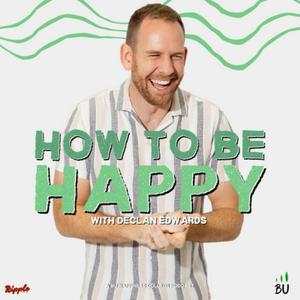
About How To Be Happy
There's no goal more universally desired than living a happy life. But these days, happiness can seem pretty hard to reach.
That's why this podcast exists. To serve as a compass in your pursuit of happiness.
Built on over 10 years of studying the science of happiness and 7+ years of coaching people across 5 countries, join your host & Happiness Researcher - Declan Edwards as he brings you:
- evidence-based strategies for mastering your mind and emotions.
- inspiring interviews with individuals who have transformed their lives
- and practical tips and techniques to help you do the same.
Podcast websiteListen to How To Be Happy, All Ears English Podcast and many other podcasts from around the world with the radio.net app
Get the free radio.net app
- Stations and podcasts to bookmark
- Stream via Wi-Fi or Bluetooth
- Supports Carplay & Android Auto
- Many other app features
Get the free radio.net app
- Stations and podcasts to bookmark
- Stream via Wi-Fi or Bluetooth
- Supports Carplay & Android Auto
- Many other app features

How To Be Happy
Scan code,
download the app,
start listening.
download the app,
start listening.
 New Zealand