
Listen to this podcast in the app for free: Download for free in the App Store
radio.net
Sleep timer
Save favourites
55 episodes
Missteps, Missing Plans and Three Weeks to Go (Episode 50)
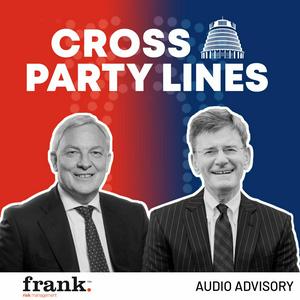
19/10/2026 | 54 mins.Hosted by Phil Goff and Chris Finlayson, Cross Party Lines reaches its 50th episode — just over a year in, and with an audience that has grown beyond either man expected. They mark the occasion the way they mark everything: with a tribute, a historical detour, and absolutely no let-up on the campaign. Three weeks out from election day, there’s too much to get through.
Thanks to Frank Risk Management, the 100% Kiwi owned Insurance Brokerage.
In this episode:
* Gang pads, political missteps and the skeleton in everyone’s closet — The Greens and Te Pāti Māori’s visit to a Mongrel Mob pad — photographed against gang patches — draws Phil’s bluntest assessment of the campaign: stupid, naive, and politically self-destructive in precisely the seats the Greens need to hold. But Phil won’t leave the history untouched. Muldoon funded millions into gang work schemes. Chris’s concern is different but equally sharp: in a campaign where repetition and message discipline are everything, going off-script to cozy up to organised crime in the final weeks is an act of self-indulgence that could cost the Greens two or three points — and potentially their Wellington North seat.
* Peters unilateral at the UN, the right to silence and a missing fiscal plan — New Zealand voted against a World Health Organization resolution on pandemic preparedness — alongside the United States, Israel and one other country, against 154 nations. Phil is unambiguous: this was Peters playing to his anti-vax base using New Zealand’s international reputation as a chip. Chris reports that National ministers wanted to vote for the resolution. Both ask the same question: did it go to cabinet? If so, Luxon owns it. If not, the coalition is more out of control than anyone has acknowledged.
* Māori seats, the TOP threshold and the defining moment that hasn’t happened yet — Phil gives his most detailed read of the Māori electorates: Labour likely to pick up three seats, Ikaroa-Rāwhiti safe with Cushla Tangaere-Manuel, Te Tai Tonga a genuine contest, Te Tai Tokerau close but leaning Labour’s way. Chris keeps a close eye on Te Tai Hauauru — formerly Tariana’s stronghold, now genuinely split — and notes Willie Jackson’s bold declaration at Adrian Rurawhe’s tangihanga that it was now Labour’s marae earned him a look that suggested otherwise. Then there’s the defining moment question: could the gang visit be this campaign’s Metiria Turei? Could there be a Peter Dunne common-sense moment that shifts 15% of undecideds overnight? Both men think the race is not yet settled, and Gerald Ford’s Poland moment — and Biden’s 2024 implosion — are offered as reminders of how fast things can move.
Along the way: the 50th episode milestone and why people keep stopping Chris at airports to say they appreciate civilised disagreement; Marilyn Waring ringing to correct the OIA history and give proper credit to Mike Minogue; a tribute to Geoff Thompson, former member for Horowhenua, who passed away this week.
Cross Party Lines exists to lift political literacy and create space for calm, good-faith political conversation. New episodes every Tuesday. If you value thoughtful debate, follow the podcast and share it with someone who might too.
📋 Election day is 7 November. Make sure you’re enrolled — and make sure everyone you know is too.
This is a public episode. If you would like to discuss this with other subscribers or get access to bonus episodes, visit crosspartylines.substack.comMean Policies, Hapless Lists and the Midterms Closing In
12/10/2026 | 53 mins.Hosted by Phil Goff and Chris Finlayson, Cross Party Lines battles on with Phil broadcasting through a lurgy picked up on the flight home from Australia — it’s an episode that moves from the campaign’s most mean-spirited policies to OIA reform, a hilariously hapless New Zealand First list, and the American midterms closing in on the Republicans like a freight train.
All thanks to Frank Risk Management, the 100% Kiwi-Owned Insurance Brokerage. Find out more at frankrisk.co.nz.
In this episode:
* Foreign aid cuts, drug testing and the return of compassionate conservatism — in theory — National and ACT’s decision to slash overseas aid draws Phil’s sharpest moral language of the season: we spend 0.24% of GDP on foreign aid, the international goal is 0.7%, and the cuts will fall on humanitarian crisis relief — Gaza, Ukraine, the World Food Programme, UNHCR. Chris is equally unimpressed — and notes the whole exercise is likely to be reversed anyway, given Peters has already come out against it. On drug testing for beneficiaries, both men defer to Jonathan Coleman who wrote a lengthy Herald piece calling the policy wrong, unprincipled and ineffective.
* Air New Zealand, OIA reform and the right of the citizen to know — Chris’s flight from Gisborne was cancelled, supposedly due to weather — suffice to say he wanted to know more about Labour’s consumer policy package, which mandates automatic refunds for cancelled or significantly delayed flights, levels the playing field for smaller regional carriers, and takes aim at airport monopoly pricing. On OIA reform, Chris is in full historical mode: the Official Information Act was a complete philosophical switch from the Official Secrets Act — from withholding as default to availability as default, built on the work of Ken Keith, Alan Danks and Jim McLay. What is happening now, across multiple governments but accelerating under this one, is a quiet reversal of that principle.
* New Zealand First’s list, the midterms and Trump renames the ocean — Chris turns to the New Zealand First list and cannot contain himself: Ron Mark at number 16, behind Hārete Hipango and Alfred Ngaro. He applies the Hanoverian principle — anyone who looks like a potential successor gets marked down — and notes Peters describing the list as representing rejuvenation after 50 years of his own continuous political presence. Stuart Nash and Shane Jones are in there. Michael Laws features, and Chris declines to comment further on defamation grounds. On the American midterms, both men identify their must-watch races: South Carolina — a seat Democrats haven’t held since the 1990s, now within a point or two — and Kansas, which hasn’t returned a Democratic senator since 1938, and is now genuinely in play. If both flip, Democrats could reach 55 or 56 Senate seats.
Along the way: Phil’s voice threatening to become a high-pitched squeal when Trump comes up; Chris being recognised at Gisborne Airport and told he looks better in person than on screen; a man on the airport bus praising Phil’s tenure as Foreign Affairs Minister; and the promise of a full American election deep-dive next week,
Cross Party Lines exists to lift political literacy and create space for calm, good-faith political conversation. New episodes every Tuesday. If you value thoughtful debate, follow the podcast and share it with someone who might too.
📋 Election day is 7 November. Make sure you’re enrolled.
This is a public episode. If you would like to discuss this with other subscribers or get access to bonus episodes, visit crosspartylines.substack.comHollow Promises, Billionaire Games and the Brexit Reckoning
05/10/2026 | 52 mins.Hosted by Phil Goff and Chris Finlayson, Cross Party Lines opens with a tribute to former Speaker Adrian Rurawhe — a man of great humility, dignity and genuine cross-party respect — before turning to the final sprint of the election campaign: empty promises from every direction, billionaires gaming the electoral system, the minor parties’ kingmaker debate, and a Burnham bounce that might finally put Brexit on trial.
All thanks to Frank Risk Management, the 100% Kiwi Owned Insurance Brokerage.
In this episode:
* The campaign’s hollow promises and the policies that actually matter — Chris reaches for Horace — the mountain labours and a ridiculous mouse is born — as his summary of the policy avalanche hitting voters in the final week. The BNZ nationalisation is a barefaced lie that will never happen. The Greens’ $2 train fare is potty. ACT’s Paris Agreement withdrawal would torpedo both the EU and UK free trade agreements and is equally dishonest — as Laura Clark, former British High Commissioner and now a climate advocate, pointed out bluntly on RNZ, New Zealand is already facing a complaint from a Dutch environmental group over its weakening of climate commitments.
* Billionaires gaming the system and the Kingmaker debate’s tired chestnuts — The Mowbray family — New Zealand’s wealthiest — and Don Brash are publicly urging voters to give electorate votes to National but party votes to ACT, engineering a potential overhang that Phil connects directly to the German experience: the Germans had an identical MMP system, the same tactic was tried, and they were forced to change the law. Both Phil and Chris are unambiguous — this rots the system, undermines electoral credibility, and should be condemned.
* Burnham’s Brexit courage and Farage on the ropes — Andy Burnham has said what no Labour leader has dared to since 2016: Brexit was born in a lie, largely propagated by Boris Johnson, it has not increased wealth, it has devastated it, and it is time for a new arrangement with Europe. Chris is delighted. Phil notes the Burnham bounce is real — Labour up to 30% in some polls, reform down to 23-25%, the Conservatives in the high teens — is exactly what real political leadership looks like, and what New Zealand has been missing.
Cross Party Lines exists to lift political literacy and create space for calm, good-faith political conversation. New episodes every Tuesday. If you value thoughtful debate, follow the podcast and share it with someone who might too.
📋 Election day is 7 November. Make sure you’re enrolled and make sure everyone you know is too.
This is a public episode. If you would like to discuss this with other subscribers or get access to bonus episodes, visit crosspartylines.substack.comEmpty Seats, Dirty Work and Blue Waves
28/09/2026 | 48 mins.Hosted by Phil Goff and Chris Finlayson, Cross Party Lines returns to dissect party launches, Nicky Hager’s latest book, the US midterms and the Xi-Trump summit that produced two pandas and precisely nothing else.
Proudly supported by our Foundational Partner Frank Risk Management - the 100% Kiwi owned insurance brokerage.
In this episode:
* Party launches: Labour’s energy versus National’s empty seats — Phil went to one launch and won’t make you guess which one. Audrey Young’s verdict — Labour had it all over National for sheer impact, with new policy, a new attitude and a better speech — saves Phil from being dismissed as a party hack, though he notes Hipkins’ language at the lectern raised eyebrows. Chris channels John Key’s campaign gospel: repeat, repeat, repeat, don’t deviate, don’t embellish.
* Nicky Hager’s Dirty Works — useful journalism or a pop gun? — Phil delivers an even-handed assessment of Hager’s career: Hollow Men and Dirty Politics were game, set and match — documentary proof of collusion with the Exclusive Brethren and the weaponisation of the OIA and the SIS. Dirty Work, both agree, is not a smoking gun — but the documented links between the Taxpayers Union, tobacco industry funding, and the orchestrated amplification of anti-Māori sentiment are not nothing, and Chris expresses a fervent hope that Hager’s next book is about New Zealand First.
* US midterms: Kansas wobbling, Texas flipping and Trump’s Faustian reckoning — Chris has been doing his homework and the picture is striking. Kansas — reliably Republican for a century — is in play. Texas, which Trump won by 13.6 points, has the Democrat ahead. Iowa farmers, hammered by tariffs and diesel costs, are reconsidering. Phil lays out the arithmetic: Democrats need four Senate seats to take the chamber; the House is almost certainly gone; and if both flip, Trump faces impeachment proceedings in his final two years while the courts continue finding his executive orders unconstitutional. Chris’s verdict on the moral of the story: if you make a Faustian deal with someone like Trump, 2026 is the year you’re held to account.
Cross Party Lines exists to lift political literacy and create space for calm, good-faith political conversation. New episodes every Tuesday. If you value thoughtful debate, follow the podcast and share it with someone who might too.
📋 Election day is 7 November. Make sure you’re on the roll.
This is a public episode. If you would like to discuss this with other subscribers or get access to bonus episodes, visit crosspartylines.substack.comPolicy Overload, Debt and Disorder
21/09/2026 | 52 mins.Hosted by Phil Goff and Chris Finlayson, Cross Party Lines returns for a week of policy overload, parliamentary chaos, and language in the House that both men thought they’d never hear. With 46 days to go, the episode cuts through the confetti of promises to ask which ones are serious, which are wacky and which are simply dishonest.
Thanks to Frank Risk Management, the 100% Kiwi Owned Insurance Brokerage and our Foundational Partner for the podcast.
To hear more from the Both Sides Now Podcast, use this link.
In this episode:
* Policy week: supermarkets, farming, Paris Agreement and the BNZ fantasy — New Zealand Firsts “Make New Zealand Healthy Again” health policy — promoting prevention while having just repealed the Smokefree Act and halved the tax on heated tobacco products — draws Phil’s sharpest word of the episode: hypocrisy. On farming and the environment, Phil draws a direct line from ACT’s deregulatory instincts to the Paris Agreement clauses embedded in both the UK and EU free trade agreements — breach them, and the tariff preferences that have grown New Zealand’s exports by 25% and 38% respectively are at risk. And on New Zealand First’s proposal to renationalise the BNZ for $30 billion — Chris parks it under wacky, and moves on.
* Debt: when to borrow, when to pay down and what the Taxpayers Union gets wrong — Chris is asking Katie Bradford and anyone who would listen for a serious debate on debt. Phil obliges with the clearest statement of fiscal philosophy either man has offered all season: borrow for intergenerational infrastructure investment, not for operating costs or tax cuts; pay down debt when times are good; keep powder dry for the unknown unknowns — Christchurch, COVID, and possibly the alpine fault. Chris’s concern: we don’t know what’s coming next.
* Parliament’s final sitting: bad language, worse legislation and valedictories worth watching — Sixty-five hours across five days, legislation passing at midnight with drafting errors that left 70,000 people without payments they were owed, and two MPs using the C-word on the floor of the House — one by spoonerism, one deliberately. Phil is forgiving of the former (John Carter, who reported the incident in his own valedictory); he is not forgiving of the latter. Chris invokes JFK’s inaugural address — civility is not a sign of weakness — and tells every candidate watching that they are signing up to one of the oldest democracies on earth and should dress and speak accordingly.
Sharp, wide-ranging and funnier than any episode this close to an election has any right to be, this episode is a reminder that the difference between good government and bad government is rarely the promises — it’s what happens when the promises meet the books, the drafters and the midnight sitting hour.
Cross Party Lines exists to lift political literacy and create space for calm, good-faith political conversation. New episodes every Tuesday. If you value thoughtful debate, follow the podcast and share it with someone who might too.
📋 46 days to go. Make sure you’re on the roll — and make sure everyone you know is too.
This is a public episode. If you would like to discuss this with other subscribers or get access to bonus episodes, visit crosspartylines.substack.com
More News podcasts

Trending News podcasts




About Cross Party Lines
A weekly podcast about the political landscape in New Zealand and around the world. Proudly going beyond the headlines, looking at the structural challenges, challenging the status quo and explaining our place in the complex geopolitical stage. Hosted by Phil Goff and Chris Finlayson. crosspartylines.substack.com
Podcast websiteListen to Cross Party Lines, Gone By Lunchtime and many other podcasts from around the world with the radio.net app
Get the free radio.net app
- Stations and podcasts to bookmark
- Stream via Wi-Fi or Bluetooth
- Supports Carplay & Android Auto
- Many other app features
Get the free radio.net app
- Stations and podcasts to bookmark
- Stream via Wi-Fi or Bluetooth
- Supports Carplay & Android Auto
- Many other app features

Cross Party Lines
Scan code,
download the app,
start listening.
download the app,
start listening.
 New Zealand