
Listen to this podcast in the app for free: Download for free in the App Store
radio.net
Sleep timer
Save favourites
416 episodes
Digger's flop, Big Oil and the bots: What actually moves people?
22/10/2026 | 45 mins.In Digger, Tom Cruise plays an oil tycoon whose rig sets off a tsunami. Within days of release, it was written off as a flop. Christiana Figueres has seen it twice, and she has questions about how quickly that verdict arrived. As she sees it, the film puts the fossil fuel lobby squarely in the frame.
This week, Christiana, Tom Rivett-Carnac and Paul Dickinson meet in person, with a stack of your questions and a bigger one underneath them all: what actually moves people to act? Is it fear, or hope? And what are the hidden influences behind the messages that move us?
If evidence on its own changes so few minds, what does? Christiana has a theory involving cake, but Tom and Paul have different ideas in the oven.
Christiana once asked a Saudi minister what his country needed before it would let the Paris Agreement through. The answer fitted on a napkin. And why does she want to take back the word "tribalism"?
Nearly three in four UK newspaper stories on June's record heatwave didn't mention climate change. Oversight, or a firewall of the kind Christiana saw on screen in Digger? Would a general strike cut through? And what happened when Paul stood at a G8 summit, alone, with a 20-foot sign?
Is there a film or a book that speaks to all this for you? Send it our way. And if you think something stranger is going on with Digger's reviews, Christiana would like to hear from you.
Learn More
🎬 Watch the trailer for Digger, Alejandro G. Iñárritu's black comedy starring Tom Cruise as a tycoon trying to save the world from a disaster he caused
🗞️ Read ECIU's analysis of UK heatwave coverage, which found 72% of national newspaper articles on June's record heat didn't mention climate change
✊ Explore Erica Chenoweth's 3.5% rule, including her own cautionary update on what it can and can't tell us
📱 Watch the trailer for The Social Reckoning, Aaron Sorkin's film about the Facebook Files, which Paul recommends
🌳 Read the Dasgupta Review, the Treasury-commissioned study of the economics of biodiversity and the case for counting nature in a nation's wealth
💡 Read IRENA's Renewable Power Generation Costs in 2025, which found over 90% of new renewable power added last year was cheaper than fossil fuel alternatives
Join the conversation
🎤 Leave us your voice notes and questions for upcoming episodes on SpeakPipe
Instagram @outrageoptimism LinkedIn @outrageoptimism
YouTube @OutrageandOptimism
Or get in touch with us via this form.
Production credits
Senior Producer: Ben Weaver-Hincks
Assistant Producer: Saoirse Wilson
Showrunner: Caitlin Hanrahan
This is a Persephonica production for Global Optimism and is part of the Acast Creator Network.
Hosted on Acast. See acast.com/privacy for more information.What World Will They Inherit? Live from Bath Abbey
15/10/2026 | 42 mins.Before she was Christiana Figueres, architect of the Paris agreement, who was she? What did believe in 2015 that she no longer believes?
In June, an event about the next generation of climate leaders was postponed because of extreme heat. This week, Outrage + Optimism comes to you live from Bath Abbey, weeks before COP31 and ten years on from Paris. What is one generation of climate leaders really handing to the next? And will it be enough?
In front of an audience of school children, students, parents and teachers, 22 year old, Xandi Drysdale, asks Christiana to reflect on the differences between her own youth and the world that his own generation is stepping into. And, 16 year old Isla asks: Why we should trust the leaders of today the political and economic systems they have maintained are the very systems that created this crisis?
Young people keep being told they must lead. So what is stopping them? Tom Rivett-Carnac and Paul Dickinson put the question to environmental psychologist Lorraine Whitmarsh and University of Bath Vice-Chancellor Phil Taylor. Then they meet Nav Sawhney, an engineer who promised his neighbour in India a washing machine and built one. Is he a model others can follow?
Paul, Christiana and Tom are in the hot seat in front of a live audience - seated in Bath Abbey, in the UNESCO World Heritage Site, what do they see as the biggest opportunities for the next generation? And what responsibility do we have to the generations after theirs?.
Thanks to the University of Bath for hosting us as part of its 60th anniversary Adelard Series, and to Bath Festivals, Bath Digital Festival and the Bath Royal Literary and Scientific Institution for partnering on the evening. Thanks too to Bath Students' Union, and to everyone who came along or sent in a question.
Learn More
🧺 Discover The Washing Machine Project, Nav Sawhney's organisation bringing the hand-cranked Divya machine to families who wash their clothes by hand
📊 Read CAST's new study of The People's Emergency Briefing, which found nearly nine in ten viewers left more motivated to act
🎬 Find a screening of The People's Emergency Briefing, the film on the UK's climate and nature crisis that Lorraine Whitmarsh advised on
🌡 Read Lorraine Whitmarsh and Bella Zanin on whether this summer's heat made more people worry about climate change
🎓 Learn about Fossil Free Careers, People & Planet's campaign to end fossil fuel recruitment on UK campuses
🏛 Explore the University of Bath's Adelard Series, marking its 60th anniversary and named after the 12th-century scholar often called England's first scientist
Join the conversation
🎤 Leave us your voice notes and questions for upcoming episodes on SpeakPipe
Instagram @outrageoptimism LinkedIn @outrageoptimism
YouTube @OutrageandOptimism
Or get in touch with us via this form.
Production credits
Senior Producer: Ben Weaver-Hincks
Assistant Producer: Saoirse Wilson
Editor: Miles Martignoni
Showrunner: Caitlin Hanrahan
This is a Persephonica production for Global Optimism and is part of the Acast Creator Network.
Hosted on Acast. See acast.com/privacy for more information.How Can a Country Survive Losing Its Land?
08/10/2026 | 40 mins.A ship rams a canoe. The canoe starts to sink. The ship's crew lean over the rail and offer a loan to repair it.
That is how Surangel Whipps Jr., President of Palau, describes climate finance in the Pacific, a region responsible for around 0.03% of global emissions. He speaks to Christiana Figueres a few weeks into his year as Chair of the Pacific Islands Forum, and as pre-COP talks wrap in in Fiji and Tuvalu ahead of COP31.
In Palau, on his islands, high tides are already flooding the taro patches with saltwater, and the main hospital sits at the water's edge.
This week, Christiana returns to the fight that wrote 1.5°C into the Paris Agreement, a limit the small island nations won while most of the world's biggest economies pushed for two degrees. A decade on, the UN expects the world to overshoot it. What does this mean for entire countries that sit just a few metres above sea level?
President Whipps explains why diesel power costs his country close to 30 cents a kilowatt hour, when solar is the cheapest energy in the big markets, and what he says to young Palauans who are no longer sure they should have children.
And, Tom Rivett-Carnac joins Christiana to ask what is actually required of the rest of us. Last year, the world's highest court sided with the islands. Last month, the UN agreed that a country does not stop being a country once the sea takes its land. Why hasn't the money followed?
Thanks to our friends at BE HOPE Podcast Takeover, bringing podcasts around the world together to explore the theme of hope and how we can continue to make progress in a rapidly changing world.
Learn More
🎬 Watch All Rise, the documentary narrated by Christiana that follows the Pacific law students who took climate change to the world's highest court
🎟️ Register for our Bath Abbey event livestream on 14 October, Powering the Next Generation to Lead Climate Action
🎧 Listen back to our earlier episodes on the road to the world court: Sovereignty and Survival: A Spotlight on Vanuatu, The Climate Case of the Century, and The ICJ Climate Opinion Explained
⚖️ Read the ICJ advisory opinion on the Obligations of States in respect of Climate Change, the unanimous July 2025 ruling that named 1.5°C the primary temperature goal under the Paris Agreement
🌺 Read the Palau Pledge, the promise every visitor signs to the children of Palau on arrival, and the text that has inspired a movement in Costa Rica to write its own
🌊 Understand the UN's first declaration on sea-level rise, Just Security's analysis of what its presumption of continued statehood means for countries that could lose their land
🛂 Learn more about the Australia-Tuvalu Falepili Union, the treaty behind the climate visa ballot that most of Tuvalu's population entered
🌡️ Read UNEP's Emissions Gap Report 2025, which found the world will very likely pass 1.5°C within the next decade, and why the size of the overshoot still matters
Join the conversation
🎤 Leave us your voice notes and questions for upcoming episodes on SpeakPipe
Instagram @outrageoptimism LinkedIn @outrageoptimism
YouTube @OutrageandOptimism
Or get in touch with us via this form.
Production credits
Senior Producer: Ben Weaver-Hincks
Assistant Producer: Saoirse Wilson
Showrunner: Caitlin Hanrahan
Palau birdsong recorded by JVMoore via xeno-canto
This is a Persephonica production for Global Optimism and is part of the Acast Creator Network.
Hosted on Acast. See acast.com/privacy for more information.The Easy Wins Are Gone. What's Actually Next for Net Zero?
01/10/2026 | 40 mins.Net Zero was once a radical idea. Now it’s both an accepted global target, and an increasingly toxic political faultline.
This week, Tom is back from the UN General Assembly and New York Climate week, where António Guterres used his last speech as UN Secretary-General to call for every country to set a timeline for quitting fossil fuels. But around the world, politicians are turning against the very idea. In Britain, a committee of MPs now wants the government to stop saying "net zero" altogether. Should the climate movement let the phrase go, or will its opponents simply come for whatever replaces it?
Christiana Figueres and Paul chat to Professor Phil Taylor, Vice-Chancellor of the University of Bath and a member of the government's Net Zero Innovation Board. Phil grew up in a North East England still living with the fallout of its last industrial transition. He warns that the cheapest, easiest progress has already been made. And so far the households gaining the most from the energy transition are the ones who can afford the shift.
So, with energy bills set to rise again, what happens when a shift sold as painless starts to hurt? And can politicians be honest about the costs and still win?
Outrage + Optimism will be live at Bath Abbey on 14 October, after this summer's extreme heat forced the original event to be cancelled. Join the livestream from anywhere using the link below.
Learn More
🎟️ Register for the Bath Abbey livestream on 14 October, Powering the Next Generation to Lead Climate Action
🌍 Read Climate Home News on Guterres's farewell speech to the General Assembly
🌊 Find out what's in the new UN Declaration on Sea Level Rise
🏛️ Explore the Energy Security and Net Zero Committee's inquiry, Building support for the energy transition
⚡ Read Climate Outreach on what a Burnham government means for climate change in the UK
🏖️ Learn how campaigners stopped the Druridge Bay coal mine
Join the conversation
🎤 Leave us your voice notes and questions for upcoming episodes on SpeakPipe
Instagram @outrageoptimism LinkedIn @outrageoptimism
YouTube @OutrageandOptimism
Or get in touch with us via this form.
Production credits
Senior Producer: Ben Weaver-Hincks
Assistant Producer: Saoirse Wilson
Showrunner: Caitlin Hanrahan
This is a Persephonica production for Global Optimism and is part of the Acast Creator Network.
Hosted on Acast. See acast.com/privacy for more information.Who Runs the World?: Inside the UN’s Secret Leadership Race
24/09/2026 | 58 mins.The news cameras may be following rising tensions between President Trump and President Pezeshkian of Iran, but deep in the bowels of the United Nations, fifteen countries are about to choose, in private, the person who speaks for 8 billion people.
It’s a process so opaque that even the candidates can't see who is voting for or against them, and - bizarrely - rumours are spreading that the eventual winner could be someone who hasn't yet entered the field.
This week, Tom Rivett-Carnac and Christiana Figueres are together in New York for the UN General Assembly and Climate Week NYC, joining the Be Hope Podcast Takeover for a second year.
As the race to replace António Guterres heads towards a fourth straw poll, Christiana - who ran for the job herself in 2016 - takes the mechanics apart: the five vetoes, the ten members whose preferences can be overruled, and the 193 countries who ‘approve’ a winner, but never get a choice. Tom and Christiana size up the race, while Christiana remembers the question that probably cost her the job in 2016, and the day she slid a sealed brown envelope across the desk of Russia’s foreign minister, Sergey Lavrov.
And Christiana speaks with her old friend Susana Malcorra, who was Ban Ki-moon's chef de cabinet before becoming Argentina's foreign minister, and running for Secretary-General alongside her in 2016. Despite multiple qualified candidates, the United Nations has never been led by a woman. Susana co-founded GWL Voices, and she has spent the years since campaigning for the first Madam Secretary-General.
Whoever wins inherits a defunded institution in a fractured world, and a first task Christiana calls unavoidable and painful. What is the UN actually for now? And if multilateralism as we've known it has stopped working, who convenes the world on climate instead?
Will the next leader be more Secretary or General?
Recorded in New York during Climate Week NYC, as part of the Be Hope Podcast Takeover for a second year.
Learn More
🗳️ Read PassBlue's report on the third straw poll, with results from all three rounds
🔍 Discover how the straw polls work in Security Council Report's What's In Blue briefing
🏛️ Compare every candidate's vision statement and CV on the UN's Selection and Appointment of the Next Secretary-General page
🌡️ Find out what the Secretary-General nominees reveal about climate change in PassBlue
📊 Explore GWL Voices' Women in Multilateralism 2026 report, including data on every Secretary-General candidate since 1945
📣 Follow 1 for 8 Billion, the campaign for an open selection process and the first woman Secretary-General
🏙️ Catch up on Climate Week NYC 2026
Join the conversation
🎤 Leave us your voice notes and questions for upcoming episodes on SpeakPipe
Instagram @outrageoptimism LinkedIn @outrageoptimism
YouTube @OutrageandOptimism
Or get in touch with us via this form.
Production credits
Senior Producer: Ben Weaver-Hincks
Assistant Producer: Saoirse Wilson
Showrunner: Caitlin Hanrahan
This is a Persephonica production for Global Optimism and is part of the Acast Creator Network.
Hosted on Acast. See acast.com/privacy for more information.
More News podcasts






Trending News podcasts









About Outrage + Optimism
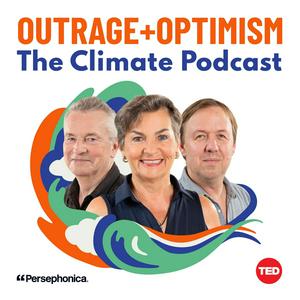
Outrage + Optimism is for anyone who is not ready to give up on making the world a better place. For unrivalled conversations with decision makers, visionary thinkers and a community of like-minded climate optimists, join former UN climate chief Christiana Figueres, political strategist Tom Rivett-Carnac and sustainable business consultant Paul Dickinson. Each week they make sense of all the top climate news stories, go behind the scenes at crucial talks and ensure you stay informed and inspired ahead of what is set to be the consequential year for climate action.As move through this decisive decade, subscribe to Outrage + OptimismAnd to see video content from the show, follow us on LinkedIn, and Instagram.Got a question? Send us a voice message.This is a Persephonica production for Global Optimism and is part of the Acast Creator Network. Hosted on Acast. See acast.com/privacy for more information.
Podcast websiteListen to Outrage + Optimism, Zombie Towns: Everything I Missed and many other podcasts from around the world with the radio.net app
Get the free radio.net app
- Stations and podcasts to bookmark
- Stream via Wi-Fi or Bluetooth
- Supports Carplay & Android Auto
- Many other app features
Get the free radio.net app
- Stations and podcasts to bookmark
- Stream via Wi-Fi or Bluetooth
- Supports Carplay & Android Auto
- Many other app features

Outrage + Optimism
Scan code,
download the app,
start listening.
download the app,
start listening.
Outrage + Optimism: Podcasts in Family
 New Zealand
