
Listen to this podcast in the app for free: Download for free in the App Store
radio.net
Sleep timer
Save favourites
327 episodes
324 - Poles in Exile
26/10/2026 | 48 mins.Thousands of Polish soldiers, refugees and civilians came to Britain after the fall of Poland, expecting eventually to return home. But as the war ended, victory brought a very different reality: Poland was now under Soviet domination.
So how did Polish communities in Britain maintain their identity during the war, and what did victory mean for people who could no longer return home?
To explore this, I'm joined by Juliette Bretan, a researcher, writer and broadcaster specialising in Britain and East-Central Europe.323 - Hap Arnold and the B-29
15/10/2026 | 43 mins.When the United States entered the Second World War, American air power was still developing. Four years later, the United States was operating thousands of aircraft, supported by an enormous industrial and technological effort, and had produced the B-29 Superfortress, the most advanced bomber of the war.
At the centre of that transformation was General Henry "Hap" Arnold.
Arnold had been involved in American military aviation from its earliest days, and during the Second World War he became the driving force behind the expansion of the US Army Air Forces. The B-29 was perhaps his greatest gamble. It was enormously expensive and technologically ambitious, and Arnold was prepared to push American industry to build an aircraft that did not yet exist.
The result was the Superfortress, a bomber capable of flying farther, higher and carrying a heavier bomb load than anything that had come before it. Ultimately, B-29s would carry the atomic bombs that destroyed Hiroshima and Nagasaki.
Today I'm joined by A. J. Baime, author of "Bird Men: The Rise of American Airpower and the Machine That Ended World War II", to look at Hap Arnold, the rise of American air power and the extraordinary story of the B-29 Superfortress.
Patreon
patreon.com/ww2podcast322 - Warsaw: A City at War, 1939–45
10/10/2026 | 57 mins.Today we're going to Warsaw, a city caught between Nazi Germany and the Soviet Union, and a city whose people endured occupation, persecution, resistance and ultimately almost total destruction.
From the invasion of 1939, through the Warsaw Ghetto Uprising and the Warsaw Uprising of 1944, we'll explore what happened to the city and its inhabitants during the Second World War.
To tell that story, I'm joined by historians Prit Buttar and Lottie Taylor, authors of 'Warsaw: A City at War, 1939–45'.
Warsaw: A City at War, 1939–45 is also available on Audible and Spotify.321 - Case Green: The Invasion of Czechoslovakia
01/10/2026 | 50 mins.In 1938, Europe was once again facing the prospect of a major war.
The immediate crisis centred on Czechoslovakia, a new state created at the end of the First World War. It was a country with a substantial industrial base, a significant arms industry and, importantly, a heavily fortified frontier with Germany.
Hitler was determined to destroy Czechoslovakia. The German military had drawn up an invasion plan known as Fall Grün, or Case Green. But there was a problem. The German armed forces were not yet ready for the kind of major European war that Hitler seemed to be risking.
So what exactly was Case Green? How did the Germans intend to defeat Czechoslovakia, how good were the Czech defences, and how did Hitler's ideas differ from those of his own generals?
And perhaps most importantly, what might actually have happened if Britain and France had refused to compromise and Germany had gone to war?
Today I'm joined by Robert Forczyk, whose book 'Case Green: The Birth of the Wehrmacht' examines the German plans for the invasion of Czechoslovakia in 1938.
Case Green is also available on Audible and Spotify.320 - Patton Reconsidered
15/09/2026 | 1h 14 mins.In this episode, we're going to look at one of the most recognisable American generals of the Second World War: George S. Patton.
Patton has become almost a character in his own right. The aggressive general with the famous speeches, the polished boots and the determination to keep his tanks moving. His reputation as one of America's great battlefield commanders has only grown since his death.
But how much of that reputation is actually deserved? Was Patton really the military genius his reputation suggests, or a talented but flawed commander whose legend has outgrown his achievements?
To help me answer that question, I'm joined by James Ellman, author of Patton Reconsidered.
patreon.com/ww2podcast
More History podcasts



Trending History podcasts











About The WW2 Podcast
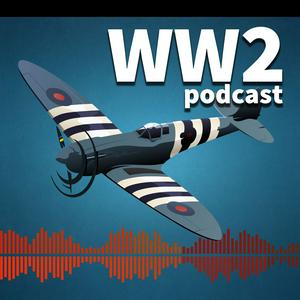
A military history podcast that looks at all aspects of WWII.
With WW2 slipping from living memory I aim to look at different historical aspects of the Second World War.
Podcast websiteListen to The WW2 Podcast, Real Survival Stories and many other podcasts from around the world with the radio.net app
Get the free radio.net app
- Stations and podcasts to bookmark
- Stream via Wi-Fi or Bluetooth
- Supports Carplay & Android Auto
- Many other app features
Get the free radio.net app
- Stations and podcasts to bookmark
- Stream via Wi-Fi or Bluetooth
- Supports Carplay & Android Auto
- Many other app features

The WW2 Podcast
Scan code,
download the app,
start listening.
download the app,
start listening.
 New Zealand
