
Listen to this podcast in the app for free: Download for free in the App Store
radio.net
Sleep timer
Save favourites
69 episodes
How Ruhollah Khomeini Constructed the Islamic Republic
08/09/2026 | 1h 13 mins.Welcome back to After the End of History. This discussion was recorded on August 27th, 2026.
The many false starts and stops of the war on Iran tell us, unhappily and perversely, that this conflict will stretch well into our future – just as we recognize its long past continuity from the 2016 strikes on Syria to the war on Iran in 1980 just after its revolution. This follows recent episodes where we talked to Brandon Wolff -Hunnicutt about the Iraq wars, and Nicholas Mulder about sanctions often preparing and precipitating total war. The long draw up to this war, and its likely duration, suggest that Iran’s sin against the West is not only its success in outmaneuvering sanctions but the Islamic Republic itself as a future-orientated form, birthed by necessity, that contributes a heretofore unknown model of popular democracy underwritten by religious law.
Our guest today describes the life and ideas of Ayatollah Khomeini, founder of the IR, which initiated a process that continues to develop and deepen even in a war against the world super-power. Dr. Nura Hossainzadeh is the author of the 2016 dissertation in Political Science at UC Berkeley, “The Constitutionalism of Ruhollah Khomeini's Theory of Guardianship.”
(read it here: https://escholarship.org/uc/item/4rg2c49c ), as well as recent articles in Middle East Eye: www.middleeasteye.net/opinion/how-boogeyman-mullahs-trope-led-us-war-iran
In conversation with our own Pat Cabell, she describes the constitutionalist responses to Iran’s early 20th Century occupations by imperial powers, and how conceptions of anti-imperialism turned to the Islamic tradition for guidance. This is a rich and rarely heard perspective on Iran as not disfigured by its battle with the empire but emboldened to inaugurate a new stage in the journey of spirit, and a new chapter of revolution, akin to the historical role of the Mexican and Russian peasants at the beginning of the century.
A partial list of works mentioned in this discussion:
- Homa Katouzian. Iran and the Revolution (2026)
- Vali Nasr. Iran's Grand Strategy (2025)
- Eskandar Sadeghi-Boroujerdi. Revolution and its Discontents: Political Thought and
Reform in Iran (Cambridge University Press, 2019) as well as
https://phenomenalworld.org/analysis/mosaic-of-deterrence/
- Ruhollah Khomeini. (anonymous) Kashf al-Âsrâr (unveiling of secrets). 1943.
- Khomeini. Hukumat-i Islami: Velayat-e faqih (Governance of the Jurist). 1970.
Hawks and Sparrows is a research collective that has been publishing and podcasting about international relations, Marxist and conservative political philosophy, history and aesthetics since 2020. Our primary archive can be found at the Patreon page for the After the End of History podcast patreon.com/afterhistory where you can also subscribe and support our work.
ATEOH on X
https://x.com/after_history
Support the showLiterary Realism 2: Alejo Carpentier - "El Siglo de las Luces"
27/06/2026 | 1h 29 mins.Welcome back to our jaunt through Alejo Carpentier’s “El siglo de las luces”, a maritime escapade in the Americas at the time of the French Revolution. With some of the literary theory covered already in episode 1, where we made the case for why this is a unique example of historical realism, we finally enjoy retelling the arc of the story and reading sections of its lurid prose. A deserted island boar feast, a guillotine being rowed into Guadalupe’s bay by starlight, former revolutionaries reimposing slavery amidst the malarial swamp of Guyane… this one’s got it all.
[Recorded December 2025]
Support the showThe Long Arc of History Bends Toward Realism: A Conversation with Christopher Mott
27/06/2026 | 1h 33 mins.[Recorded on 29 July 2025.]
We sat down with the always insightful Christopher Mott of the Institute for Peace and Diplomacy to talk about the patterns of American culture and their effects on foreign policy. His distinctive blend of cultural criticism, global history, and strategic thinking were on full display. Listeners will enjoy our discussion of the deep history of Eurasia in his 2015 book The Formless Empire: A Short History of Warfare and Diplomacy in Central Asia. We asked him questions about his amazing white paper Woke Imperium: The Coming Confluence Between Social Justice and Neoconservatism and the sarcastic wisdom found on his blog The Trickster’s Guide to Geopolitics. But the core of our conversation revolved around the prospects of a new realism in American foreign policy since the disasters of Ukraine, the Middle East and looming war with China.
Links:
The Formless Empire: A Short History of Diplomacy and Warfare in Central Asia
Woke-Imperium
The Trickster's Guide to Geopolitics | International Relations for the Outsider
Modus Vivendi: Realism's Missing Link
Support the showMarx's "Herr Vogt" - Ep. 2, Part 2 - Spies in the Workers' Movement
27/06/2026 | 37 mins.[Recorded 31 January 2025]
A continuation of our discussion on Marx's "forgotten text," Herr Vogt: A Spy in the Workers' Movement.
Support the showMario Vargas Llosa: The Realist as Neo-Liberal
11/06/2026 | 1h 5 mins.Welcome back to our mini-series on realism and the Latin American novel. In this episode, we provide a thorough engagement with the late Peruvian master, Mario Vargas Llosa, an author of major works from all the way back in the 1950s to the current decade. Pat speaks with Neil Larsen, Professor Emeritus of Comparative Literature, about his seminal essay, “Mario Vargas Llosa: The Realist as Neo-Liberal.” What makes Vargas Llosa revolutionary as a storyteller, but a reactionary ideologue? We cast a glance over Perú’s distinct 20th century history and how Vargas Llosa’s anti-leftism oddly heralded the Milei/Bolsonaro New Right, possibly soon to include Keiko Fujimori, the daughter of former Peruvian dictator Alberto Fujimori. Thus, we discuss in detail Vargas Llosa's great novel Historia de Mayta, about a failed 1958 highlands insurgency, written during the Sendero Luminoso uprising. We also consider two of Vargas Llosa's strongest 21st Century works, the interlinked La Fiesta del Chivo (2000) about the Dominican Republic and Tiempos Récios (2019) about Guatemala, which seem to confirm Neil’s thesis that despite his reactionary politics he couldn’t help but depict a CIA coup with anything but bone-chilling precision and sober pessimism.
Support the show
More History podcasts

Trending History podcasts









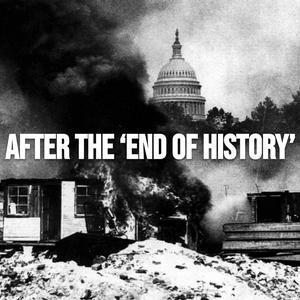
About After the ‘End of History’
After the ‘End of History’ is a podcast about International Relations Theory and History.
Podcast websiteListen to After the ‘End of History’, You're Dead to Me and many other podcasts from around the world with the radio.net app
Get the free radio.net app
- Stations and podcasts to bookmark
- Stream via Wi-Fi or Bluetooth
- Supports Carplay & Android Auto
- Many other app features
Get the free radio.net app
- Stations and podcasts to bookmark
- Stream via Wi-Fi or Bluetooth
- Supports Carplay & Android Auto
- Many other app features

After the ‘End of History’
Scan code,
download the app,
start listening.
download the app,
start listening.
 New Zealand

