

Listen to this podcast in the app for free: Download for free in the App Store
radio.net
Sleep timer
Save favourites
483 episodes
Frank Turek and the Atheist Student: Why Didn't God Make Us Perfect?
21/09/2026 | 17 mins.A YouTuber named Jay claims Frank Turek dodged a university student's question: if God is perfect, why didn't He create us perfect rather than flawed? Kevin plays the clips, and Dr. Craig explains why the question is built on confusion. Only God is a perfect being, and God cannot be created, so any created being is necessarily imperfect. Imperfect does not mean morally bad. Adam and Eve were sinless, but innocent rather than perfect. There is also no problem with a world where sin is possible, only with a world where it is actual. Dr. Craig applies Alvin Plantinga's idea of transworld depravity: there may be no feasible world in which free creatures always choose rightly. He also corrects the claim that God can alter the laws of logic, and explains why omnipotence does not mean doing the logically impossible.The Spirit of the Logos? (QoW #1009)
17/09/2026 | 5 mins.A listener who's been working through Dr. Craig's Systematic Philosophical Theology asks whether it's more accurate to say Jesus Christ is "the Spirit of the Logos" united to a human body, rather than "the soul of the Logos," pointing to passages describing God as spirit and drawing an analogy to how a human spirit unites to a body. Dr. Craig first corrects the premise: his actual view is that the Logos is the soul of Jesus, not that the Logos possesses a soul. He then explains why he avoids "spirit" language here, it risks blurring the incarnation with the Holy Spirit's indwelling or even demonic possession, when in fact the incarnation is a unique union unlike either.Is God Still Around? (QoW #1008)
17/09/2026 | 9 mins.A listener from the UK argues that the Kalam cosmological argument has a fatal flaw: even if it proves God created the universe, that doesn't prove God still exists today, any more than a house proves its builder is still alive. Dr. Craig responds by pointing to arguments for a metaphysically necessary being (from the Leibnizian cosmological, moral, and ontological arguments), which by definition cannot go out of existence. He also explains why the Kalam functions as one link in a cumulative case rather than standing alone, and closes with the resurrection of Jesus as public, historical evidence that God remains active in the world.Apatheism and the Unexamined Life
14/09/2026 | 18 mins.Journalist Jonathan Rauch's Atlantic essay "Let It Be" argued that apatheism, simply not caring whether God exists, is a mark of civilizational progress, making society safer and less prone to religious conflict. Philosopher Paul Copan disagrees, calling it a sign of decline. Kevin and Dr. Craig work through the disagreement: what's actually at stake if the question of God goes unexamined, whether a secular society can sustain objective meaning and purpose without a theistic foundation, and whether the altruism and self-sacrifice inspired by Christian belief have any real secular equivalent. Dr. Craig also revisits his case for the absurdity of life without God, drawing on thinkers from Pascal to Nietzsche, and argues that an atheistic worldview cannot be lived out both consistently and happily. He closes with thoughts on how Christians can awaken genuine curiosity about God in a culture that has simply stopped caring.Inevitable Sin? (QoW #1007)
10/09/2026 | 8 mins.A listener writes in with a philosophical challenge to the coherence of Christian doctrine: if God knowingly creates the exact conditions under which people will sin, how can he justly hold them responsible for sinning, and how can Christ's atonement make sense as a remedy for a failure that was effectively built into the system? Dr. Craig traces the problem to a hidden assumption in the question: theological necessitarianism, the idea that circumstances which make sin likely also make it inevitable. He argues that God's providence creates freedom-permitting circumstances, not deterministic ones, citing 1 Corinthians 10:13 on God's promise to supply a way of escape from every temptation. Craig also draws a key distinction between moral perfection, which he grants is impossible for finite creatures, and simply living without sin, using Adam and Eve's pre-fall innocence as an example of the latter without the former. He closes by addressing apostasy directly, denying that God ever places anyone in circumstances they are unable to handle.
View the full Question of the Week here!
More Christianity podcasts
 Ask NT Wright AnythingChristianity, History, Religion & Spirituality
 A Stronger FaithChristianity, Religion & Spirituality, Spirituality
 The Changes Ahead PodcastChristianity, Religion & Spirituality
 Jesus People PodcastChristianity, Religion & Spirituality
 The Bible in a Year (with Fr. Mike Schmitz)Christianity, History, Religion & Spirituality
 Timothy Keller Sermons Podcast by Gospel in LifeChristianity, Religion & Spirituality
 Unbelievable?Christianity, Religion & Spirituality
 Lakepointe Church with Josh HowertonChristianity, Religion & Spirituality
 Kids Corner "Liz and Friends"Christianity, Kids & Family, Religion & Spirituality
 BibleProjectChristianity, Religion & Spirituality
Trending Christianity podcasts
- The Changes Ahead PodcastChristianity, Religion & Spirituality
 The Ed Newton PodcastChristianity, Religion & Spirituality
 Learning How to See with Brian McLarenChristianity, Religion & Spirituality
 Derek Prince Ministries PodcastChristianity, Religion & Spirituality
 Deepen with Pastor Joby MartinChristianity, Religion & Spirituality
 Return To TraditionChristianity, Religion & Spirituality
 Sunday Sanctuary with Petra BagustChristianity, Religion & Spirituality
 2819 ChurchChristianity, Religion & Spirituality
 Bodies Behind The BusChristianity, Documentary, Health & Wellness, Mental Health, Religion & Spirituality, Society & Culture
 David Pawson - ’Unlocking the Bible’ PodcastChristianity, Religion & Spirituality
 The J.John PodcastChristianity, Education, Religion & Spirituality, Self-Improvement
 Behold IsraelChristianity, News, News Commentary, Religion & Spirituality
 The Gospel TruthChristianity, Religion & Spirituality
 Snarky FaithChristianity, News, Politics, Religion & Spirituality, Spirituality
 The Remnant Radio's PodcastChristianity, Philosophy, Religion & Spirituality, Society & Culture
 Rule of LifeChristianity, Religion & Spirituality
 The Bible RecapChristianity, Religion & Spirituality
 Word of Life Church PodcastChristianity, Religion & Spirituality
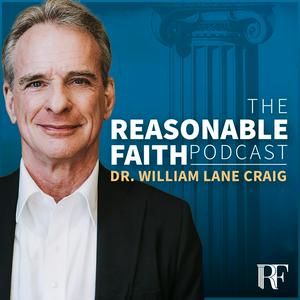
About Reasonable Faith Podcast
Reasonable Faith features the work of philosopher and theologian Dr. William Lane Craig, discussing the most important issues concerning the truth of the Christian faith today.
Reasonable Faith aims to to provide an articulate, intelligent voice for biblical Christianity in the public arena, to challenge unbelievers with the truth of biblical Christianity, and to train Christians to state and defend Christian truth claims with greater effectiveness.
Visit https://www.reasonablefaith.org for all of our debates, animated short films, interviews and lectures, articles, and more.
Podcast websiteListen to Reasonable Faith Podcast, Ask NT Wright Anything and many other podcasts from around the world with the radio.net app
Get the free radio.net app
- Stations and podcasts to bookmark
- Stream via Wi-Fi or Bluetooth
- Supports Carplay & Android Auto
- Many other app features
Get the free radio.net app
- Stations and podcasts to bookmark
- Stream via Wi-Fi or Bluetooth
- Supports Carplay & Android Auto
- Many other app features

Reasonable Faith Podcast
Scan code,
download the app,
start listening.
download the app,
start listening.
Reasonable Faith Podcast: Podcasts in Family
 New Zealand