
Listen to this podcast in the app for free: Download for free in the App Store
radio.net
Sleep timer
Save favourites
52 episodes

Two logging tools walk into a conference :: Jesse Barnum of 360Works
19/10/2026 | 32 mins.Live from EngageU in Malmö, Sweden.
Weird little coincidence: Jesse Barnum of 360Works and I both just shipped a logging tool for FileMaker. We didn't talk to each other first. So we sat down and compared notes.
Jesse's is Layout Logger, a plug-in he first wrote in 2008 and just dusted off. Think Google Analytics for FileMaker: which layouts people use, which scripts they run, what version they're on, where they connect from. You drop one file on the server, add a line to your startup script, and that's it. Then you hand the logs to Claude and ask it who's doing what. (You can even spot people sharing passwords.)
Mine is Clio. It logs data changes to a little sidecar server, lets you ask your logs questions in plain English, and has rules that can tell you when something DIDN'T happen.
Completely different approaches to two different problems. So of course we spent half the time working out how to marry them up.
Also in here: OnWindowTransaction and where it bites, why the last 5% of an AI build takes so long, a good story about checking the AI's work, and why we both think what Claris showed at the keynote is a big deal.
Chapters
0:00 Four things you're about to hear
0:21 Two logging tools, one coincidence
0:46 Layout Logger, since 2008
1:56 Google Analytics for FileMaker
3:03 How it works: 20 times a second
3:49 Install: one file, one script line
6:05 Go, WebDirect, and a bug report
7:17 The boring way and the cool way
8:55 Who's sharing passwords?
9:14 An idea Jesse writes down
10:42 Matt's turn: from FMLog to Clio
12:43 A sidecar on Fly.io
13:54 Rules, and things that don't happen
15:43 OnWindowTransaction, warts and all
20:00 Ask your logs
20:52 Marrying the two tools
23:19 Open source, and the last 5%
24:10 Midjourney and D&D
25:22 Eight logs, one timeline
26:55 Trust, but verify
27:56 Checking the AI's work
30:07 Two models check each other
31:24 Claude Code today
32:04 Bigger than FileMaker 7
Layout Logger: 360works.com
Clio: navarre.aiEngageU wrap-up :: Joris Aarts and Jay Sayers
13/10/2026 | 24 mins.Live from EngageU in Malmö, Sweden. Episode 2 of 3.
Two conversations from the last day of the conference.
First up: Joris Aarts. He runs EngageU along with Johan Hedman (They make it look easy, which it isn't). Fifty new attendees this year. Pretty much every session was about AI, and the few speakers who opened with "no AI" got applause. We talk about what the panel changed my mind on, why this feels like the iPad era all over again, and next year in Antwerp. He says 300 people. Matt says 400. Americans: Dust off your passports.
Then Jay Sayers from Skeleton Key, at his first EngageU. We'd both just walked out of a security session that scared me a little (I do AI all day and understood a scary small percentage of it). Jay talks about why Skeleton Key went slow on AI, what "AI in the process" means compared to AI that writes your code, and the customer who walked in saying "We need AI" and walked out with no AI at all. And why FileMaker's security model is something we shouldn't take for granted.
Stick around to the end for one-sentence stories.
Chapters
0:00 Three things you're about to hear
0:17 Joris Aarts: fifty new faces
2:05 AI all day, and applause for "no AI"
2:27 Making it look easy
4:15 The panel, and AI for the sake of AI
5:02 Remember the iPad era?
5:33 Next year: Antwerp
6:32 Americans, dust off the passport
6:48 300 attendees? 400?
8:08 What you only get in person
8:47 Karaoke
9:50 Jay Sayers, Skeleton Key
11:22 The security session
14:58 A cautious first AI project
17:17 FileMaker's security model
21:23 "We need AI"
23:27 One-sentence stories
Next week: Matt & Jesse Barnum of 360Works. Logs, logs and more logs.Live from EngageU :: Claris CEO Ryan McCann
04/10/2026 | 21 mins.Live from EngageU in Malmö, Sweden. Episode 1 of 3.
Two years ago Ryan McCann was a brand new CEO and we recorded a podcast. So we did it again, right after a keynote where Claris showed its new agentic development tools and opened sign-ups for the developer preview.
I told him I think this is the biggest change in the life of a FileMaker developer since FileMaker 7. Maybe bigger. Ryan is "cautiously optimistic", and then he says things like "we can take off, but we have to move with urgency." Exciting times.
We get into:
- Why the hard part for a small business is still a production system that runs the business, even though prototyping just got really cheap
- Who the "adult in the room" is when the customer's cousin builds something over a weekend (it's you)
- The fear around AI, and why neither of us spends much time there
- What it's like to build a FileMaker file from a prompt in Claude Code: tables, layouts, scripts, even data
- Ryan turns the tables and interviews me for a few minutes. Sorry about that.
- "You've got to earn it. You've got to prove it." How Claris decides what gets shown on stage
- My name for the new tool, which nobody thinks is funny
Chapters
0:00 Three things you're about to hear
0:27 Two years later
1:05 The biggest change since FileMaker 7?
4:27 What's still hard for small and mid-sized businesses
6:28 The adult in the room
7:58 80% of people don't like AI. Will that pass?
11:44 Building FileMaker from a prompt
13:47 Ryan asks the questions
17:50 Earn it, prove it
19:19 "I have a vision for this company"
20:48 The developer preview, and a bad joke
Recorded at EngageU 2026, Malmö. Next week: Joris Aarts and Jay Sayers.Vince Menanno – Inspector Pro 10 for FileMaker Pro
03/09/2026 | 1h 12 mins.Vince Menanno, the Chief Innovation Officer at https://beezwax.net shows his latest tool to manage technical debt and help developers manage their FileMaker projects. This is the latest version of this application that so many developers rely on for information about their database.
Who added this script? Who deleted it?
Which objects are unreferenced?
How many dependencies does this object have and where are they? Show me graphically!AI Consciousness, Clio, and the Future of FileMaker Training
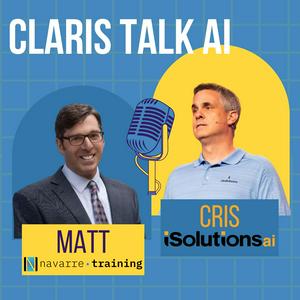
13/08/2026 | 1h 12 mins.Matt Navarre and Cris Ippolite return for a wide-ranging ClarisTalk AI conversation about how quickly the AI landscape is changing — from philosophical questions about AI consciousness to very practical FileMaker applications.
The episode starts with a discussion of a Google AI consciousness paper exploring what happens when language models are steered toward or away from claims of consciousness. Matt and Cris use that as a springboard into theory of mind, empathy, free will, AGI, and the difficulty of defining consciousness in humans, animals, and machines.
From there, they move into the practical impact of newer AI models, including Fable 5, Astra, and advanced coding workflows. Matt shares how newer models helped expand his Linear A research project, including finding and processing hundreds of academic papers, while Cris talks about using stronger models to review complex codebases, find vulnerabilities, and solve problems that previous models missed.
They also discuss the changing FileMaker conference landscape, including Full Access in California, EngageU in Europe, community-led events, and the role AI is beginning to play in the Claris/FileMaker ecosystem.
Matt then introduces Clio, his FileMaker logging and AI analysis tool. Clio captures FileMaker log data into an external SQL/Postgres-backed system, supports rules and alerts, and lets users ask questions of their logs in natural language. The key idea: keep FileMaker clean, make the integration non-destructive, and let AI work against rich operational history.
Cris shares a major update on his own FileMaker training work: he is retiring from traditional FileMaker training and turning decades of scripts, courses, DevCon presentations, user group talks, and FileMaker explanations into an AI-accessible knowledge base. The goal is to give the community a 24/7 FileMaker tutor built from his own teaching voice and experience.
The conversation closes on a hopeful note: AI can be frightening, especially for developers and business owners who feel their profession shifting under them. But hands-on use changes the picture. For both Matt and Cris, AI has become less of a threat and more of a way to unlock long-held ideas, build faster, learn faster, and create new opportunities.
Topics covered
- Google AI consciousness research
- Theory of mind and AI self-attribution
- Whether language models can simulate empathy or consciousness
- Fable 5, Astra, and next-generation coding models
- Using AI to research Linear A and ancient scripts
- AI agents as research assistants and focus groups
- Full Access, EngageU, and FileMaker community conferences
- Matt’s free AI + FileMaker integration classes
- Clio: AI-powered FileMaker log analysis
- Non-destructive FileMaker integrations
- Rules, alerts, and AI chat over operational logs
- Cris Ippolite’s FileMaker training corpus
- Solving the “two sigma problem” with AI tutors
- Why hands-on AI use reduces fear
- AI as “3D printing for ideas”
Mentioned / notable
- Ronnie Rios
- Full City Consulting
- Google AI / Paradigms of Intelligence paper
- Fable 5
- Astra
- Linear A research
- Full Access conference
- EngageU
- Claris
- Ryan McCann
- Todd Geist / ProofKit
- Fly.io
- Clio
- navarre.ai
- Cris’s article: “Hallucination Isn’t a Probability Problem”
- OpenAI DevDay
- Alexei Folger
More Technology podcasts




Trending Technology podcasts




















About ClarisTalk AI
FileMaker Pro meets AI. This is a continuing educational series about how and why to integrate AI into your Claris FileMaker Pro solutions. What it's all about, why it's important, and where do you start? We mix in plenty of FileMaker tips and tricks as well. FileMaker veterans Matt Navarre and Cris Ippolite have 432 years of combined development experience, and somehow still haven't learned much. But we are trying.Look for new episodes every two weeks.
Podcast websiteListen to ClarisTalk AI, The Vergecast and many other podcasts from around the world with the radio.net app
Get the free radio.net app
- Stations and podcasts to bookmark
- Stream via Wi-Fi or Bluetooth
- Supports Carplay & Android Auto
- Many other app features
Get the free radio.net app
- Stations and podcasts to bookmark
- Stream via Wi-Fi or Bluetooth
- Supports Carplay & Android Auto
- Many other app features

ClarisTalk AI
Scan code,
download the app,
start listening.
download the app,
start listening.
 New Zealand
