

Listen to this podcast in the app for free: Download for free in the App Store
radio.net
Sleep timer
Save favourites
37 episodes
Billionaires And The Future Of Democracy – With Carl Rhodes
09/06/2026 | 1h 4 mins.With wealth-inequality now worse than it was in ancient Rome, and the uber-rich exchanging wealth for power and applying that power to circumvent democracy and amass even more wealth, what can we do to break out of the loop and create a more equitable future?
I met with the wonderful Carl Rhodes, Professor of Business & Society at the University of Technology Sydney, to try to answer that question.
Over the past ten years, the richest 1 percent have gained at least $33.9 trillion in wealth in real terms, enough to end annual poverty 22 times over. Since the US elections in November 2024, billionaires have accumulated wealth at a rate three times faster than the previous five years. In the twelve months to March 2026, the billionaire class accrued $4 trillion in new wealth, a full one-fifth of their total accumulated wealth.
The consequence of neoliberalism is accelerated social and ecological destruction. We have all the technologies we need to halt global warming and feed the planet through peak population. We have all the money we need to end poverty and provide universal access to healthcare. If we make better collective choices. But ‘we’ are not making them, not when the uber-rich are parleying extreme wealth for extreme influence. Policy skews to the rich; the rich get richer; the toll worsens.
Carl dissects the myths around 'good' billionaires, explains the system that got us into this mess and – more importantly – how we might get out of it.
======
As always, check out the companion article with additional takeaways and the full transcript on the FutureBites page. More on my work as a Futurist Speaker, and why I do what I do, at www.brucemccabe.com
If you enjoyed these insights, please subscribe so you don’t miss out on what’s next, and help spread the word by sharing this episode with your friends and colleagues.Insect-like Drones That Sense, Learn and Swarm – With Guido de Croon
10/11/2025 | 27 mins.Insect-like drones that tend crops, perform aircraft inspections and find gas leaks are here ... and they’re only the beginning!
Today I’m diving into the future of bio-inspired drones with the one and only Professor Guido de Croon, head of the Micro-Air Vehicle Lab at Delft Technical University in The Netherlands.
Guido shares the latest insect-inspired research developments in vision-systems, energy-efficient intelligence, height-sensing, autonomous navigation, swarming, energy-harvesting and speedy decision-making. We discuss early commercial applications and spinout companies, and how the MAVLab team is building on it’s victory in the 2025 autonomous drone racing championship in Abu Dhabi to take agility to a whole new level.
It’s the stuff of sci-fi, except … it isn’t. MAVLab creations now flap their wings like birds and dragonflies, carry sensors that process information and facilitate ‘event-based’ decisions much like eyes, ears and brains do in the natural world. They emulate the navigation ‘algorithms’ of bees and ants. They swarm to accomplish collective goals based on how insects do it. Will robot insects one day harvest energy from their environment, thereby extending their missions indefinitely? You’ll have to listen to find out!
As you’ll hear, I’m thrilled to be catching-up with Guido. He’s one of my favorite scientists. He’s happy, positive, and bursting with ideas to help industry -- and it's infectious! Ever since we first connected in 2021 I’ve enjoyed featuring MAVLab creations in my presentations. Why? Because these tiny drones ‘push the limits’ of what’s possible by drawing inspiration from nature, an approach that will continue to unlock new opportunities for decades, and because (despite being tiny) they inspire audiences think BIGGER about the future!
Thank you Guido, for your passionate, joy-filled insights on the future of tiny drones.
======
As always, you'll find additional commentary and takeaways and the full transcript on the Future Bites page soon.
More on my work as a Futurist Speaker, and why I do what I do, at www.brucemccabe.com
I podcast my conversations with future-makers so more people can find pathways to a better future. If you enjoy these insights, help spread the word by liking, subscribing and sharing with others!Collaborative Housing: Pathway to a Better Future? – With Darinka Czischke
01/11/2025 | 52 mins.Vancouver, Dublin, Los Angeles, Sydney – in so many cities I visit, skyrocketing rents and prices are making housing a struggle for ordinary people. For younger people especially, it is a generational challenge that limits their future prosperity.
But all over Europe communities are using collaborative housing to pool capital and enjoy a host of shared financial and social benefits in return. Is this a better way?
In this episode, I'm in The Netherlands exploring collaborative housing with Darinka Czischke, Professor of Housing and Social Sustainability at the Delft University of Technology (TU Delft).
Darinka debunks a few myths associated with the oft-repeated phrase ‘housing crisis’ before diving into the motivations behind these communities and the shared benefits that transcend affordability. She details where and why collaborative housing projects thrive, the importance of scale, how scale has already been achieved in places like Zurich, and the national and cultural factors that support collaborative housing. We discuss multi-generational approaches, and how community-based options unlock more benefits than “aging-in-place” strategies. City governments are identified as key enablers, and Darinka shares what policymakers can do to help.
My favorite part? Darinka’s first-hand observations from collaborative housing projects she has stayed in.
There’s something for everyone in this conversation. Darinka is a passionate advocate for a better future; her insights are practical, universal, and VERY topical.
======
As always, additional commentary and takeaways and the full transcript will be on the Future Bites page soon. More on my work as a Futurist Speaker, and why I do what I do, at www.brucemccabe.com
If you enjoyed this episode, why not share it with friends and colleagues? Getting more people aware of real projects for equitable and socially sustainable housing has to be one way to contribute to a better future!Fantastic Voyage: Your Medical Micro-Robot Is Ready – With Brad Nelson
20/10/2025 | 47 mins.Microscale robots will be conducting medical procedures inside our bodies sooner than you think. That’s the big takeaway from this fascinating conversation with Prof. Bradley Nelson, head of the Multi-Scale Robotics Lab at ETH Zürich, and for those of us who grew up watching Fantastic Voyage, that's a stunning statement!
Brad walks us through the lab’s tiny bio-inspired prototypes and associated innovations in propulsion, power-delivery, external control and biocompatibility. He discusses the special challenges of fabricating and operating robots at micro- and nano-scales, and how all these developments are now converging into tiny robots capable of performing real-world procedures such as thrombectomies and precision drug deliveries to tumors inside the brain.
He also explores targets for first procedures, future aspirations, the regulatory approvals journey and the ‘democratization of surgery’ benefits that will be unlocked by adding telesurgery and more autonomy.
Prof. Brad Nelson has spent more than 40 years researching and building robots and has won numerous awards in robotics, nanotechnology, and biomedicine. He was named to the "Scientific American 50" list for outstanding acts of leadership in science and technology. His lab is undefeated international champion in Robocup's Nanogram Soccer League and he is in the Guinness Book of World Records for the "Most Advanced Mini Robot for Medical Use!
My special thanks to him for hosting me and sharing his insights, and also to Oliver Brinkman, who took time away from his blood vessel navigation experiments(!) to show me around the lab.
It’s an inspiring journey into the near future of medicine. Enjoy!
======
As always, additional commentary and takeaways and the full transcript will be on the Future Bites page soon. More on my work as a Futurist Speaker, and why I do what I do, at www.brucemccabe.com
If you enjoyed these insights, why not subscribe so you don’t miss out on what’s next, and help us spread the word by sharing this episode with colleagues!Will A.I. Boil The Planet? – With Vlad Coroama
15/10/2025 | 1h 5 mins.Will A.I. use up the worlds electricity? Or will A.I. contribute more upside than downside by helping us solve the world’s sustainability problems?
In an era of ‘exponential AI,’ the answers have huge implications for our future, but they are far from clear, because ICTs contribute in many complex ways to energy savings AND use.
I meet with IT & sustainability guru Dr Vlad Coroama for an in-depth look at both sides of the ledger.
After exploring direct impacts, Vlad takes the discussion up a level by exploring indirect secondary effects (detrimental and beneficial) to get me thinking MUCH bigger about the dynamics shaping our future. We have a lot of coffee-fuelled fun going back and forth over his ideas! And of course Vlad draws on his meticulous research to offer some overall assessments of where we are today and where we are going in future with respect to AI, data centers and energy.
Vlad Coroama heads the Roegen Centre for Sustainability (RC4S) where he assists governments in using digital technologies to save energy and emissions, and in reducing the direct footprint of digitalisation. Much of his work focuses on the rapidly increasing energy/carbon footprint of AI and data centers. He has researched the complex relationships between computing and sustainability for 20 years in Switzerland (ETH Zurich, Empa), Brazil (University of São Paulo), Portugal (Instituto Superior Técnico, Coimbra University), Sweden (KTH Stockholm), and Germany (TU Berlin).
You will enjoy Vlad's company. He is a BIG thinker, he builds his arguments thoughtfully, based on careful analysis, and he has a way of cutting through complexity using simple, powerful examples. The world needs 10,000 more like him!
======
As always, additional commentary and takeaways and the full transcript will be up on the Future Bites page soon. More on my work as a Futurist Speaker, and why I do what I do, at www.brucemccabe.com
Enjoy the insights? Follow, share, and leave a review to help more curious listeners find the show :-)
More News podcasts
 The Rest Is PoliticsGovernment, News, Politics
 The Rest Is Politics: USGovernment, News, Politics
 Pod Save AmericaNews, News Commentary, Politics, Society & Culture
 The DetailNews
 Global News PodcastDaily News, News
 The DailyDaily News, News
 At Large with Toby ManhireNews, Politics, Society & Culture
 The News AgentsDaily News, Government, News, Politics
 Black Box: The ChatbotsDocumentary, News, Society & Culture
 The Mike Hosking BreakfastNews
Trending News podcasts
 Lovett or Leave ItComedy, News
 The David Frum ShowNews, News Commentary
 The Duran PodcastNews
 The New Yorker Radio HourArts, Books, News, News Commentary, Politics, Society & Culture
 Reuters World NewsDaily News, News
 The Political Scene | The New YorkerNews, Politics
 Top CommentDocumentary, News, Society & Culture, Tech News, True Crime
 Who the Hell is Hamish?News, True Crime
 A Right Royal PodcastEntertainment News, News, Society & Culture
 ContextHistory, News
 Focus on PoliticsNews
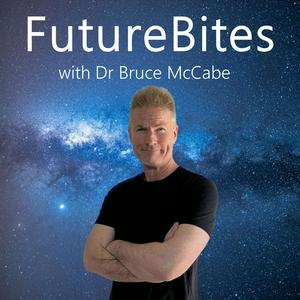
About FutureBites with Dr. Bruce McCabe
FutureBites is a podcast exploring promising and exciting pathways to a better future. Hosted by Dr Bruce McCabe, a futurist and keynote speaker who travels the world presenting his unique insights and research on the future to corporations, governments, and audiences in all industries. In each FutureBites episode, Bruce meets with an inspiring leader in science, technology, economics or the social sciences to talk about ideas, game-changers and opportunities to create a better future.
Podcast websiteListen to FutureBites with Dr. Bruce McCabe, The Rest Is Politics and many other podcasts from around the world with the radio.net app
Get the free radio.net app
- Stations and podcasts to bookmark
- Stream via Wi-Fi or Bluetooth
- Supports Carplay & Android Auto
- Many other app features
Get the free radio.net app
- Stations and podcasts to bookmark
- Stream via Wi-Fi or Bluetooth
- Supports Carplay & Android Auto
- Many other app features

FutureBites with Dr. Bruce McCabe
Scan code,
download the app,
start listening.
download the app,
start listening.
FutureBites with Dr. Bruce McCabe: Podcasts in Family
 New Zealand