Listen to this podcast in the app for free: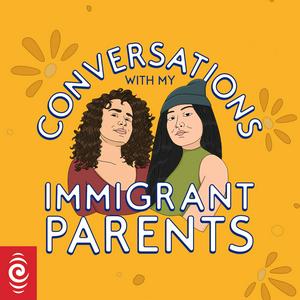 Download for free in the App Store
radio.net
Sleep timer
Save favourites
26 episodes
None of Us Know
07/5/2023 | 53 mins.
Both Mahe and his dad Tui were raised by their Tongan grandmothers. In the last episode of the series, father and son discuss namesakes, queerness, and parenting through fear and uncertainty.Content warning: This episode contains reference to domestic violence and discussion of losing children.Watch the video version of the episode hereBoth Mahe and his dad Tui were raised by their Tongan grandmothers. In the last episode of the series, father and son discuss namesakes, queerness, and parenting through fear and uncertainty.Mahe and his dad Tui Pofele share a heartfelt conversation in the last episode of Conversations with My Immigrant Parents. Tui arrived in Tāmaki Makaurau from Tonga when he was very young, although he is unsure of his exact age when he arrived, and is unable to corroborate it."No-one tells my story properly," Tui recalls, "They have no record of me entering New Zealand. That's why I always joke and say, 'Well give my tax money back.' So I gather I came really young."Tui also had Mahe when he was young, becoming a father for the first time at age 20. When he and Mahe's mother separated, Tui's mother Manaema took care of Mahe so that Tui could work enough to be able to support Mahe and his siblings. Mahe credits Manaema with a lot of his upbringing and character, saying, "She's embedded in me." Mahe describes his grandmother's sacrifices as motivation to work hard and strive for excellence in his own life.One of the reasons Mahe put himself and Tui forward for the podcast was to have more of a discussion about his sexuality, which he had revealed to his father a few years earlier."I knew that I was bisexual, and even if you took it badly, I was prepared to just carry on with my life anyway, because for me, I wanted to be fully happy."Mahe also talks a little more about what it's like occupying a liminal space in terms of his sexuality. He says that often he feels bisexual men are not truly accepted in either gay or straight communities, and that he struggles to make and maintain queer friendship groups.The makers of this podcast want to extend a special note of gratitude to Mahe and Tui for sharing their time and stories. Tui's wife Lovi was very ill when this podcast recording took place and, tragically, she passed away not long after.Go to this episode on rnz.co.nz for more details
Crying from Up in the Sky [Vietnamese]
30/4/2023 | 34 mins.
Hương fell pregnant at 20, but she didn't know it was twins until it was time to push. In this bilingual episode, she talks with her daughters Hà and Ly about dependence, marriage, and homecomings.This episode is available both in the original Vietnamese and with an English dub.Watch the video version of the episode hereHương fell pregnant at 20, but she didn't know it was twins until it was time to push. In this bilingual episode, she talks with her daughters Hà and Ly about dependence, marriage, and homecomings.Hương Nguyễn didn't know she was having two babies when she was pregnant."I delivered Ly first. I had absolutely no idea about the twins. The doctor said I still needed to deliver one more baby."In this penultimate and special bilingual episode of Conversations With My Immigrant Parents, Hương sits down with her twin daughters Hà and Ly and talks about wishing she had more support with raising them, what going back home to Vietnam for the first time since she left as a young woman was like, and a closeness with her daughters that is like sisterhood.The Nguyễn whānau arrived here as refugees from Vietnam, via Hong Kong, where Ly and Hà lived for the first two years of their lives. There was little food, baby clothes, or things to buy or share in the camp, and Hương tried hard to provide for her daughters. When cooking she had to balance one on her front and the other on her back. Her descriptions paint a clear picture of how different life with two babies was instead of the one she had expected.The pandemic started right when Hà's long-term relationship ended and she moved back in with her mother in her 30s. In many ways, Hà and Hương believe this physical closeness has helped their relationship grow. As Hương describes it, "I know her more, can understand her more, and really empathise with each other's stories. It's quite pleasant, actually. Fun at times, too!"…Go to this episode on rnz.co.nz for more details
Crying from Up in the Sky [English Dub]
30/4/2023 | 34 mins.
Hương fell pregnant at 20, but she didn't know it was twins until it was time to push. In this bilingual episode, she talks with her daughters Hà and Ly about dependence, marriage, and homecomings.This episode is available both in the original Vietnamese and with an English dub.Watch the video version of the episode hereHương fell pregnant at 20, but she didn't know it was twins until it was time to push. In this bilingual episode, she talks with her daughters Hà and Ly about dependence, marriage, and homecomings.Hương Nguyễn didn't know she was having two babies when she was pregnant."I delivered Ly first. I had absolutely no idea about the twins. The doctor said I still needed to deliver one more baby."In this penultimate and special bilingual episode of Conversations with My Immigrant Parents, Hương sits down with her twin daughters Hà and Ly and talks about wishing she had more support with raising them, what going back home to Vietnam for the first time since she left as a young woman was like, and a closeness with her daughters that is like sisterhood.The Nguyễn whānau arrived here as refugees from Vietnam, via Hong Kong, where Ly and Hà lived for the first two years of their lives. There was little food, baby clothes, or things to buy or share in the camp, and Hương tried hard to provide for her daughters. When cooking, she had to balance one on her front and the other on her back. Her descriptions paint a clear picture of how different life with two babies was instead of the one she had expected.The pandemic started right when Hà's long-term relationship ended and she moved back in with her mother in her 30s. In many ways, Hà and Hương believe this physical closeness has helped their relationship grow. As Hương describes it, "I know her more, can understand her more, and really empathise with each other's stories. It's quite pleasant, actually. Fun at times, too!"…Go to this episode on rnz.co.nz for more details
Mama Is More Stronger
23/4/2023 | 42 mins.
Tooba and her husband Habib chat with their teens about community and strength in Ōtautahi, a place that has been both a source of immense grief and love since they arrived in 2007 from Pakistan.Content warning: This episode contains discussion of the white supremacist terror attack of March 15th, 2019.Watch the video version of the episode hereTooba and her husband Habib chat with their teens about community and strength in Ōtautahi, a place that has been both a source of immense grief and love since they arrived in 2007 from Pakistan.Habib, Tooba, and their children Fatima and Usman have lived through some of the darkest events in Ōtautahi's history. The family moved from Pakistan in 2007, and have lived in Ōtautahi ever since. Habib works for the Ministry of Ethnic Communities and Tooba doesn't formally have a job, though she does a great deal of work providing support to many members of her community. Fatima and Usman, despite being a year apart, are in the same year at high school.After arriving in their new home town, the family moved around a number of times, living in rental houses all around Christchurch from their arrival up until 2021. According to Tooba, leaving one house and moving into the next was a test of strength: "The bad thing about moving houses was the inspections. They were giving us the dirtiest house and then we were cleaning and making it like new, and after three months, taking photos, even if there was one piece of grass growing, and they were saying, 'You need to mow like this.'" The 2011 earthquake was a crisis felt by the whole country, though the magnitude of it was hard to comprehend for anyone outside the city, and especially to those unfamiliar with what Ōtautahi pre-earthquake might have looked and felt like. But unfortunately, they were only the first of two major tragedies to be suffered in the same decade.2019's white supremacist terror attack at Al Noor mosque and the Linwood Islamic Centre was, in Tooba's words, "the worst nightmare of our life." The family describe realising the magnitude of the violence against their community more and more over the course of the day, as they learnt about what exactly had unfolded. Fatima says she started wearing her hijab after the attacks, and doesn't think she would have done so if not for that, and Usman talks about his school facilitating more Muslim groups since the attacks. Tooba and Habib's community work leveled up following the March 15th attacks, and remains an important aspect of family life…Go to this episode on rnz.co.nz for more details
(I Need To) Put More Water in My Beans
16/4/2023 | 47 mins.
In Tūranganui-a-Kiwa, Mara and Beto learn how their son Jamil found out about the birds and the bees in Brazil, while their kids talk about growing up black in Gisborne and having DJs for parents.Content warning: This episode contains reference to sexual content.Watch the video version of the episode hereIn Tūranganui-a-Kiwa, Mara and Beto learn how their son Jamil found out about the birds and the bees in Brazil, while their kids talk about growing up black in Gisborne and having DJs for parents.The Weiss dos Santos whānau have lived for many years in Tūranganui-a-Kiwa. Parents Mara and Beto are DJs. They perform under the name BrazilBeat Sound System and have toured Aotearoa many times, playing in festivals and night clubs. Daughter Jazz works in film production in Tāmaki Makaurau, and younger son Jamil has recently arrived there for university.Beto was born and raised in Rio de Janeiro, Brazil, and Mara grew up in San Diego in the United States. Mara went to Brazil as part of an environmental conference, and ended up meeting Beto there. They lived together in Brazil for four years before Mara's parents (who had immigrated earlier to Aotearoa) asked them to come to Gisborne to have their first child. The family continued to move between Brazil and the US, but eventually moved permanently to Tūranganui-a-Kiwa in 2001.Their arrival back to Gisborne was under the worst of circumstances. Sadly, they were called to leave the U.S. by the untimely death of Mara's brother Damon, and decided to stay on to help Mara's parents."We came back and had his funeral and everything, and then we returned to the U.S., but we just felt we couldn't stay there anymore, that we just had to come back and be with my parents and support them through this and be together as a family," Mara says.Gisborne was a far smaller city than either Mara and Beto were used to. The move also came with a choice that Beto felt was necessary to make, prioritising fatherhood over his career as a musician, especially given his own relationship with his father. "For me, it was my kids was a priority more than my music." Jazz and Jamil share on the podcast about how they feel they grew up being treated quite differently by their parents. In many ways, Jazz feels she broke ground for Jamil, "I took the brunt of the strict parents, and you were able to go out and drink when you were 15 and 16." Despite what their peers believed, their parents' profession as DJs didn't mean they got to live a parentless, party lifestyle…Go to this episode on rnz.co.nz for more details
More Society & Culture podcasts
 Mamamia Out LoudSociety & Culture
 Between Two Beers PodcastSociety & Culture, Personal Journals
 Stuff You Should KnowSociety & Culture
 The Girls UninterruptedSociety & Culture, Personal Journals
 Darling, Shine!Health & Wellness, Kids & Family, Society & Culture, Mental Health
 ConversationsSociety & Culture, Relationships
 The Louis Theroux PodcastArts, Comedy, Society & Culture
 AdriftHistory, Society & Culture, Documentary
 THE MORNING SHIFTMusic, News, Sports
 Kiwi YarnsSociety & Culture, Personal Journals
Trending Society & Culture podcasts
 This is LoveSociety & Culture, Personal Journals
 The Why Files: Operation PodcastFiction, Science, Society & Culture, Documentary, Life Sciences, Science Fiction
 Khloé in Wonder LandSociety & Culture
 The LRB PodcastSociety & Culture
 Origin StoryHistory, News, Society & Culture, News Commentary
 Stuff They Don't Want You To KnowSociety & Culture
 Kim Hill Wants To KnowSociety & Culture
 The Tramping LifeSociety & Culture, Places & Travel
 怡楽播客
怡楽播客 Trust Me: Cults, Extreme Belief, and ManipulationComedy, Society & Culture, True Crime
 SCAMMERLANDSociety & Culture, Documentary
 Danny Jones PodcastComedy, Society & Culture, Documentary
 Woman's HourSociety & Culture
 The MontoyasSociety & Culture
 Freakonomics RadioSociety & Culture, Documentary
 Modern LoveSociety & Culture
 Life ChangingSociety & Culture, Personal Journals
 Mark Narrations - Reddit StoriesComedy, Society & Culture, Relationships
 Secrets We KeepKids & Family, News, Society & Culture, True Crime, Documentary, Parenting, Politics
 Eckhart Tolle: Essential TeachingsSociety & Culture
 The PanelSociety & Culture
 The Slow NewscastNews, Society & Culture, Documentary, News Commentary
About Conversations With My Immigrant Parents
Immigrant whānau across Aotearoa have frank conversations covering love, ancestry, home, food, expectation, and acceptance.
Podcast websiteListen to Conversations With My Immigrant Parents, Mamamia Out Loud and many other podcasts from around the world with the radio.net app
Get the free radio.net app
- Stations and podcasts to bookmark
- Stream via Wi-Fi or Bluetooth
- Supports Carplay & Android Auto
- Many other app features
Get the free radio.net app
- Stations and podcasts to bookmark
- Stream via Wi-Fi or Bluetooth
- Supports Carplay & Android Auto
- Many other app features

Conversations With My Immigrant Parents
Scan code,
download the app,
start listening.
download the app,
start listening.


 New Zealand