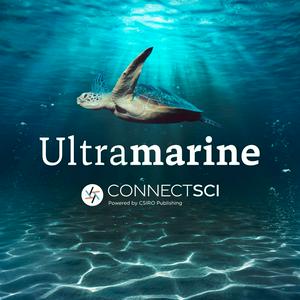
PodcastsScienceUltramarine: the science of our oceans and waterways

Ultramarine: the science of our oceans and waterways

ConnectSci
Ultramarine: the science of our oceans and waterways
Latest episode

7 episodes

  • Ultramarine: the science of our oceans and waterways

    The impact of shifting ocean currents

    13/2/2026 | 19 mins.
    Ocean currents are the hidden systems that regulate Earth’s climate, moving heat and energy around the planet. But as the ocean warms, those currents are beginning to shift, with major consequences for Australia.

    In this episode of the Ultramarine, science journalist Ellen Phiddian explains how ocean currents work, how scientists track their movement, and why predicting their future is so complex. The conversation explores changes already being observed, from the Antarctic Circumpolar Current to the East Australian Current pushing further south along Australia’s east coast.

    Together, the episode unpacks what scientists know, what remains uncertain, and why Australia, as an island continent surrounded by multiple ocean systems, is particularly exposed to changes in ocean circulation. Understanding how the ocean moves, it turns out, is essential to understanding Australia’s climate future.

    More information:
    Earth Nullschool: An interactive global map that shows ocean currents, winds, and temperatures moving around the planet in near real time. A great way to visualise systems like the East Australian Current.
    Integrated Marine Observing System (IMOS): Australia’s national network of ocean sensors, moorings, and observing platforms used to track ocean currents, temperature, and conditions around the coastline.

    For the latest science news and discoveries visit https://connectsci.au/news
    Hosted on Acast. See acast.com/privacy for more information.

  • Ultramarine: the science of our oceans and waterways

    The Strange Physics of Tides

    27/1/2026 | 18 mins.
    David Boldeman is joined by science journalist Ellen Phiddian to explore the strange and often misunderstood physics of tides. The conversation unpacks why most coastlines experience two tides a day, why tidal behaviour varies so dramatically around the world, and what tide charts are actually measuring. Along the way, they examine spring and king tides, the influence of geography and ocean shape, and how tidal forces affect not just the oceans, but the Earth and Moon over deep time including the possibility that tides played a role in the origins of life.

    For the latest science news and discoveries visit https://connectsci.au/news
    Hosted on Acast. See acast.com/privacy for more information.
  • Ultramarine: the science of our oceans and waterways

    How do we measure sea level rise?

    14/1/2026 | 17 mins.
    This episode explains how sea level rise is measured — not just that it’s happening. It demystifies the tools, the data, and the validation process that sit behind one of the most talked-about climate metrics.

    Sea level is a baseline measurement that underpins city planning, infrastructure design, flood risk modelling, and long-term coastal decision-making. Understanding how we know builds trust in what we know.

    Science journalist Ellen Phiddian joins host David Boldeman to guide you through the measurement process, how evidence is tested, and how journalists assess confidence in scientific claims.
    Hosted on Acast. See acast.com/privacy for more information.
  • Ultramarine: the science of our oceans and waterways

    How you can help save the Great Barrier Reef

    04/1/2026 | 32 mins.
    In this Ultramarine episode of the Connect Sci Podcast, host David Boldeman speaks with Sean Daly from Citizens of the Reef about how students, teachers, and everyday Australians can play a real role in protecting the Great Barrier Reef.

    Sean explains the major threats facing coral reefs — especially climate change and outbreaks of Crown-of-Thorns Starfish — and why traditional scientific monitoring can only cover a small fraction of this vast marine system. He talks about the Great Reef Census, a global citizen-science project where divers, tourists, schools, and volunteers photograph and analyse reef images to build the most comprehensive picture yet of reef health.

    Explore the organisations and resources mentioned:
    Citizens of the Reef — https://citizensgbr.org/
    Great Reef Census — https://greatreefcensus.org
    Schools Program — https://greatreefcensus.org/schools
    Sean’s Schools presentation available via Google Drive
    Hosted on Acast. See acast.com/privacy for more information.
  • Ultramarine: the science of our oceans and waterways

    The secret life of dams: small waters shape changing climate

    19/12/2025 | 29 mins.
    Australia has more than 1.7 million farm dams, and together they play a far greater role in climate and environmental health than most people realise. In this episode of the ConnectSci Podcast, host David Boldeman speaks with Dr Martino Malerba, freshwater ecologist and Senior Lecturer at RMIT University, about the surprising science behind these small but significant water bodies. Hosted on Acast. See acast.com/privacy for more information.

More Science podcasts

About Ultramarine: the science of our oceans and waterways

Ultramarine investigates the latest research, innovations and science news from our oceans and marine environments. Hosted on Acast. See acast.com/privacy for more information.

Podcast website

Listen to Ultramarine: the science of our oceans and waterways, Science Vs and many other podcasts from around the world with the radio.net app

Get the free radio.net app

  • Stations and podcasts to bookmark
  • Stream via Wi-Fi or Bluetooth
  • Supports Carplay & Android Auto
  • Many other app features
Social
v8.6.0 | © 2007-2026 radio.de GmbH
Generated: 2/21/2026 - 3:46:00 PM