

Listen to this podcast in the app for free: Download for free in the App Store
radio.net
Sleep timer
Save favourites
64 episodes
Help create the next season
02/07/2026 | 1 mins.The podcast has just clocked over 10,150 downloads. THANK YOU.
And we're a bit tired, so we're taking a break over the US summer — with a new season coming your way September 2026.
BUT we need you.
We want to know...
🎙️ What conversations are being avoided right now?
🎙️ What’s something you think about or discuss privately, but rarely hear discussed openly?
The best episodes usually start with someone saying:
“Can someone please talk about this?”
Use this form to anonymously (or nonymously) drop your ideas, hot takes, sticky questions, or niche orchestra dilemmas below ⬇️
https://lnkd.in/eM4asFmA
Maybe you’re keen put your hand up to join us for a live coaching or problem-solving session.??
See you in August with fresh voices, fresh conversations, and hopefully slightly more sleep.Bridging the Gap Across the Aisle
07/06/2026 | 34 mins.In this episode, Ingrid and Susan unpack Ingrid's perspective of organisation dynamics within an orchestra, from her point of view as assistant conductor. This role bridges the gap between playing and non-playing staff in an orchestra, and experiences the benefits and challenges of this border zone. This week, Ingrid draws out the commonalities between these two main parts of an orchestra, and lays out a way of engaging with both parts that makes the most of their connection and interdependence.
🌉 We need a wide bridge between performers and non-performers – the more people who know what’s going on in both parts, the better our organisations will function and the healthier our people will be.
🛠️ There are lots of jobs that need doing in an orchestra – and many of them are invisible. The more visible we can make every role, the better we can function as a unified team.
👂We need to learn to listen without judgement, to learn about the varied experiences of the people around us. This is not natural for many of us who have spent years learning to listen with judgement in musical contexts.
For more on seeing each others’ perspective, have a listen back to episode four of this season!
LINKS
Find Ingrid at Ingrid Martin and Conducting Artistry
Find Susan at Notable Values
PODCAST TEAM
Production support and audio engineering by Thomas Grayden
Theme music composed by QiQi
Theme music performed by QiQi and Darby Lee
LAND ACKNOWLEDGEMENT
This podcast was recorded on Waawiiyaataanong Country and produced on Wurundjeri Woi Wurrung Country. We pay our respects to Elders past and present, and acknowledge the ongoing impacts of colonisation on Indigenous communities."Artistic Excellence" – What Are We Really Saying?
24/05/2026 | 30 mins.We hear and use the phrase “artistic excellence” in so many ways – a justification for decisions, a way of talking about the status quo, a slur against those we disagree with. But what actually is it? In this episode, Susan and Ingrid deconstruct the idea of artistic excellence, from Susan’s perspective of relational health in an organisation, and Ingrid’s position of music making. They decipher what we mean when we say this phrase, and how we can use it intentionally to give the message we really mean to give.
🤹♂️ Different organisations, different ensembles, different positions all have different requirements for artistic excellence. The clearer we are on what we’re looking for, the clearer we can be about whether or not we found it. “I’ll know it when I hear it” is not enough.
🤝 We don’t have to agree on what “artistic excellence” means to each of us individually, but we do need to have consensus on what it means to all of us collectively. Affirm the range of opinions, and then find unity for this specific group.
🎨 Is “artistic excellence” code for “technical excellence?” If so, we can just say what we mean. We know that art cannot be judged by technical perfection, so artistic excellence is not a useful phrase for this kind of evaluation.
What does artistic excellence mean to you? What part of that do you want to keep, what do you want to move away from, and what might you want to add to what you have received from your teachers and heroes and colleagues? It’s so much better for everyone if we only hold ourselves to definitions we actually agree with.
LINKS
Find Ingrid at Ingrid Martin and Conducting Artistry
Find Susan at Notable Values
PODCAST TEAM
Production support and audio engineering by Thomas Grayden
Theme music composed by QiQi
Theme music performed by QiQi and Darby Lee
LAND ACKNOWLEDGEMENT
This podcast was recorded on Waawiiyaataanong Country and produced on Wurundjeri Woi Wurrung Country. We pay our respects to Elders past and present, and acknowledge the ongoing impacts of colonisation on Indigenous communities.Conductors and Feedback
10/05/2026 | 37 mins.On this episode, Susan and Ingrid take the feedback discussion into Ingrid's area of expertise: conducting. They discuss how to receive feedback as a conductor, how to support conductors in their ongoing development, and how to create an atmosphere of healthy feedback in an orchestra. Conducting is not magic. It’s a skill like anything else, and needs to be developed and supported in the same way as any role in the orchestra.
🧑💼 A conductor needs to be aware of where feedback from players is coming from: varying levels of comfort with giving feedback, varying levels of expertise in giving feedback, and varying dynamics depending on the hierarchy of the orchestra.
🪢 There is inherent tension in developing conducting skills: conductors need to lead with authority and certainty, but growth requires flexibility and openness. Conductor training programs need guardrails to make sure conductors are given the kind of feedback they need, from the right people, in a safe environment – like an instrumental masterclass.
📪 Our system tends not to be set up to give conductors quality feedback – feedback can be delayed by months, and is by necessity heavily filtered. Supporting top quality conducting requires timely, specific feedback, and upfront agreements about how feedback is given.
LINKS
Find Ingrid at Ingrid Martin and Conducting Artistry
Find Susan at Notable Values
PODCAST TEAM
Production support and audio engineering by Thomas Grayden
Theme music composed by QiQi
Theme music performed by QiQi and Darby Lee
LAND ACKNOWLEDGEMENT
This podcast was recorded on Waawiiyaataanong Country and produced on Wurundjeri Woi Wurrung Country. We pay our respects to Elders past and present, and acknowledge the ongoing impacts of colonisation on Indigenous communities.Suffering as the Status Quo
26/04/2026 | 35 mins.This week, Susan and Ingrid recognise that classical music is an industry that often causes psychological harm, in a way that other industries do not. Fortunately, it is very possible to unlearn harmful practices, and to make choices that change the way our organisations operate – the rapid development of hearing safety in orchestras is a good example of this. The idea of suffering is central to many of our musical cultures, and we need to start having the conversation about what actually helps people thrive in the classical music industry.
🤐 Many of us learn that in order to stay in the system, progress in the system, and succeed in the system, we need to stay quiet about our suffering.
🚀 Suffering escalates: first it becomes invisible, then normalised, then necessary, then competitive.
🧑💼 Some good questions to ask ourselves and our colleagues: “What would an outsider see here?” “What other ways might there be of doing this?”
If this conversation has brought up awareness of suffering that you have experienced, know that this doesn’t have to be the reality in our industry. Seek support, and support those around you in their own experiences, as we work together to improve the way we support everyone in our industry to thrive.
LINKS
Pelletier, B. (2025). Effects of Sleep Extension on Musical Performance Skills. Music & Science, 8. "While further research is necessary to establish causality and explore long-term effects... the findings underscore sleep extension's potential to significantly enhance musical skills and psychological flexibility among musicians, potentially opening new avenues for optimizing performance and fostering resilience in creative pursuits."
Bergen, P. (2024). Substance use in Australian orchestras: a scoping study "Previous research has established that musicians use a range of substances to manage performance anxiety, with beta-blockers and alcohol reported as the most common. To discover current patterns of use, we distributed an anonymous, online scoping survey to all professional Australian orchestras. The survey response rate was 17% of musicians, and representative of orchestral instrument groupings, with just over 50% of participants reporting using substances to manage performance anxiety. The most used substance was beta blockers, but other drugs and recreational substances were also reported. Notably, substance use does not noticeably ease for musicians with permanent orchestral jobs as they age."
Find Ingrid at Ingrid Martin and Conducting Artistry
Find Susan at Notable Values
PODCAST TEAM
Production support and audio engineering by Thomas Grayden
Theme music composed by QiQi
Theme music performed by QiQi and Darby Lee
LAND ACKNOWLEDGEMENT
This podcast was recorded on Waawiiyaataanong Country and produced on Wurundjeri Woi Wurrung Country. We pay our respects to Elders past and present, and acknowledge the ongoing impacts of colonisation on Indigenous communities.
More Arts podcasts
 99% InvisibleArts, Design
 DishArts, Comedy, Food, Society & Culture
 ill-advised by Bill NighyArts, Books, Comedy, Music
 Fresh AirArts, Books, Society & Culture, TV & Film
 The Magnus ArchivesArts, Drama, Fiction, Performing Arts, Science Fiction
 Fashion Neurosis with Bella FreudArts, Fashion & Beauty, Relationships, Society & Culture
 The MothArts, Performing Arts
 The Food ProgrammeArts, Food
Trending Arts podcasts
 The Great Detectives of Old Time Radio| Daily Mystery DramasArts, Drama, Fiction, Performing Arts
 Something Rhymes with PurpleArts, Comedy, Education
 Every OutfitArts, Fashion & Beauty
 Amanda Wakeley: StyleDNAArts, Documentary, Fashion & Beauty, Society & Culture
 Not A Podcast ASOIAF Re-Read PodcastArts, Books
 Forever35Arts, Fashion & Beauty, Health & Wellness, Leisure
 Down These Mean Streets (Old Time Radio Detectives)Arts, Performing Arts, TV & Film
 Inklings Book ClubArts, Books
 The Great IndoorsArts, Design, Society & Culture
 Poetry UnboundArts, Books, Relationships, Religion & Spirituality, Society & Culture, Spirituality
 The World's Best Construction PodcastArts, Design, Documentary, Society & Culture
 Dressed: The History of FashionArts, Fashion & Beauty, History, Society & Culture
 SpookedArts, Leisure, Performing Arts, Society & Culture
 Creative Pep TalkArts, Business, Design, Education
 Things Bakers Know: The King Arthur Baking PodcastArts, Food, Hobbies, Leisure
 Emma by Jane Austen - A Dramatic ReadingArts, Books, Fiction, Performing Arts
 Anne's House Of DreamsArts, Books, Drama, Fiction
 The Nerd of the RingsArts, Books, Entertainment News, News
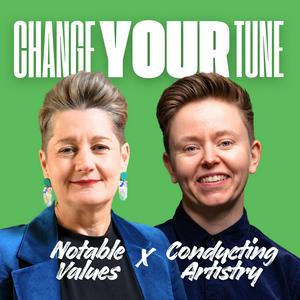
About CHANGE YOUR TUNE
The 𝗛𝗨𝗠𝗔𝗡 side of orchestras and classical music. In early 2026 we’re relaunching the podcast to explore what helps people and culture thrive and where systems, hierarchy and tension get in the way.
We'll uncover the dynamics that shape collaboration, communication, well-being and performance in classical music.
Ingrid and Susan are both outsiders and insiders in classical music. Ingrid is a professional conductor who used to be an emergency doctor. Susan is a trainer and consultant who founded a multi-million dollar tech company. Between them, they know what supports people to be their best at work.
Check out the back catalogue of 5 seasons featuring conversations with classical musicians about feelings (YES!), finding their value and career transitions. Meet professional classical musicians now thriving as entrepreneurs, master craftsmen, counsellors, personal trainers, software developers, lawyers and more. We need to NORMALISE the reality of underemployment, unemployment, career pivots and exits for classical musicians.
Podcast websiteListen to CHANGE YOUR TUNE, 99% Invisible and many other podcasts from around the world with the radio.net app
Get the free radio.net app
- Stations and podcasts to bookmark
- Stream via Wi-Fi or Bluetooth
- Supports Carplay & Android Auto
- Many other app features
Get the free radio.net app
- Stations and podcasts to bookmark
- Stream via Wi-Fi or Bluetooth
- Supports Carplay & Android Auto
- Many other app features

CHANGE YOUR TUNE
Scan code,
download the app,
start listening.
download the app,
start listening.
 New Zealand