
Listen to this podcast in the app for free: Download for free in the App Store
radio.net
Sleep timer
Save favourites
87 episodes
YOU CAN SEE EVERYTHING, Or Can You?
07/11/2026 | 1h 14 mins.Delving into YOU CAN SEE EVERYTHING, the mind-blowing new film by Nathan Fielder and Lance Oppenheim currently wowing audiences at a theater new you. I'm joined by special guest [M]ichael Dalebout, a scholar whose work in the fields of rhetoric, art, and film and media examines the interrelation of authenticity, artificiality, and self-identity in comedy. This gives them unique insights into Fielder’s complex approach to these issues in his “cringe comedy” television series THE REHEARSAL and NATHAN FOR YOU as well as into Fielder's increasingly fraught interrogation of disgraced health tech CEO Elizabeth Holmes, whose maddening insistence on her total innocence and transparent honesty after being convicted of fraud has been mesmerizing the multitudes watching YOU CAN SEE EVERYTHING.Giving LIZZIE BORDEN 40 Whacks
07/11/2026 | 1h 5 mins.Even knowing that writer-director-producer Ryan Murphy routinely chooses fascinating television series topics based on historical figures and then makes infuriatingly stupid shows about them, co-hosts Eileen and Dolores were unprepared for the big bloody mess that is MONSTER: THE LIZZIE BORDEN STORY. The biggest problem is that it’s not actually the Lizzie Borden story, if you know anything about the notorious ax-murderer, acquitted in 1893 of killing her rich miserly father and hated stepmother, but assumed to be guilty by almost everybody down through the generations. It’s also not the Aileen Wuornos story or the Countess Elizabeth Bathory story, though those women—convicted of multiple murders in very different centuries, countries, classes, and life circumstances of every kind—are also dragged in to further confuse the addled narrative. It’s a kind of pseudo-feminist TV jamboree positing that all women who kill are oppressed by the patriarchy in the same way and are therefore, essentially, one Universal Woman Killer.Grading TEENAGE SEX & DEATH AT CAMP MIASMA
28/08/2026 | 58 mins.Co-hosts Eileen and Dolores have high praise for TEENAGE SEX AND DEATH AT CAMP MIASMA, the new horror-comedy by up-and-coming writer-director Jane Schoenbrun (I SAW THE TV GLOW). It’s about nerdy, academically-trained filmmaker Kris Williams (Hannah Einbinder of HACKS), who’s been hired to reboot an old 1980s slasher film franchise yet is in denial about the taboo sexual charge the slasher films give her. As part of her research and an expression of her intense fandom, she seeks out the reclusive star of the first CAMP MIASMA movie, Billy Presley, played by Gillian Anderson (THE X-FILES). Together at Billy’s wintry home in the mountains where the first low-budget CAMP MIASMA gore-fest was set and shot, Kris and Billy begin a collaboration on the rebooted franchise film by exploring the meaning and impact of the CAMP MIASMA films through their own increasingly intimate and erotically charged relationship.Historic Re-release of THE DEVILS
18/08/2026 | 1h 12 mins.Host Eileen Jones is joined by writer and cinephile Alex Deley in celebrating Ken Russell's THE DEVILS, a 1971 film so controversial in its day that it was heavily censored, then banned in many countries, then released but rated X in the UK and USA, then critically reviled—Roger Ebert gave it zero stars—and then made very hard to find for decades. Now with a director's cut finally and fully restored in 4K, with an upcoming theatrical re-release, we can access and fully appreciate the brilliance of Russell's best film.
Based on Aldous Huxley's 1952 book THE DEVILS OF LOUDUN, and John Whiting's 1960 stage adaptation THE DEVILS, the film concerns the appalling historical records of a 1634 case of demonic possession overtaking the nuns at an Ursuline convent in Loudun, France, which was supposedly achieved by the sorcery of the dissolute but popular priest Father Urbain Grandier (played by Oliver Reed). The tormented abbess, Sister Jeanne des Anges (Vanessa Redgrave) falsely accuses Grandier of being in league with the devil, which suits the plans of Catholic statesman Cardinal Richelieu, who’s consolidating state power by crushing the authority of the feudal lords. Their walled and fortified cities include Loudun, and Grandier has served as a defiant champion of the people of Loudun. His brutal and carnivalesque trial, torture, and execution is a gruesome public spectacle precipitating Loudun’s destruction.
Russell called this his most political film, saying it represents “what happens when the state takes over.”NIGHT OF THE HUNTER and the Southern Gothic
18/08/2026 | 1h 18 mins.The only film that actor Charles Laughton directed is the now-celebrated NIGHT OF THE HUNTER (1955), a unique, nightmarish, dark fairy tale vision that's part of the "Southern Gothic" series of films currently running on the Criterion Channel.
The film's an adaptation of Davis Grubb's 1953 novel, which in turn was based on the real-life Depression-era case of Harry Powers, a serial killer who answered lonely-hearts ads and then murdered widows for their life savings, killing several of their children in the process. Powers was hanged in West Virginia in 1932. In THE NIGHT OF THE HUNTER, the phony preacher "Reverend" Harry Powell (Robert Mitchum) targets Willa Harper (Shelley Winters), the widow of a bank robber who was hanged without ever divulging where he stashed the $10,000 he got away with. Once he's married to the doomed Willa, Harry Powell zeroes in on her children, John (Billy Chapin) and Pearl (Sally Jane Barnes), who clearly know where the money's hidden.
Soon the orphaned children have to flee downriver to escape the predatory killer on their trail. They're taken in by a self-sufficient farm-woman, Miss Rachel Cooper (Lillian Gish), who cares for needy children found wandering the roads during the Depression. Inevitably, there's an epic standoff between Miss Cooper and Harry Powell, with the fate of John and Pearl hanging in the balance.
More Arts podcasts







Trending Arts podcasts


















About Filmsuck
Support us on Patreon.com/filmsuck for bonus episodes and more perks!
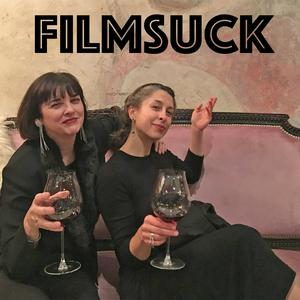
A weekly podcast hosted by Eileen Jones, film critic at Jacobin magazine and recovering academic, and Dolores McElroy, diva enthusiast and lecturer in film and media at UC Berkeley.
In this podcast for the people, we bring you the truth about the rotten state of cinema, its often odious or ham-fisted relationship to politics, and its occasional wondrous bursts of courage and brilliance. We consider the glories of cinemas past, and wonder about lots of things: what’s the role of contemporary film in a time of bad art and worse taste; popular entertainment in a time of fragmentation, generalized disaffection, and PTSD; and media in a time when it seems to have lost its power to get us off our asses?
In short, what is to be done when film sucks?
Podcast websiteListen to Filmsuck, 99% Invisible and many other podcasts from around the world with the radio.net app
Get the free radio.net app
- Stations and podcasts to bookmark
- Stream via Wi-Fi or Bluetooth
- Supports Carplay & Android Auto
- Many other app features
Get the free radio.net app
- Stations and podcasts to bookmark
- Stream via Wi-Fi or Bluetooth
- Supports Carplay & Android Auto
- Many other app features

Filmsuck
Scan code,
download the app,
start listening.
download the app,
start listening.
 New Zealand

