
Listen to this podcast in the app for free: Download for free in the App Store
radio.net
Sleep timer
Save favourites
296 episodes
Art, Automation, and AI — Part 3
16/10/2026 | 53 mins.Tim opens by picking up where Part 2 ended: if language can be translated into numbers, what does that make possible for reading and evaluating writing? Shawn starts with the chicken and egg. Language came first, and math is a distillation of language built for solving problems.
Tim offers a practical frame. A CPA takes your question (“do I have enough money?”), looks at the numbers, and gives you a true answer based on the evidence. Shawn runs with it: a good accountant doesn’t care whether he likes you, and he won’t lie to you because the consequences land on you later. That has been Shawn’s standard for editorial feedback for 35 years. Look only at the evidence on the page, set aside personal attachment, and tell the writer the truth about how their words are landing with the reader.
From there, Shawn explains what a large language model is actually doing. Every letter, word, and space becomes a number, the model finds patterns in an enormous corpus, and it returns the most probable match. It runs on the principles and heuristics of programmers none of us have met. He distinguishes a living system, which hasn’t stopped and can’t be computed, from an artifact, which has a beginning, middle, and end and therefore can be fully computed. The machine can’t tell you what you’ll feel when you read something. It can only tell you the potential is there.
Shawn shares why he stopped working privately with writers six or seven years ago. At $150,000 per manuscript, the work inevitably became ghostwriting, and he didn’t want to spend his life as Rumpelstiltskin. His dream has been to leave everything he knows about story and myth in a form that is accessible, affordable, and more consistent than he is on a bad day.
Tim then introduces the distinction that has shaped Story Grid’s recent work: knowledge versus skill. You can read every book and attend every workshop on riding a bike and still fall off the first time you get on one. Almost everything produced for writers, including by Story Grid, has been knowledge. He walks through the research on deliberate practice and on kind versus wicked learning environments. Writing is among the most wicked, because feedback is slow, inconsistent, or wrong, and practicing in that environment builds confidence without building skill.
The two discuss whether writing has objective standards. Tim’s answer is music: you can love or hate Taylor Swift, but the songs objectively work, and jazz players don’t leave the box, they push its boundary outward. Shawn adds that the boundary moves as you approach it, which is exactly how myth works.
Tim recounts how Story Grid’s feedback work evolved from six-week scene workshops with week-long turnaround to the realization that a scene is too big to practice, the way his weightlifting coach broke the snatch into pieces. The unit had to shrink to the sentence, and the feedback had to come fast.
Shawn closes by describing what he built. It is a calculator, not an inference machine. He distilled what he does when he reads, starting with a sense of the whole and then filtering down to the evidence on the page, into a sequence of deterministic grades. Each submission is graded three times for agreement, then an emitter translates the grades into the language Shawn uses with students. The writer gets back their exact submission with feedback under each sentence: what worked and why, what needs revision and how to fix it on resubmit, plus an overall summary. No LLM, no telling writers what they want to hear. Just 35 years of editorial judgment returned within 24 hours, the way a CPA uses QuickBooks and then hands you what the numbers mean.Art, Automation, and AI — Part 2
09/10/2026 | 1h 4 mins.Tim picks up the artifact-versus-artifice thread from last week and asks the practical question: what does it have to do with automation and AI?
Shawn's first answer is a distinction. An LLM takes in the corpus of human artifacts, finds the most popular patterns, and stitches them into something that looks original but is a mimicked artifact, not a new one. Artifice, the capacity to project something into the future that has never existed, stays with the human. From there the conversation turns to what AI is actually good for (speed and research), what prompting really is, and then into the deep end: whether a written sentence can be fully computed, and what that means for how editing works.
Topics covered:
Original artifacts versus mimicked artifacts, and why an LLM output is an integration of what already exists rather than a projection of what could be
Why AI behaves like a confirmation bias machine, and why it's hard to get it to tell you something you don't want to hear
Jaron Lanier's "Wikipedia on steroids" framing, and why the people building AI present it as a savior
Shawn's Library of Congress story: two weeks of research that would take a second today, and Tim's espresso machine example from a scene he was writing
Prompting as programming: knowing exactly what you want, the same way you once had to learn how to search Google
Why developmental editing is slow by nature: you can't evaluate the first sentence until you've read the whole artifact
Content and context, show and tell, and everything packed into the two-word sentence "Tim screams"
The Russian doll structure: sentence, scene, arc, quadrant, whole, and the mythic standard that applies at every level
Gödel's incompleteness theorem, the Church-Turing thesis, David Deutsch, and Claude Shannon's information theory, and how Shawn uses all five to argue that a halted artifact can be fully computed
Russell and Whitehead's Principia Mathematica and the failed attempt to prove that one is one
Shawn's actual editing process for a scene: did anything change, find the sentence evidence for each of the five commandments, confirm each is shown rather than told
Inciting incident, turning point, crisis, climax, resolution, and the A-P-A-P-A pattern of antagonism and protagonism across the five
Why a progressive complication is a reaction, not a transformation, and why the antagonist always leads the inciting incident
Why language is a form of math and math is a form of language, and why F=ma and "don't jump out the window" are the same message
Why Shawn won't hoard what he knows, and what it would mean to formalize it so a machine can analyze a writer's work the way he does
Books and works referenced
The Story Grid by Shawn Coyne
Principia Mathematica by Alfred North Whitehead and Bertrand Russell
The Odyssey, The Iliad, Pride and Prejudice, The Lord of the Rings, The HobbitArt, Automation, and AI — Part 1
02/10/2026 | 49 mins.Tim opens with a broad question: a few years after ChatGPT hit the public consciousness, where does Shawn stand on what AI is, how it's useful, how it isn't, and what it means for writing and editing?
Shawn's answer comes from the three years he spent on Mentoring the Machines with John Vervaeke, author of Awakening from the Meaning Crisis. Rather than start with AI, he starts with technology itself and builds up from there. The episode is less a list of tips than a map, and by the end it lands on a clear claim: AI is an algorithmic system that simulates the heuristics, principles, and stories of its programmers, and it has zero understanding of myth.
Topics covered:
Three kinds of technology: external (the shovel), shared or "nomo" technology (the idea of the shovel passed between people), and psychotechnology (the capacity to think up the shovel in the first place)
Algorithms, heuristics, and principles, and why each one maps to a human capacity we use every day without noticing
Why a theory is really a limitation, and how innovation (Newton to Einstein) pushes the limit outward
Story as the integration of algorithms, heuristics, and principles, and myth as the larger cycle that story sits inside
What myth actually means, why Tim got corrected for misusing it in an email, and why "it's just a myth" is a sign the language has been degraded
Artifact versus artifice: the recorded thing versus the capacity that made it, and how the two combine into art
The Odyssey, Scylla and Charybdis, and why a story whose circumstances never happened can still be a higher form of truth than a record
Why the "AI will destroy us" story and the "AI will let us drink pina coladas forever" story are both agendas, and what to look for when a story is all chaos or all order
Tim's internet-in-the-'90s comparison, and whether AI is fundamentally different from past technologies
Computational versus conscious systems: why speed and scale may never cross the threshold to consciousness, and why the only real test would be an original artifact
Shawn's definitions of consciousness (attention, awakening, awareness, affordance, attunement, agreement, alignment, at-onement), and why the machines don't care
Faith as a practical problem rather than a religious claim, and why you need the artifice of falsity to reach the artifact of truth
Books referenced
Mentoring the Machines by Shawn Coyne and John Vervaeke
Awakening from the Meaning Crisis by John Vervaeke
The Odyssey
Links
Sign up for the Story Grid newsletter at StoryGrid.com
Mentoring the MachinesHow do you write a book you're proud to publish?
25/09/2026 | 52 mins.Tim opens with a stat that frames the whole conversation: the average unpublished writer he surveyed has been at it for nearly 15 years. He puts the question to Shawn directly. What is Story Grid trying to do about that?
Shawn's answer starts with the mythic patterns that make stories like The Odyssey, The Lord of the Rings, and Pride and Prejudice last, and lands somewhere most writing advice doesn't: the sentence. His argument is that the same beginning, middle, and end that shapes a novel also shapes a scene and a sentence, and that the sentence is the smallest unit capable of carrying a transformation. Get that right and the larger structures follow.
Along the way, Tim and Shawn cover:
Why reading Save the Cat, McKee, and MasterClass doesn't translate into being able to write a mythic story, and what Aristotle's subject-and-predicate has to do with it
The chicken sexing model of learning: repetition plus feedback from someone who knows, instead of theory first
What Shawn actually meant when he told Tim, after two full manuscripts, that he couldn't write a sentence
The five commandments (inciting incident, turning point, crisis, climax, resolution) as five "criticalities" of everyday experience, and how each one can be written as one sentence
Antagonism and protagonism as forces, not roles, and why antagonism isn't the bad guy
Why Story Grid students are limited to one sentence per commandment
Tim's guitar and jiu-jitsu comparisons, and why writing is harder to self-correct than either
Flow state, Mihaly Csikszentmihalyi's Flow, and why feeling like you're taking dictation from the muse doesn't mean the writing works
Journaling versus writing: the difference between monologue and a dialogue with a reader
The Aunt Louise test for whether your five sentences are actually working
Also mentioned: Brent Spalding, a Story Grid student whose novel was published by Story Grid Publishing.
Books referenced
Flow by Mihaly Csikszentmihalyi
On Writing by Stephen King
Story by Robert McKee
Save the Cat by Blake SnyderThe Final Episode
25/05/2023 | 35 mins.This will be the final episode of the Story Grid Podcast for the foreseeable future. Tim gives some background on why this decision was made along with an update on his current writing project and other happenings around Story Grid.
More Arts podcasts







Trending Arts podcasts






















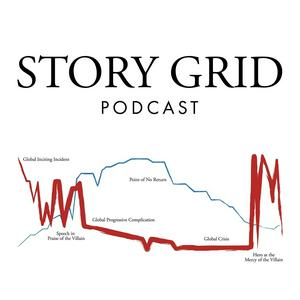
About Story Grid Writing Podcast
Helping you become a better writer.
Join Shawn Coyne, author of Story Grid and a top editor for 30+ years, and Tim Grahl, struggling writer, as they discuss the ins and outs of what makes a story great.
More at www.StoryGrid.com.
Podcast websiteListen to Story Grid Writing Podcast, 99% Invisible and many other podcasts from around the world with the radio.net app
Get the free radio.net app
- Stations and podcasts to bookmark
- Stream via Wi-Fi or Bluetooth
- Supports Carplay & Android Auto
- Many other app features
Get the free radio.net app
- Stations and podcasts to bookmark
- Stream via Wi-Fi or Bluetooth
- Supports Carplay & Android Auto
- Many other app features

Story Grid Writing Podcast
Scan code,
download the app,
start listening.
download the app,
start listening.
 New Zealand

