

Listen to this podcast in the app for free: Download for free in the App Store
radio.net
Sleep timer
Save favourites
121 episodes
Starfish Teachers: It Made a Difference to That Teacher
14/10/2026 | 11 mins.Summary
What happens when some of the best teachers in a district are invited to present at conferences across the country, but are never asked to share what they know in their own schools? In this solo episode, Gene Tavernetti reflects on the way classroom teachers with deep expertise in evidence-informed instruction can be sought out by educators elsewhere while their knowledge is overlooked or discouraged at home.
Gene explores Tall Poppy Syndrome, the social cost of standing out, and why sending teachers to conferences with instructions to bring learning back is unlikely to produce meaningful schoolwide change without leadership and a culture that values internal expertise. He revisits the Starfish Story with a less comforting conclusion: if conference learning changes only one classroom, perhaps all we can say is, “It made a difference to that teacher.”
Chapters
0:00 — The expertise schools overlook
2:00 — Tall Poppy Syndrome and the cost of standing out
5:00 — Why conference learning does not automatically spread
8:00 — The Starfish Story and a challenge for leaders
Show Notes
Gene Tavernetti reflects on teachers whose expertise is valued everywhere except at home.
The episode asks school and district leaders whether they know where the expertise is in their own organization.
A strong internal culture gives teachers meaningful opportunities to share and use what they know.
This podcast sponsored by:
The Bell Ringer, a weekly newsletter providing news, tools, and resources on the science of learning, written by education reporter Holly Korbey. Subscribe here.Digital Captives: Reclaiming the Human Side of Teaching
07/10/2026 | 1h 2 mins.Summary
In this from-the-archives episode, Bart Hoffman interviews Dr. Frank Rodriguez and Gene Tavernetti about their book Digital Captives: Helping Schools Strike a Balance Between Humans and Hardware. They trace how technology moved from a tool intended to augment instruction into something that can displace attention, relationships, reading, and meaningful learning.
Frank and Gene discuss what they have observed in schools and after-school programs, why the pandemic accelerated existing problems, and how educators can respond without swinging from unquestioned technology adoption to an equally unhelpful rejection of digital tools. Their central message is practical: schools need intentional systems that put humans, learning, and healthy technology habits back at the center.
Chapters
0:00 — Introduction: from digital natives to digital captives
2:17 — What changed for students and schools
6:00 — When technology stopped augmenting instruction
10:27 — The problem of too much digital material
14:09 — Finding balance between humans and hardware
18:00 — Adult modeling, attention, and schoolwide systems
23:18 — Practical ways schools can reset technology habits
26:00 — Screen inferiority and reading comprehension
31:30 — Rebuilding conversation, focus, and human connection
38:00 — Leading change without creating another pendulum swing
47:56 — The book, the authors, and where to learn more
60:30 — Closing thoughts
Show Notes
Dr. Frank Rodriguez — Educator and leader of after-school and community learning programs whose work with students and staff helped prompt the research behind Digital Captives.
Gene Tavernetti — Host of Better Teaching and co-author of Digital Captives.
Bart Hoffman — Education leader and friend of the podcast who conducts the interview.
Digital Captives: Helping Schools Strike a Balance Between Humans and Hardware is written by Frank Rodriguez, Donna Smith, and Gene Tavernetti.
Learn more about the authors and the book through Schools Next.
This is a refreshed from-the-archives presentation of Better Teaching episode 90.
This podcast sponsored by:
The Bell Ringer, a weekly newsletter providing news, tools, and resources on the science of learning, written by education reporter Holly Korbey. Subscribe here.Culture Is Built, Not Inherited: How Schools Actually Change
30/09/2026 | 8 mins.Summary
Gene Tavernetti examines the familiar explanation that school improvement is difficult because “it’s just the culture.” Drawing on work with schools across the United States and Canada, he argues that culture is not fixed atmosphere—it is the residue of daily decisions, habits, and follow-through.
The practical path to change is to change what people do. Gene lays out a focused approach: choose one or two specific instructional practices, support them through consistent coaching, use common look-fors in leadership walkthroughs, and protect the commitments through follow-through. The goal is a shift from isolated classrooms to a shared identity around how “we teach here.”
Chapters
0:00 — Welcome to Better Teaching
0:37 — Why “it’s just the culture” becomes an excuse
2:13 — Culture is built from daily decisions
3:08 — Change behavior before trying to change beliefs
4:12 — Make coaching and walkthroughs consistent
5:26 — From “I teach here” to “we teach here”
6:42 — Protect the culture you want through follow-through
Show Notes
Guest/host: Gene Tavernetti
Gene’s professional site: tesscg.com
Gene’s books include Teach Fast: Focus, Adaptable, Structured Teaching and Maximizing the Impact of Coaching Cycles.
Better Teaching is part of the BE Podcast Network: bepodcastnetwork.com
Production card: Basecamp
This podcast sponsored by:
The Bell Ringer, a weekly newsletter providing news, tools, and resources on the science of learning, written by education reporter Holly Korbey. Subscribe here.Changing Culture Starts with Fluency: Why New Teachers Need Explicit Instruction
30/09/2026 | 14 mins.Summary
What do new teachers most need to know? Gene Tavernetti argues that one of the most important answers is explicit instruction—not as a topic to study in a professional-development session, but as a practice to design, deliver, and improve until it becomes fluent. Drawing on work with teacher-induction programs and new hires from many different credentialing programs, Gene explains why fluency in explicit instruction reduces decision-making load and strengthens classroom practice.
The conversation also explores why explicit instruction provides a baseline for accommodations and modifications, reduces unnecessary variation before interventions are introduced, helps educators evaluate curriculum and AI-generated lessons, and gives professional learning communities a common language for collaboration.
Chapters
0:00 — Welcome to Better Teaching
0:41 — What new teachers need beyond credentialing
2:20 — Moving from knowledge to fluency in explicit instruction
4:45 — Why fluency reduces classroom decision overload
6:25 — Using strong lesson design as a baseline for adaptations
7:35 — Eliminating variables before launching interventions
9:05 — Evaluating curriculum and AI-generated lessons
10:35 — Building a common language for collaboration
12:25 — What explicit instruction does—and does not—mean
13:25 — Recap and closing
Show Notes
Guest/host: Gene Tavernetti
Gene’s professional site: https://tesscg.com/
Gene’s books include *Teach Fast: Focus, Adaptable, Structured Teaching* and *Maximizing the Impact of Coaching Cycles*.
Better Teaching is part of the BE Podcast Network: https://bepodcastnetwork.com/
Basecamp production card: https://3.basecamp.com/3104101/buckets/37549891/card_tables/cards/10347189507
This podcast sponsored by:
The Bell Ringer, a weekly newsletter providing news, tools, and resources on the science of learning, written by education reporter Holly Korbey. Subscribe here.How to Sabotage a Coach
23/09/2026 | 7 mins.Summary
Instructional coaches are often treated as a school’s all-purpose backup: covering classes, managing testing logistics, joining extra committees, and handling whatever emergency appears next. In this episode of Better Teaching, Gene Tavernetti explains how those individually reasonable requests quietly dismantle a coaching program.
Gene makes the case for protecting coaching time as carefully as instructional time. He recommends a clear job description, a schedule that protects observation and debriefing, explicit monthly expectations, and a target of spending 70–80 percent of the coach’s time in classrooms. The long-term choice is clear: covering a class solves today’s problem, while coaching improves instruction this year and the years that follow.
Chapters
0:00 — Welcome to Better Teaching
0:46 — The all-purpose support trap
1:23 — How understaffing consumes the coaching calendar
3:12 — The message teachers receive when coaches are pulled
4:08 — Define and protect the coaching role
4:49 — Keep 70–80% of the coach’s time in classrooms
5:16 — Dr. Randy Olson and the “nothing is an emergency” rule
5:44 — Short-term convenience versus long-term improvement
6:42 — Closing thoughts and resources
Show Notes
**Host:** Gene Tavernetti
**Core takeaway:** Protect the coaching calendar like instructional time. Define what coaches do—and what they do not do—and hold leadership accountable for preserving that work.
**Recommended starting point:** Write a clear coaching job description, set a weekly schedule for observations and debriefs, and review the coach’s time allocation monthly.
**Gene’s books:** *Teach Fast, Focus Adaptable Structure Teaching* and *Maximizing the Impact of Coaching Cycles*
**Website:** TESS Consulting Group
**BlueSky:** @gtavarnetti
**X/Twitter:** @gtavarnetti
**BE Podcast Network:** bepodcastnetwork.com
About Better Teaching
Better Teaching is hosted by Gene Tavernetti and focuses on practical ideas for teachers, instructional coaches, administrators, and everyone who supports better work in classrooms—no clichés, no buzzwords, only stuff that works.
Added/created/modified by Codex on 2026.09.22 13:22 PT on ombee
This podcast sponsored by:
The Bell Ringer, a weekly newsletter providing news, tools, and resources on the science of learning, written by education reporter Holly Korbey. Subscribe here.
More Education podcasts









Trending Education podcasts











About Better Teaching: Only Stuff That Works
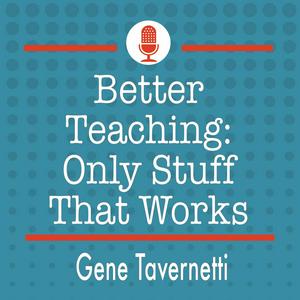
Descriptions of effective teaching often depict an idealized form of "perfect" instruction. Yet, pursuing perfection in teaching, which depends on children's behavior, is ultimately futile. To be effective, lessons and educators need to operate with about 75% efficiency. The remaining 25% can be impactful, but expecting it in every lesson, every day, is unrealistic. Perfection in teaching may be unattainable, but progress is not. Whether you are aiming for the 75% effectiveness mark or striving for continuous improvement, this podcast will guide you in that endeavor.
Podcast websiteListen to Better Teaching: Only Stuff That Works, IMO with Michelle Obama and Craig Robinson and many other podcasts from around the world with the radio.net app
Get the free radio.net app
- Stations and podcasts to bookmark
- Stream via Wi-Fi or Bluetooth
- Supports Carplay & Android Auto
- Many other app features
Get the free radio.net app
- Stations and podcasts to bookmark
- Stream via Wi-Fi or Bluetooth
- Supports Carplay & Android Auto
- Many other app features

Better Teaching: Only Stuff That Works
Scan code,
download the app,
start listening.
download the app,
start listening.
 New Zealand