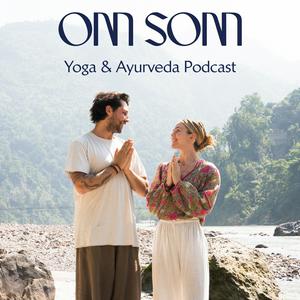
PodcastsEducationOm Som Yoga + Ayurveda Podcast

Om Som Yoga + Ayurveda Podcast

Aaron Petty + Paige Taylah
Om Som Yoga + Ayurveda Podcast
Latest episode

129 episodes

  • Om Som Yoga + Ayurveda Podcast

    Chant This Mantra & Watch What Unfolds | Asato Mā

    21/06/2026 | 37 mins.
    PRACTICE WITH US

    ✦ Sadhana Sangha - 5 practices per month, asana workshops, subtle body techniques, Yoga Sūtra translation
    https://practice.omsom.yoga/365-sadhana-sandha/join
    ✦ OmSom App (free) - yoga philosophy, Sanskrit study + online community
    Search OmSom in the App Store
    ✦ 100 Hr Asana Sadhana Dharma
    https://practice.omsom.yoga/asana-sadhana-dharma-oto
    ✦ 200 Hr Yoga Teacher Training Sri Lanka 2026
    https://omsom.yoga/200-hour-yoga-teacher-training-sri-lanka
    ✦ 50 Hr Online Yin Yoga Teacher Training
    https://practice.omsom.yoga/yin-yoga-and-prana-vayus-oto

    IN THIS EPISODE

    Mantra June continues. After Praṇava (Auṃ), Gāyatrī, and Mahā Mṛtyuñjaya, we arrive at one of the most beloved and most widely chanted prayers in the tradition - Asato Mā, also known as the Pavamāna Mantra.

    Oṃ Asato mā sad gamaya Tamaso mā jyotir gamaya Mṛtyor mā amṛtaṃ gamaya Oṃ Śāntiḥ Śāntiḥ Śāntiḥ
    Lead me from the unreal to the real. Lead me from darkness to light. Lead me from death to immortality.

    We trace this prayer back to a fire ceremony in the Bṛhadāraṇyaka Upaniṣad, where the ṛṣis prepare a metaphorical offering of the entire cosmos to the fire of awareness. At the peak of the ritual, three sages speak three lines and what makes their prayer so radical is what they don't ask for. No superpower. No riches. No outcome. Only to be led, pointed in the right direction, and left to walk the path themselves.

    This one is simple. We let it stay simple.

    WHAT YOU'LL LEARN

    Why Asato Mā is an invocation, not a request - a prayer for guidance rather than a specific outcome (and how that contrasts with the Gāyatrī)
    The story behind the mantra: the cosmic horse, the metaphorical fire, and the offering of totality to awareness itself
    A clear, line-by-line translation: asat → sat, tamas → jyotir, mṛtyu → amṛta, and the meaning of gamaya
    Why amṛta, the "nectar of immortality", is the nectar of self-knowledge, not a deathless body
    How abhyāsa and vairāgya (practice and surrender) live inside this single prayer
    The Ayurvedic lens: how disease arises from the mind, and how cultivating a sattvic mind becomes the healer through diet, brahmacarya, and pratyāhāra
    The journey through the three guṇas, tamas → rajas → sattva, and why you can't leap straight to stillness
    How to weave the mantra into daily life as bhāvana, an opening to practice or a quiet companion when you feel lost

    TEXTUAL REFERENCES

    Bṛhadāraṇyaka Upaniṣad - source of the Asato Mā / Pavamāna mantra (1.3.28), and of the horse-as-cosmos imagery (1.1.1)
    Pavamāna Sūkta - Ṛg Veda, 9th Maṇḍala (Soma Pavamāna)
    Gāyatrī Mantra & Mahā Mṛtyuñjaya Mantra - earlier Mantra June episodes, referenced for contrast
    Praṇava (Auṃ) - the Mantra June opener
    Concepts drawn on: śraddhā, abhyāsa & vairāgya, Īśvara praṇidhāna, the three guṇas (sattva, rajas, tamas), brahmacarya, pratyāhāra

    TRY THIS IN YOUR PRACTICE
    Use Asato Mā the way the tradition does, as an opening, not as japa. Before your next practice, chant it three times:

    Oṃ Asato mā sad gamaya
    Tamaso mā jyotir gamaya
    Mṛtyor mā amṛtaṃ gamaya
    Oṃ Śāntiḥ Śāntiḥ Śāntiḥ

    Let it be an invocation: I'm doing this practice, I don't fully know where it leads - please, lead me there in time. Notice that the mantra never says "I will go." It says lead me. So this week, where life feels foggy, practise being led: trust the path, trust the tradition, and let "I don't know yet" be enough.

    SHARE & CONNECT

    Website: https://omsomyoga.com
    OmSom App (free): search OmSom in the App Store
    Instagram: @omsomyoga

    If this episode landed, the best way to support the show is to share it with one person who might need it.

    We operate a yoga studio in Berwick, Victoria, Australia, offering classes, workshops, and Yoga Teacher Training programs. We'd love to connect with you wherever you are on your journey.

    HARI OM
  • Om Som Yoga + Ayurveda Podcast

    Mahā Mṛtyuñjaya: The Mantra for Conquering the Fear of Death

    14/06/2026 | 28 mins.
    PRACTICE WITH US

    ✦ Sadhana Sangha - 5 practices per month, asana workshops, subtle body techniques, Yoga Sūtra translation
    https://practice.omsom.yoga/365-sadhana-sandha/join
    ✦ OmSom App (free) - yoga philosophy, Sanskrit study + online community
    Search OmSom in the App Store
    ✦ 100 Hr Asana Sadhana Dharma
    https://practice.omsom.yoga/asana-sadhana-dharma-oto
    ✦ 200 Hr Yoga Teacher Training Sri Lanka 2026
    https://omsom.yoga/200-hour-yoga-teacher-training-sri-lanka
    ✦ 50 Hr Online Yin Yoga Teacher Training
    https://practice.omsom.yoga/yin-yoga-and-prana-vayus-oto

    IN THIS EPISODE

    Of all the mantras in the yoga tradition, the Mahā Mṛtyuñjaya is the one people reach for when something goes wrong - when someone is sick, dying, or afraid. But despite its name, it isn't a mantra against death. It's a prayer not to die before you're ready: to ripen fully into life, and to be loosened from the fear of dying the way ripe fruit falls freely from the vine.

    We sit with one of the mantras closest to Aaron's heart. They unpack its meaning line by line, tell the story of the sage Mārkaṇḍeya who conquered death itself, and explore why a mantra so wrapped in taboo is actually one of the most nourishing and Ojas-building practices in the tradition.
    Content note: this episode discusses death and dying.

    WHAT YOU'LL LEARN
    ✦ Why this mantra, when everything else falls apart - the difference between asking for eternal life and asking for ripeness and fullness of life.
    ✦ The cucumber that isn't a cucumber - what the urvāruka fruit really is, and why it drops freely when ripe rather than needing to be cut from the vine.
    ✦ The story of Mārkaṇḍeya - Shiva's impossible choice, a sixteen-year-old's deepest samādhi, and the moment Yama, the god of death, was defeated.
    ✦ Śavāsana as a death ritual - how every time you lie down at the end of practice, you're rehearsing the art of letting go of the body.
    ✦ A line-by-line translation - Rudra the three-eyed one who howls with compassion, and what we're truly asking for when we chant.
    ✦ The Ojas connection - why the most "feared" mantra in the tradition is also the most nourishing, and how it supports each dosha.
    ✦ How and when to use it - readiness, chanting for the sick and dying, and weaving it into everyday life.

    TEXTUAL REFERENCES

    ✦ Ṛg Veda - the origin of the mantra, found in a portion dedicated to Rudra and traditionally attributed to the sage Vasiṣṭha.
    ✦ Mahābhārata - the earliest source of the Mārkaṇḍeya story, told within Yudhiṣṭhira's conversation with the sage himself.
    ✦ Mārkaṇḍeya Purāṇa, Bhāgavata Purāṇa, Śiva Purāṇa, Skanda Purāṇa - the same story recurs across all of these texts.
    ✦ Bhagavad Gītā - Krishna's teaching that one who remembers him at the moment of death attains his state; the root teaching behind the Hare Krishna tradition's practice.
    ✦ Yoga Sūtras of Patañjali - abhiniveśa, the fear of death, named as a root of suffering.

    THE MANTRA

    Om Tryambakaṃ Yajāmahe
    Sugandhiṃ Puṣṭi-vardhanam
    Urvārukam-iva Bandhanān
    Mṛtyor Mukṣīya Mā'mṛtāt

    We worship the three-eyed one, fragrant, the increaser of nourishment. As the ripe fruit is freed from its binding to the vine, may I be freed from death, but not from immortality.

    SHARE & CONNECT

    Website: https://omsomyoga.com
    OmSom App (free): search OmSom in the App Store
    Instagram: @omsomyoga

    If this episode landed, the best way to support the show is to share it with one person who might need it.

    We operate a yoga studio in Berwick, Victoria, Australia, offering classes, workshops, and Yoga Teacher Training programs. We'd love to connect with you wherever you are on your journey.

    HARI OM
  • Om Som Yoga + Ayurveda Podcast

    The Mantra That Brahmā Hid Inside a Single Syllable - Deciphering Gayatri

    07/06/2026 | 47 mins.
    PRACTICE WITH US

    ✦ Sadhana Sangha - 5 practices per month, asana workshops, subtle body techniques, Yoga Sūtra translation
    https://practice.omsom.yoga/365-sadhana-sandha/join
    ✦ OmSom App (free) - yoga philosophy, Sanskrit study + online community
    Search OmSom in the App Store
    ✦ 100 Hr Asana Sadhana Dharma
    https://practice.omsom.yoga/asana-sadhana-dharma-oto
    ✦ 200 Hr Yoga Teacher Training Sri Lanka 2026
    https://omsom.yoga/200-hour-yoga-teacher-training-sri-lanka
    ✦ 50 Hr Online Yin Yoga Teacher Training
    https://practice.omsom.yoga/yin-yoga-and-prana-vayus-oto

    IN THIS EPISODE
    If Om is the sound that holds everything together, the Gāyatrī is the prayer that lights up the mind. We explore the mantra the ancient ṛṣis understood as a request for clarity - may our intellect be illuminated. Through the story of Brahmā condensing the three Vedas down into a single syllable, the meaning of each word of the mantra, the goddess Gāyatrī Devī as the light of the morning sun, and how the mantra meets each dosha, this episode is an invitation into one of the most potent practices in the tradition — held with reverence for where it comes from.

    WHAT YOU'LL LEARN
    Why the Gāyatrī is a prayer for the buddhi (the discerning intellect) rather than the heart or body, and why the ṛṣis saw a clouded mind as the obstacle to yoga
    The story of Brahmā condensing the three Vedas → three verses → three words (bhūr bhuvaḥ svaḥ) → the single syllable Om, and how this shows the Gāyatrī holds all Vedic knowledge
    The Gāyatrī meter (chhanda): 24 syllables arranged 8–8–8, the same rhythm the Vedas are recited in, compared playfully to the 5-7-5 of a haiku, and why this aids memory and retention
    Gāyatrī Devī - the etymology Gāyantam Trāyate iti Gāyatrī ("she who, when sung, protects"), and the goddess as the feminine light of the morning sun, likened to consciousness itself
    A line-by-line translation of the mantra, including the vyāhṛti (Om Bhūr Bhuvaḥ Svaḥ) as body, mind, and soul / the three worlds, and the difference between Svaḥ and Svāhā (the wife of Agni)
    How the Gāyatrī works within Āyurveda as a heating, solar mantra connected to sādhaka pitta, and how to adapt it for Vāta, Pitta, and Kapha types
    A cautionary teaching story on the potency of the mantra and the importance of teacher-to-student transmission and reverence

    TEXTUAL REFERENCES
    Manusmṛti - the source of the story of Brahmā drawing the Gāyatrī from the three Vedas; also the teaching that one who recites the Gāyatrī at both twilights gains the merit of reciting the entire Vedas
    The Vedas - Ṛgveda (tat savitur vareṇyam), Sāmaveda (bhargo devasya dhīmahi), Yajurveda (dhiyo yo naḥ pracodayāt)
    Indu Arora - Mudra: The Sacred Secret - referenced for a series of 24 mudrās that can be practised with the Gāyatrī Mantra (verify exact book title)
    Robert Svoboda - Kundalini (Aghora II) - the story of the student who chanted the mantra without reverence

    TRY THIS IN YOUR PRACTICE
    Chant the Gāyatrī at sunrise, slowly and with reverence - not rushing toward a number, but letting each of the three lines (8–8–8) land. Notice the mantra as a request, not a demand: may the light of that sun illuminate my mind.
    Vāta - chant aloud, steady and rhythmic, to ground into the body
    Pitta - slow, soft, internal repetition; release your grip on the practice
    Kapha - chant at sunrise to invite warmth and momentum into the day
    And take the closing teaching to heart: let this mantra be offered to you at the right time. The right teachings reveal themselves when you're ready.

    SHARE & CONNECT

    Website: https://omsomyoga.com
    OmSom App (free): search OmSom in the App Store
    Instagram: @omsomyoga

    If this episode landed, the best way to support the show is to share it with one person who might need it.

    We operate a yoga studio in Berwick, Victoria, Australia, offering classes, workshops, and Yoga Teacher Training programs. We'd love to connect with you wherever you are on your journey.

    HARI OM

  • Om Som Yoga + Ayurveda Podcast

    The Hum of the Universe: Decoding the Mantra Om, The Three Sounds, the Fourth Silence & the Nine Stages

    31/05/2026 | 50 mins.
    PRACTICE WITH US

    ✦ Sadhana Sangha - 5 practices per month, asana workshops, subtle body techniques, Yoga Sūtra translation
    https://practice.omsom.yoga/365-sadhana-sandha/join
    ✦ OmSom App (free) - yoga philosophy, Sanskrit study + online community
    Search OmSom in the App Store
    ✦ 100 Hr Asana Sadhana Dharma
    https://practice.omsom.yoga/asana-sadhana-dharma-oto
    ✦ 200 Hr Yoga Teacher Training Sri Lanka 2026
    https://omsom.yoga/200-hour-yoga-teacher-training-sri-lanka
    ✦ 50 Hr Online Yin Yoga Teacher Training
    https://practice.omsom.yoga/yin-yoga-and-prana-vayus-oto

    IN THIS EPISODE

    If you had to pick the most important syllable in the entire tradition of yoga (one sound that contains everything) what would it be? In this episode, Aaron and Paige open the June series on mantra and bhakti by exploring Auṃ, the syllable chanted at the beginning and end of every yoga class, painted on every mat, stuck to the back of every car, and yet very rarely understood for what it actually is.

    We unpack why Patañjali never calls it Om in the Yoga Sūtra (and what he calls it instead), why the texts describe it as the sound of Īśvara, and why every other mantra in the tradition begins with this sound. We map the three syllables A–U–M to the three states of consciousness, sit with the fourth state  (turīya) that lives in the silence after the M, and then walk through the nine stages of that silence as taught in the Nāda Yoga and Kashmir Śaivite tradition.

    What You'll Learn
    ✦ The meaning of bhakti and why mantra is inseparable from devotion
    ✦ The difference between a mantra and an affirmation (and why one points to something while the other is the thing itself)
    ✦ Why Patañjali codifies Om as Praṇava in the Yoga Sūtra and the aesthetic superstition behind the name change
    ✦ The three syllables of A–U–M and the three states of consciousness they express: jāgrat (waking), svapna (dreaming), suṣupti (deep sleep)
    ✦ The fourth state, turīya, that arises in the silence after M
    ✦ The Maṇḍūkya Upaniṣad teaching of the bow, the arrow, the string, and the target, and why the release is the part you can't practice
    ✦ The nine stages of silence after Om as taught in Nāda Yoga: bindu, ardha candra, nirodhinī, nāda, nādānta, śakti, vyāpinī, samanā, unmanā
    ✦ How the syllables of A–U–M map to the doṣas - and how to use mantra to work with the mahāguṇas (sattva, rajas, tamas)
    ✦ The distinction between japa (mantra you repeat) and ajapa (mantra that repeats itself)
    ✦ Why Om is described as the hum of the universe and how to actually hear it

    Textual References
    Patañjali's Yoga Sūtra (Samādhi Pāda)
    ✦ Tasya vācakaḥ praṇavaḥ - "The expression of Īśvara is the syllable Praṇava."
    ✦ Taj-japas tad-artha-bhāvanam - "Repeat that mantra while contemplating its meaning."
    ✦ The following sūtra: through this practice, the awareness turns inward and the obstacles to yoga fall away.

    Maṇḍūkya Upaniṣad 
    ✦ All twelve verses of this short Upaniṣad are dedicated to the syllable Auṃ, mapping its sounds to the four states of consciousness. The bow-and-arrow analogy referenced in this episode is drawn from the Upaniṣadic teaching tradition.

    Bhagavad Gītā
    ✦ Kṛṣṇa: "The one who utters the single syllable Om Brahman and remembers me departs from the body and reaches the supreme destination."

    Kashmir Śaivism / Nāda Yoga tradition
    ✦ The nine progressive stages of the silence after Om (some traditions list seven, others twelve).

    Ayurveda and the Mind by Dr. David Frawley
    ✦ Referenced for the application of mantra to the mahāguṇas.

    SHARE & CONNECT

    Website: https://omsomyoga.com
    OmSom App (free): search OmSom in the App Store
    Instagram: @omsomyoga

    If this episode landed, the best way to support the show is to share it with one person who might need it.

    We operate a yoga studio in Berwick, Victoria, Australia, offering classes, workshops, and Yoga Teacher Training programs. We'd love to connect with you wherever you are on your journey.

    HARI OM

  • Om Som Yoga + Ayurveda Podcast

    So'haṃ Haṃsa - The Mantra You've Been Repeating Your Whole Life Without Knowing

    24/05/2026 | 34 mins.
    PRACTICE WITH US✦ Sadhana Sangha - 5 practices per month, asana workshops, subtle body techniques, Yoga Sūtra translationhttps://practice.omsom.yoga/365-sadhana-sandha/join✦ OmSom App (free) - yoga philosophy, Sanskrit study + online communitySearch OmSom in the App Store✦ 100 Hr Asana Sadhana Dharmahttps://practice.omsom.yoga/asana-sadhana-dharma-oto✦ 200 Hr Yoga Teacher Training Sri Lanka 2026https://omsom.yoga/200-hour-yoga-teacher-training-sri-lanka✦ 50 Hr Online Yin Yoga Teacher Traininghttps://practice.omsom.yoga/yin-yoga-and-prana-vayus-otoIN THIS EPISODEWhat if there was a mantra you've been repeating your whole life without knowing it? One you didn't choose, one you didn't learn, one that lives inside every single breath.In this episode, we turn toward Ajapa Mantra, the mantra that doesn't need to be repeated, because it's already happening. So'haṃ on the inhale. Haṃsa on the exhale. The sound of breath itself.We unpack the mythology of the celestial swan, the meaning of I am That, and the practice of viveka, the discernment to take only the milk and let the water glide off.We upack:✦ Why So'haṃ and Haṃsa are called the Ajapa Mantra, the mantra that is not repeated✦ Mantra defined: man (mind) + tra (protecting) - protecting the mind from overthinking✦ The relationship between mantra, breath, and silence✦ Viveka - the yogic capacity for discernment✦ How to use So'haṃ Haṃsa in āsana, prāṇāyāma, and meditation✦ The Ayurvedic practice of "listening to the burp" - discernment applied to eating✦ Why mantra is an experience, not just wordsWHAT YOU'LL LEARN✦ The difference between So'haṃ and Haṃsa - and why one points to the vastness of being, while the other points to the capacity to move through the world untouched by it.✦ Why this mantra is called Ajapa - already present in every breath, not something you create but something you tune into.✦ The mythology of the swan and what it teaches about discernment, nourishment, and what we choose to let glide off.✦ How to apply viveka in daily life from your meditation cushion to your dinner plate.✦ A practical entry point into mantra practice, even if you don't yet understand or feel the depth of it.TEXTUAL REFERENCES✦ The mythology of Haṃsa, the celestial swan, drawn from the broader Purāṇic and Vedic tradition - the swan as the symbol of viveka (discernment) and the vehicle of Brahmā.✦ The Ajapa Mantra tradition, referenced across multiple yogic texts as the natural mantra of the breath (So'haṃ on inhale, Haṃsa on exhale).✦ Companion to last week's episode on Śūnya (the void) - Soham as I am That, the recognition of the vast emptiness explored in the previous conversation.SHARE & CONNECTWebsite: https://omsomyoga.comOmSom App (free): search OmSom in the App StoreInstagram: @omsomyogaIf this episode landed, the best way to support the show is to share it with one person who might need it.We operate a yoga studio in Berwick, Victoria, Australia, offering classes, workshops, and Yoga Teacher Training programs. We'd love to connect with you wherever you are on your journey.HARI OM
More Education podcasts
About Om Som Yoga + Ayurveda Podcast
Welcome to the Om Som Yoga and Ayurveda Podcast with Aaron Petty and Paige Taylah. Our goal with this podcast is to dive into how we as humans can live more intentional, ethical & sustainable lives. And also how we can come into harmony with, ourselves, others & the earth in the process.
Podcast website

Listen to Om Som Yoga + Ayurveda Podcast, Everyday Māori and many other podcasts from around the world with the radio.net app

Get the free radio.net app

  • Stations and podcasts to bookmark
  • Stream via Wi-Fi or Bluetooth
  • Supports Carplay & Android Auto
  • Many other app features