
Listen to this podcast in the app for free: Download for free in the App Store
radio.net
Sleep timer
Save favourites
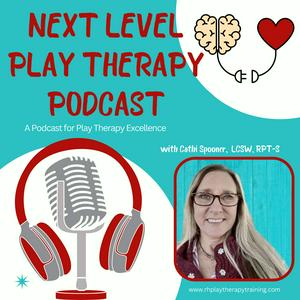
Next Level Play Therapy: A Podcast for Play Therapy Excellence
Cathi Spooner, LCSW, RPT-S
Latest episode
143 episodes
Play Therapy Not Working? 4 Ways to Get Unstuck
22/10/2026 | 47 mins.Send us Fan Mail
Is play therapy working for your client, or are you stuck in the "I don't know if this is helping" loop?
In this free weekly podcast episode for play therapists and child and adolescent therapists, you'll learn 4 practical ways to tell if play therapy is working and what to do when nothing seems to help.
You've tried the play therapy activity books, searched Pinterest for play therapy ideas, and used what you learned at your last play therapy training.
Your supervisor was supportive, but they don't practice play therapy. If you're worried you're failing your client, this podcast is for you.
In this episode you'll learn:
✅ How to revisit your case conceptualization and ground yourself in your play therapy model
✅ Why safety and therapeutic rapport come before insight, and how to check your expectations
✅ How to get useful feedback from parents, caregivers, and the child
✅ Why play therapy consultation helps you see what's happening in the playroom
For play therapists and child and adolescent therapists at any stage of their play therapy journey. Join my free webinar, How to Provide Play Therapy Without Second-Guessing Yourself, Even With Complex Cases.
We'll focus on building the confidence to trust your clinical decisions, even when a case gets complicated.
📅 Sunday, October 25, 2026 at 4:00 pm PT / 7:00 pm ET
🔗 Save your free spot here → https://www.rhplaytherapytraining.com/f/pta-webinar
Join my free Facebook Community Play and Expressive Arts Therapy Playground.
Check out my free resources for mental health professionals working with children, adolescents, and families who want to integrate play therapy and expressive arts into their clinical work.
I work with individuals and agencies to develop successful strategies and meet the treatment needs of your child and adolescent clients and their families using play therapy & expressive arts.
Contact me to schedule a free 30-minute video call if you're ready to level up your skillsFamily Play Therapy: 3 Signs a Parent Is Ready (and 3 Signs They're Not)
15/10/2026 | 48 mins.Send us Fan Mail
In family play therapy, the caregiver's readiness matters as much as the child's. Because the parent-child relationship is the vehicle for healing, a parent has to be emotionally and mentally prepared to enter their child's world without taking it over.
In this free weekly podcast, we break down how to assess parent readiness for family play therapy sessions, so you can decide when to bring a caregiver into the playroom and when more preparation is needed first.
You'll learn:
✔ 3 signs a parent IS ready for joint family play therapy: following the child's lead without correcting, showing curiosity about the child's inner world, and staying regulated during moments of distress
✔ 3 signs a parent is NOT ready yet: demanding quick fixes and immediate compliance, using the session to lecture or interrogate the child, and being too consumed by their own unresolved stress or trauma
✔ What to do when a parent isn't ready, including how parent consultation sessions and individual therapy referrals can build the caregiver's capacity to show up
✔ How to keep the door open to family play therapy without pushing caregivers before they can succeed.
Who this is for: Play therapists, child therapists, adolescent therapists, and mental health professionals who work with children and families and want more confidence in caregiver assessment, parent consultation, and family play therapy.
Key takeaway: A parent who isn't ready yet doesn't mean family play therapy is off the table. It usually means the work starts with the caregiver, so the family play therapy sessions are set up for real connection and healing.
Want to go deeper? If you're ready to build your skills in play therapy and learn how to involve caregivers in the healing process, explore Play Therapy Academy: https://www.rhplaytherapytraining.com/play-therapy-academy
Listen to the podcast, bring your questions and your toughest caregiver scenarios, and let us know in the comments: what signs do you look for when deciding if a parent is ready?
👍 Like, subscribe, and turn on notifications so you never miss an episode.
Join my free Facebook Community Play and Expressive Arts Therapy Playground.
Check out my free resources for mental health professionals working with children, adolescents, and families who want to integrate play therapy and expressive arts into their clinical work.
I work with individuals and agencies to develop successful strategies and meet the treatment needs of your child and adolescent clients and their families using play therapy & expressive arts.
Contact me to schedule a free 30-minute video call if you're ready to level up your skillsFamily Play Therapy: Why Treating Just the Child Limits Outcomes
08/10/2026 | 41 mins.Send us Fan Mail
If you're a play therapist or child therapist meeting with kids weekly while updating parents on the side — this episode is for you.
Individual play therapy is powerful. But when the family system stays the same, even the best playroom work has a ceiling.
In this free weekly podcast, we're exploring one of the most important clinical questions in play therapy: when does individual work hit its limits — and what changes when you bring the family into the room?
We cover:
Where individual-only play therapy runs out of room
When the family system stays unchanged, progress in the playroom has a ceiling — no matter how skilled you are.
What changes when the family is in the room
Observe relational patterns firsthand, coach attachment-focused parenting strategies in real time, and create change where the problem actually lives — in the parent-child relationship.
When family play therapy isn't the right fit
Family play therapy isn't always the right next step. We'll walk through the clinical situations where family play therapy sessions may not serve the child.
Why a strategic family play therapy framework matters
Inviting parents into the playroom isn't enough. A structured framework is what turns "everyone's in the room" into lasting change in outcomes.
Listen to the podcast and share with a colleague!
This episode connects directly to this month's Consultation Call theme: bringing caregivers into the room. Come with your questions and cases.
Join my free Facebook Community Play and Expressive Arts Therapy Playground.
Check out my free resources for mental health professionals working with children, adolescents, and families who want to integrate play therapy and expressive arts into their clinical work.
I work with individuals and agencies to develop successful strategies and meet the treatment needs of your child and adolescent clients and their families using play therapy & expressive arts.
Contact me to schedule a free 30-minute video call if you're ready to level up your skillsCongruence & Co-Regulation in Play Therapy
01/10/2026 | 45 mins.Send us Fan Mail
Congruence & Co-Regulation in Play Therapy: How Nervous System Attunement Heals Kids
What does it really mean to use "therapeutic use of self" in the playroom? In this podcast episode, we go beyond the buzzwords to explore how congruence and co-regulation actually help children build their own capacity for emotion regulation.
This is part three in our series on the nervous system in play therapy — and why oversimplifying this concept can get in the way of the deep, lasting healing our clients need.
In this podcast episode, we cover:
🔹 Congruence in the Playroom — What it really means to match your internal experience with what you express, and why "performing" calm or warmth isn't the same as being a regulated, authentic presence
🔹 The Coregulation Connection — How your nervous system state becomes the mechanism through which children learn their own emotions are safe, workable, and useful
🔹 Self-Awareness for Therapists — Why you have to be congruent with yourself before you can be congruent with a child, and how "resonance circuits" let your nervous system attune to theirs
🔹 Supporting Parents & Caregivers — Creating safety for caregivers so they see you as a true partner in their child's healing, and recognizing what activates your own insecurity or imposter syndrome in session
🔹 Therapist Self-Care — The "put your own oxygen mask on first" principle, and why your own therapy and a supportive play therapy community aren't optional extras — they're part of doing this work well
Ray, D. C., Jayne, K. M., & Stulmaker, H. L. (2014). A way of being in the playroom: Experience-expression congruence model (EECM). International Journal of Play Therapy, 23(1), 18–30.
Johnston, T. E., Gross, J. J., Chen, W., McEvoy, P., Becerra, R., & Preece, D. A. (2025). Emotion beliefs and emotion regulation strategy use. Personality and Individual Differences, 240, 113066.
#PlayTherapy #TherapistSelfCare #NervousSystemRegulation #Coregulation #ChildTherapy #EmotionRegulation #TherapeuticUseOfSelf #TraumaInformedCare #PlayTherapist #ChildDevelopment
Join my free Facebook Community Play and Expressive Arts Therapy Playground.
Check out my free resources for mental health professionals working with children, adolescents, and families who want to integrate play therapy and expressive arts into their clinical work.
I work with individuals and agencies to develop successful strategies and meet the treatment needs of your child and adolescent clients and their families using play therapy & expressive arts.
Contact me to schedule a free 30-minute video call if you're ready to level up your skillsWindow of Tolerance in Play Therapy: Why Kids "Bail" on Deep Play
23/09/2026 | 41 mins.Send us Fan Mail
You're 20 minutes into a play therapy session. The child is in it — deep in the sandtray, the story, the metaphor. And then, without warning, they bail. Silliness. A different toy. A total tonal 180.
If you've ever second-guessed yourself in that moment — wondered if you lost the thread, if they're avoiding, if the work "didn't land" — this episode is for you.
That shift isn't resistance. It isn't disengagement. It's regulation happening in real time.
A child's nervous system was never built to sustain 45 straight minutes in emotional intensity — and clinicians who miss this often misread the most important therapeutic moment in the room.
In this week's podcast for play therapists and child therapists, we're unpacking:
✅ Why the exit out of deep affect is a nervous-system-driven event, not a client "resisting the work"
✅ How to distinguish regulation-seeking behavior from true avoidance or disengagement in session
✅ What this means for pacing, containment, and how you structure session flow around a child's window of tolerance
✅ How to track these shifts clinically — and use them as data, not disruption
This is a working conversation for play therapists who want to sharpen their read on nervous system cues in the playroom and stop treating natural regulatory rhythm as a problem to manage.
This is also one small piece of what we go deeper on inside Play Therapy Elevation CIRCLE — my community for play therapists who want ongoing case consultation, clinical skill-building, and support that goes beyond a single play therapy training.
More on that soon — for now, come learn, bring your questions, and let's dig into the work together.
Join my free Facebook Community Play and Expressive Arts Therapy Playground.
Check out my free resources for mental health professionals working with children, adolescents, and families who want to integrate play therapy and expressive arts into their clinical work.
I work with individuals and agencies to develop successful strategies and meet the treatment needs of your child and adolescent clients and their families using play therapy & expressive arts.
Contact me to schedule a free 30-minute video call if you're ready to level up your skills
More Education podcasts









Trending Education podcasts


























About Next Level Play Therapy: A Podcast for Play Therapy Excellence
Join me on Next Level Play Therapy, a podcast for child and adolescent therapists seeking to elevate your play therapy services. Hosted by Cathi Spooner, LCSW, RPT-S, at Renewing Hearts Play Therapy Training. Each episode delves into the nuances of play therapy, exploring innovative techniques, evidence-based practices, and practical strategies for providing exceptional therapeutic experiences. These engaging discussions cover a wide range of topics, including building rapport with children, how to make sure you get great outcomes for clients, therapeutic toys and tools and strategies to use in sessions, addressing trauma and attachment issues, engaging parents, promoting emotional regulation, and nurturing resilience for children and their families.Whether you're an experienced therapist looking to refine your skills or a novice clinician venturing into the world of play therapy, the Next Level Play Therapy podcast equips you with the knowledge and insights to enhance your play therapy practice. With interviews featuring experts in play therapy, exploration of best practices, discussion of game-changing principles and strategies, this podcast equips you with the tools to unlock the amazing power of play therapy to transform the lives of children, adolescents, and families.Tune in to Next Level Play Therapy and take a journey towards becoming an exceptional play therapist as we navigate the next level strategies that lead to profound healing and growth for children and their families.
Podcast websiteListen to Next Level Play Therapy: A Podcast for Play Therapy Excellence, 6 Minute English and many other podcasts from around the world with the radio.net app
Get the free radio.net app
- Stations and podcasts to bookmark
- Stream via Wi-Fi or Bluetooth
- Supports Carplay & Android Auto
- Many other app features
Get the free radio.net app
- Stations and podcasts to bookmark
- Stream via Wi-Fi or Bluetooth
- Supports Carplay & Android Auto
- Many other app features

Next Level Play Therapy: A Podcast for Play Therapy Excellence
Scan code,
download the app,
start listening.
download the app,
start listening.
 New Zealand