
Listen to this podcast in the app for free: Download for free in the App Store
radio.net
Sleep timer
Save favourites
411 episodes
#306 'A Solution To Wealth Inequality', Chris Kelly Entrepreneur & Author
18/10/2026 | 1hWelcoming Chris Kelly, author of A Solution to Wealth Inequality and founder of AboveWealth.org, to Purposely Podcast.
Chris starts from a simple observation: the current debate about wealth inequality is not going anywhere. One side denies there is a problem, the other pushes for higher taxes, and the gap keeps growing. His book makes a different argument. If you want to solve this problem, you have to get wealthy people to want to solve it. That meanspersuasion, not a fight, and it is not about vilifying the wealthy.
Chris is not against tax, and he explains why. In his view, the current approach puts the cart before the horse, and taxreform becomes far easier once wealthy people have accepted that they do not need endless wealth. At the heart of the book is the idea of a number: thepoint at which more money stops making life better. Chris shares his own number, and why he sees it as a way to set limits without asking anyone to live like a monk.
His own path starts with an accounting degree and a very short stint in investment banking, which he left quickly butwhich taught him an attention to detail he still uses. He then spent years at Google, learning how online advertising works, before starting his own online advertising business and, in 2014, NextGen Leads. He grew up in a middle-classfamily where money was a concern, and wanted to become wealthy. The for-purpose world is new to him, and he describes learning about it quickly since writing thebook.
Mark pushes on the harder questions. Has philanthropy really been an inequality buster, and can giving sometimes do moreharm than good? Chris agrees these are real problems, and says his book focuses on the very top of the funnel: getting wealthy people to care in the first place. He wrote a short book by design, aimed at ordinary readers rather thanbillionaires, in the hope the conversation spreads until it reaches the people who can act. They also explore the role of ego and recognition in giving, and why Chris thinks the norm of giving in secret lets those who give nothing off thehook.
For fundraisers, there is plenty to take away. Chris describes what a successful entrepreneur looks for when asked togive: evidence of progress, data and a real sense of accomplishment, rather than mission statements and virtue signalling. Mark and Chris discuss venturephilanthropy and what it means to speak the language of the donor, and Chris shares his view on impact investing.
Chris is open about the pushback the bookhas received, including the response that it is naive to think rich people would ever give more. His answer is that culture keeps evolving, and that there is no reason endless wealth accumulation could not one day be something peoplelook back on and question. He closes with a message of hope: wealth inequality is a difficult problem, but it is not an impossible one.
Key Themes
· Why the current debate onwealth inequality is stuck
· Persuasion over force: gettingwealthy people to want to solve the problem
· Why Chris is not against tax,and why he thinks culture has to shift first
· What your number is, and whenmore money stops making life better
· Ego, recognition and why givingin secret may hold giving back
· What fundraisers can learn fromhow an entrepreneur wants to be asked to give
· Venture philanthropy, impactinvesting and speaking the donor's language
· Culture evolves: why endlesswealth accumulation may one day be questioned
This episode of Purposely is brought to you by Benevity and Trust Investments.#305 ‘We Have Everything Except Price’, Michelle Blau, General Manager at Fair Food
11/10/2026 | 56 mins.Welcoming Michelle Blau, General Manager at Fair Food, to Purposely Podcast.
Fair Food is a West Auckland food rescue charity that describes itself as the food bank to the food banks. It collects good, healthy food before it becomes waste and gets itto people who would otherwise go without, around 15 tonnes every week, all for free. That is roughly 5,000 loaves of bread, 4,000 meat packs and 40,000 pieces of produce passing through each week. Started 15 years ago by community groups as a social supermarket, it moved to supplying community organisations directly, so people in crisis can get their needs met in as few stops as possible.
Michelle makes a striking case. Aotearoa loses around 10% of the food it produces and exportsmost of the rest, yet she sees more hunger here than she saw working in places affected by conflict, drought and famine. The difference is that here, the cause is price. She talks about schools where children do not eat between Friday lunch and Monday breakfast, working families who now need food support, and how one unexpected bill can push a household to a food parcel.
We also get into the environmental side. Fair Food sits where hunger and climate meet, saving more than 2,000 tonnes of greenhouse gas emissions a year by keeping good kai out of landfill. Michelle explains why retailers are some of theirbest partners, the confusion between best before and use by dates, and the surprising things that come through the doors, from 26 pallets of oats to 60,000 almond croissants.
Then Michelle takes us back to Kentucky, where she was raised by a single mum who worked as a school social worker. She is open about a childhood shaped by hardship, and bythe neighbours, family and friends whose generosity meant poverty never limited her potential. A strong sense of justice led her to a fellowship through the Civil Rights Project at Harvard, then eight years in the trade union movement,the Peace Corps in Kazakhstan, and communications leadership in international development, before she and her family chose Aotearoa as home.
We talk about her leadership style, including holding corporate volunteers and elected leaders to Fair Food's values, and why she believes hunger is a solvableproblem in a country of five million people.
Michelle closes with three things we can all do: know your neighbours and notice who is doingit tough, give if you can, and take the time to understand why so many peopleare struggling by getting out into communities beyond your own.
• Fair Food's role as the food bank to the food banks
• Why hunger exists in a country that produces so muchfood
• Food insecurity among children and working families
• Where food rescue, hunger and climate meet
• Working with retailers and the truth about best beforedates
• Michelle's journey from Kentucky to Aotearoa
• Trade unions, collective action and internationaldevelopment
• Leading with curiosity and holding people to account
• Three practical ways to help turn the dial on hunger
Find out more about Fair Food: https://www.fairfood.org.nz
This episode of Purposely isbrought to you by Benevity and Trust Investments.#304 'You're All Fundraisers' Emily Trevail & Emily Murdoch Empower Fundraising
04/10/2026 | 1h 1 mins.Welcoming Emily Trevail and Emily Murdoch, the duo behind Empower Fundraising, to Purposely Podcast.
Empower Fundraising is a Christchurch-based consultancy helping charities make fundraising clear, achievable and built to last. It started with a podcast.
Emily and Emily launched Dear Donors to fill a gap they saw in the sector: plenty of polished campaign case studies, but not enough real stories from the people doing the work. A few months in, working together was going so well that they turned it into a business. Their clients now range across health, social services and sport, from national organisations to local Christchurch groups.
The problem they set out to solve will be familiar to many listeners. Organisations know they need to fundraise more strategically but lack the time, people or outside perspective to do it. Others hire their first fundraiser with no database, nostewardship history and an expectation that the new role will cover its own salary and then some within months. Empower offers a lower-risk step in between: strategy alongside hands-on delivery and mentoring, so the organisation can carry it forward itself. For smaller groups not ready for thatlevel of support, they run peer workshops in Christchurch and on Banks Peninsula.
We get into why fundraising is not sales. Sales is transactional, while fundraising connects people to impact they could not create on their own. But it is not begging either. The organisations doing it well think long term, know their donors as people rather than lists, and pick up the phone instead of sending another email. On face-to-face fundraising, the advice is to stay the course. A pool of regular givers is also the future pipeline for major gifts and bequests, and some of those donors give more each month than they pay for their streaming subscriptions.
We also revisit the fundraising pyramid, including a newer view that the top is widening while middle-income giving is being squeezed. The Emilys make the case for focusingon people already connected to your cause before chasing cold audiences, and Emily T shares how the British Heart Foundation built a major research fund by working closely with forward-thinking philanthropists and corporates.
Emily Trevail grew up in the UK, studied science at Bath and spent time on conservation work in the Scottish moorlands before volunteering in Nepal, helping rebuild schools after the 2015 earthquake. She cancelled herflights home to finish the school she had started. That experience set her direction, leading to roles at Shelterbox and the British Heart Foundation, where time in the bequest team showed her fundraising could be a real career.
Emily Murdoch was nicknamed “little mother” as a child for looking after the other kids. After a year in Ireland she moved to New Zealand, studied health science at the University of Canterbury and joined the Cancer Society in health promotion, where she ended up splitting her time with fundraising. A great manager, Jane Sheriff, showed her what the career could be. Later, at Ronald McDonald House,the work became too close to home as a parent of young children, and she moved into consulting.
The conversation closes with practical advice. Do not assume direct mail is dead. Capture good data. Use AI to help with analysis, but never to replace the human connection. Lean on the Fundraising Institute of Australasia and the widerfundraising community. And for board members, a simple challenge: give to your own charity, consider a bequest yourself, and keep the people you serve at thecentre of every decision.
Find out more about EmpowerFundraising: https://www.empowerfundraising.co.nz/about-us
This episode of Purposely isbrought to you by Benevity and Trust Investments.
Key ThemesSHORT 'Business, Travel and Climate' Darrell Wade Founder of Intrepid Travel
27/09/2026 | 6 mins.In this SHORT episode of Purposely, Intrepid Travelco-founder Darrell Wade joins us on why he sees everyone from staff to travellers as stakeholders in the business, why climate became impossible to look away from, and why corporate giving works best when it's good for thebusiness too.
Darrell traces it back to how Intrepid was built. Whatstarted as two shareholders quickly became a business where travellers, staff, suppliers, hoteliers and transport partners were all treated as stakeholders in the company's success. Once you see the business that way, he says, climatechange stops being someone else's problem – every stakeholder you care about is affected, and the ripple goes further still. That's not just a responsibility, in his view, but an opportunity: to start conversations, find solutions andactually change behaviour, even if no single business can solve it alone.
He's wary of framing corporate giving as an obligationcompanies should feel guilty for not meeting. Instead, he argues structured philanthropy can genuinely benefit a business, and points to three reasons it works at Intrepid. It's aligned with the company's mission and values, sogiving back to destinations is simply logical. It deepens the traveller experience – pairing a trip with a local NGO working on an issue like human rights or the environment, matching donations dollar for dollar, and sending travellershome understanding the destination, not just its beaches. And it engages staff, many of whom fundraise, volunteer or give through payroll via the Intrepid Foundation – something Darrell believes makes them more engaged employees whostay longer.
Key themes
Seeing staff, travellers and suppliers as stakeholders inyour success
Climate change as a responsibility that ripples out to everystakeholder
Moving past guilt-based framing toward philanthropy thatbenefits the business
Matching traveller donations to local NGOs to deepen thetravel experience
Staff engagement through the Intrepid Foundation -fundraising, volunteering, payroll giving
Corporate giving as a loyalty and retention tool, not justgenerosity
This episode of Purposely is brought to you by Benevity and Trust Investment.#303 'Representing & Enabling Charity Leaders' Jane Ide, CEO at ACEVO
20/09/2026 | 1h 9 mins.MORE
More Business podcasts








Trending Business podcasts





















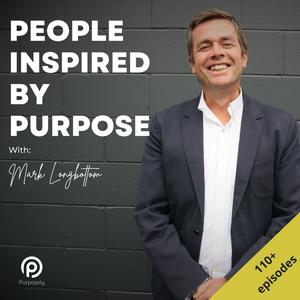
About People Inspired By Purpose - Purposely Podcast
Speaking with people of purpose, those making the world a better place
People Inspired By Purpose - Purposely Podcast amplifies the stories of inspirational people from across the Globe, philanthropy leaders, founders and CEO's of nonprofits, charities, for purpose business leaders as well social entrepreneurs. They are often inspired by their own experiences.
Join the Purposely team www.purposelypodcast.com
Podcast websiteListen to People Inspired By Purpose - Purposely Podcast, A Bit of Optimism and many other podcasts from around the world with the radio.net app
Get the free radio.net app
- Stations and podcasts to bookmark
- Stream via Wi-Fi or Bluetooth
- Supports Carplay & Android Auto
- Many other app features
Get the free radio.net app
- Stations and podcasts to bookmark
- Stream via Wi-Fi or Bluetooth
- Supports Carplay & Android Auto
- Many other app features

People Inspired By Purpose - Purposely Podcast
Scan code,
download the app,
start listening.
download the app,
start listening.
 New Zealand
