

Listen to this podcast in the app for free: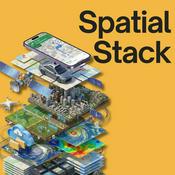 Download for free in the App Store
radio.net
Sleep timer
Save favourites
90 episodes
Thinking Spatially for a Living: Chris Tucker on 175 Years of the American Geographical Society
08/09/2026 | 47 mins.In this episode of the Spatial Stack, Matt sits down with Dr. Chris Tucker, chairman of the American Geographical Society, in the year the AGS turns 175.
Chris makes the case that spatial thinking is foundational literacy, on the level of language or math, and that the 4.5 million people who have taken AP Human Geography are already practicing it every day in jobs that never mention geography. He shares how a single question from a CIA veteran, about why we cannot draw a bounding box on a map and pull in everything known about that place at that moment, set the direction for almost thirty years of his career.
The conversation also covers what has changed about getting into this work. The advanced degree, the expensive workstation, and the expensive software used to be the price of entry. Free tools and YouTube replaced all three.
Chris then takes on a challenge: name five careers that do not sound geographic but where spatial skills give you a real edge. Surveying, the CAD and built environment world, aviation, marine navigation, and conservation all make the list, along with a case for why geography works as both a horizontal and a vertical.
We also get into the AGS itself, from the Fliers' and Explorers' Globe signed by Amelia Earhart, Sir Edmund Hillary, and Neil Armstrong, to the geographers at 156th and Broadway who worked on the inquiry behind the Treaty of Versailles.
If you have ever struggled to explain what you actually do for a living, this conversation gives you better language for it.
Connect with Chris Tucker and the AGS:
LinkedIn: https://www.linkedin.com/in/christopher-tucker-5595689/
American Geographical Society: https://www.americangeo.org
Email: tucker@americangeo.org
LEARN MORE
AGS 175th anniversary campaign: https://www.americangeo.org
The Fliers' and Explorers' Globe: https://www.americangeo.org/globe
Geography 2050 (Africa: Shaping the Future): https://www.geography2050.org
Teen Maptivist: https://teenmaptivists.org
CHAPTERS:
00:00:00 – Welcome and Chris Tucker's Background
00:01:21 – 4.5 Million AP Human Geography Students
00:04:48 – Spatial Thinking as Foundational Literacy
00:09:08 – 175 Years of the American Geographical Society
00:12:03 – The Fliers' and Explorers' Globe
00:15:05 – The AGS and the Treaty of Versailles
00:18:02 – The 175th Anniversary Campaign
00:21:49 – How Matt and Chris Found Geography
00:24:59 – Free Tools and Getting Back Into the Work
00:27:07 – Advocating for Geography in Schools
00:30:55 – Geography as Horizontal and Vertical
00:35:01 – Five Careers Where Spatial Gives You an Edge
00:40:34 – Getting Involved with AGS and Geography 2050
---
📊 FREE: The Modern GIS Skill Map
The 5 skills that actually matter in modern GIS (and what you can stop learning). Based on a survey of 1,400+ geospatial professionals.
➡ Get the free training + PDF guide: https://forrest.nyc/go/training/
📰 Daily modern GIS insights: https://forrest.nyc
CONNECT WITH ME
📸 Instagram: https://www.instagram.com/matt_forrest/
💼 LinkedIn: https://www.linkedin.com/in/mbforr/
📧 Newsletter: https://forrest.nyc
🌐 Website: https://forrest.nycMapping the Invisible: Soil Fungi, Satellites, and the Largest Network on Earth with Justin Stewart
26/08/2026 | 38 mins.What does it take to map something you have never seen?
In this episode, Matt Forrest sits down with Justin Stewart, quantitative ecologist at SPUN, the Society for the Protection of Underground Networks, to unpack how his team built the first global map of arbuscular mycorrhizal fungi, the soil organisms living in symbiosis with most plants on Earth.
Justin walks through the full pipeline, from robotic microscopy of threads two and a half microns wide up to a planetary prediction at one square kilometer resolution. The team assembled 16,000 soil samples from more than 300 studies across 11 languages, trained a random forest on 34 satellite-derived layers in Google Earth Engine, and
summed the result: roughly 110 quadrillion kilometers of fungal thread, about 300 megatons of carbon, six times the biomass of every human alive.
The findings were not what anyone expected. The densest networks are under grasslands, not forests. Croplands run about 50 percent sparser. And 90 percent of the biodiversity hotspots for these fungi sit outside any protected area.
In this episode, we cover:
- Why mapping a symbiosis is harder than mapping an organism
- Robotic imaging in the Amolf biophysics lab, and tracking half a million nodes at once
- Building a global database from literature in 11 languages
- Random forest niche modeling and uncertainty analysis in Google Earth Engine
- The effective radius algorithm that turns network length into biomass
- Why grasslands, flooded wetlands, and the Tibetan plateau light up on the map
- Tilling, fertilizer, and how a 450 million year old symbiosis gets broken
- Rights of nature, eDNA, and why predictive maps are not yet admissible evidence
LINKS:
Justin Stewart
SPUN profile: https://www.spun.earth/team-members/justin-stewart
LinkedIn: https://www.linkedin.com/in/justin-stewart-70512645/
Google Scholar: https://scholar.google.com/citations?hl=en&user=1aqTJIUAAAAJ
SPUN
Website: https://www.spun.earth
Underground Atlas: https://a-hidden-infrastructure.spun.earth/story/a-hidden-infrastructure
LEARN MORE
The paper: Science, June 11, 2026. DOI 10.1126/science.adu4373
Mycorrhizal Biodiversity Map: https://a-hidden-infrastructure.spun.earth/story/a-hidden-infrastructure
CHAPTERS:
00:00:00 – The largest living network on Earth
00:02:15 – Welcome and intro
00:03:38 – What the map shows: a partnership, not an organism
00:05:48 – Robots, petri dishes, and carbon moving at 400 kilometers an hour
00:07:47 – The question that started it: how much is out there?
00:09:25 – 110 quadrillion kilometers and six times human biomass
00:11:15 – What a quantitative ecologist actually does
00:13:53 – Trade, lipids, and 30 percent of a plant's nitrogen
00:16:31 – What people get wrong about soil
00:18:27 – The pipeline: 34 satellite layers, random forest, Earth Engine
00:21:02 – From length to weight: effective radius and the robot named Prince
00:25:41 – Croplands and a broken 450 million year symbiosis
00:31:40 – Rights of nature and getting predictions accepted as evidence
00:37:10 – Where to find SPUN and Justin
📊 FREE: The Modern GIS Skill Map
The 5 skills that actually matter in modern GIS (and what you can stop learning). Based on a survey of 1,400+ geospatial professionals.
➡ Get the free training + PDF guide: https://forrest.nyc/go/training/
📰 Daily modern GIS insights: https://forrest.nyc
CONNECT WITH ME
📸 Instagram: https://www.instagram.com/matt_forrest/
💼 LinkedIn: https://www.linkedin.com/in/mbforr/
📧 Newsletter: https://forrest.nyc
🌐 Website: https://forrest.nycBeyond the Blue Dot: AI & LLM Navigation with Zephr's Sean Gorman and Pramukta Rao
16/07/2026 | 42 mins.What does it actually take for an AI to navigate you through the real world, without a screen and without a camera running the whole time?
In this episode of the Spatial Stack, Matt Forrest sits down with Sean Gorman and Pramukta Rao, the co-founders of Zephr, to unpack how they ground large language models in location. Sean and Pramukta spent twenty years building startups together, from GeoIQ to Snap's visual positioning work, and at Zephr they walked away from the camera and went back to the sensors already in your phone.
They get into why the blue dot on a map breaks down the moment you stop looking at a screen, why language models are bad at spatial reasoning like left, right, and across the street, and how they fix it by doing the geometry first and handing the model clean language. Instead of training ever-bigger foundation models, they push a small model and well-structured data down to the edge so the conversation stays fast.
In this episode, we cover:
- Why they left visual positioning and AR cameras behind after Snap
- Cooperative positioning: getting survey-grade accuracy out of commodity phones
- GNSS and the urban canyon problem (3 meters to 50 meters and back)
- Beyond the blue dot: building a first-person, egocentric experience
- Why LLMs struggle with geometry, and what context engineering solves
- Small models at the edge vs giant foundation models
- Overture Maps, GERS IDs, and conflating POIs with imagery to "agree on reality"
- The grounding service: MCP, REST, and Opus or Gemma on device
- Conversations about place as a new geospatial primitive
Whether you build with spatial data, work on AI navigation, or just want to see where location and LLMs are heading, this conversation is your field guide.
Connect with Zephr:
Website: https://zephr.xyz
Sean Gorman (LinkedIn): https://www.linkedin.com/in/sean-gorman-93a79
Pramukta Rao (LinkedIn): https://www.linkedin.com/in/pramukta/
Zephr (LinkedIn): https://www.linkedin.com/company/zephr-xyz
00:00:00 – Intro and twenty years of startups together
00:04:05 – Why they walked away from cameras and AR at Snap
00:04:54 – Commodity sensors and cooperative positioning
00:07:15 – GNSS 101 and the urban canyon problem
00:10:56 – Beyond the blue dot: an egocentric experience
00:13:37 – Why LLMs are bad at left, right, and across the street
00:18:19 – Context engineering and the retrieval problem
00:22:03 – Small models at the edge vs giant foundation models
00:30:09 – Collective memory: OpenStreetMap, Mapillary, Overture
00:32:08 – Conflating POIs with imagery to agree on reality
00:35:36 – The grounding service: MCP, REST, Opus or Gemma on device
00:38:37 – What's next: conversations as a new geospatial primitive
00:42:22 – Where to find Zephr
📊 FREE: The Modern GIS Skill Map
The 5 skills that actually matter in modern GIS (and what you can stop learning). Based on a survey of 1,400+ geospatial professionals.
➡ Get the free training + PDF guide: https://forrest.nyc/go/training/
🚀 Join The Spatial Lab:
Stop guessing at your career path. Get direct mentorship, advanced training, and a roadmap to these high-value roles inside The Spatial Lab.
👉 https://forrest.nyc/spatial-lab/
📰 Daily modern GIS insights: https://forrest.nyc
CONNECT WITH ME
📸 Instagram: https://www.instagram.com/matt_forrest/
💼 LinkedIn: https://www.linkedin.com/in/mbforr/
📧 Newsletter: https://forrest.nyc
🌐 Website: https://forrest.nycWhy the GIS Title Is Shrinking but Spatial Work Is Growing
14/07/2026 | 16 mins.In this episode of the Spatial Stack, Matt sits down solo to work through a fight that broke out across Reddit and LinkedIn last week: is GIS dying, or is it just changing its name?
It started with a GIS manager who argued the field is alive, pointing to a friend who landed a $200,000 job building autonomous systems, a role where GIS never appeared in the title or the description. The comments pushed back. If the keyword for our whole profession barely returns jobs anymore, is the field really growing?
Matt's answer is that both sides are right. The work of spatial is expanding into data engineering, software, and product roles. The GIS title is contracting at the same time. It's one trend seen from two directions, the same way geology departments quietly became geoscience without the work ever changing.
He makes the case that the title was never the skill. Spatial intuition is, and it's the thing that transfers into higher-paying roles that don't carry the GIS label. Then he closes with a challenge: describe who you are and what you do without using the words GIS, spatial, or geospatial.
Whether you're job hunting, stuck in the technician trap, or an employer who wants this skill set but doesn't know what to call it, this conversation is about how we position the work going forward.
---
📊 FREE: The Modern GIS Skill Map
The 5 skills that actually matter in modern GIS (and what you can stop learning). Based on a survey of 1,400+ geospatial professionals.
➡ Get the free training + PDF guide: https://forrest.nyc/go/training/
CHAPTERS:
00:00:00 – The Reddit post that started it
00:01:00 – Two views: the work is growing vs. the title is shrinking
00:02:34 – Why "stay positive" doesn't pay the rent
00:03:33 – Spatial is special: what actually transfers
00:04:53 – The geology-to-geoscience analogy
00:05:54 – The title of GIS was never the skill
00:07:09 – The technician trap and where the salaries moved
00:08:18 – Listener comments: spatial judgment, the map as interface
00:10:32 – What to do now: SQL, Python, and cloud-native beyond the toolbox
00:11:51 – Building a portfolio on LinkedIn
00:13:22 – The Spatial Intuition Challenge
00:15:32 – Put your face on it: make it a video
CONNECT WITH ME
📸 Instagram: https://www.instagram.com/matt_forrest/
💼 LinkedIn: https://www.linkedin.com/in/mbforr/
📧 Newsletter: https://forrest.nyc
🌐 Website: https://forrest.nycAI, Embeddings, and the Future of Location Data with Dataplor's Ryan Urabe
17/06/2026 | 49 mins.What does it actually take to make AI useful on location data?
In this episode, Matt Forrest sits down with Ryan Urabe, co-founder and CTO of Dataplor, to unpack how AI, embeddings, and agents are changing the way we work with points of interest and places data.
Ryan explains why general-purpose models already understand spatial concepts but still struggle to execute them, and why the real unlock is the harness around the model, not a geospatial-specific model. He walks through Dataplor's data-quality philosophy, the category problem (why "supermarket" and "grocery store" have zero string similarity but near-zero conceptual distance), and how embeddings let them measure conceptual distance across 10^9 places and even across languages.
Whether you build with spatial data, lead a data team adopting AI, or you are trying to figure out what embeddings actually do, this conversation maps out what is working today and what is still forming.
In this episode, we cover:
- Why AI is an accelerant for data quality, not a replacement for it
- Treating AI like a capable employee on their first day
- Where general models fall short on spatial problems
- DuckDB as the Swiss Army knife for orchestrating spatial data
- The category problem and conceptual vs. semantic distance
- How embeddings map 7-Eleven in Tokyo and Tennessee to the same concept
- A vision for agentic AI built natively for geospatial
- The "end of the scarcity of intelligence" framing for where this is all heading
Connect with Ryan:
LinkedIn: https://www.linkedin.com/in/rurabe/
Website: https://www.dataplor.com
Email: ryan@dataplor.com
LEARN MORE
Dataplor's agentic SaaS product is launching this summer. To start your complimentary trial, contact: freetrial@dataplor.com
📊 FREE: The Modern GIS Skill Map
The 5 skills that actually matter in modern GIS (and what you can stop learning). Based on a survey of 1,400+ geospatial professionals.
➡ Get the free training + PDF guide: https://forrest.nyc/go/training/
00:00:00 – Cold open
00:01:01 – Welcome and Ryan's background
00:03:44 – Why AI still struggles with location
00:05:13 – Bringing Dataplor's data into AI, product and team
00:08:36 – How technical teams are adopting AI
00:10:10 – Treating AI like a capable new employee
00:12:20 – Where general models fall short on spatial
00:16:44 – DuckDB and opinionated workflows
00:18:14 – Data quality as the whole game
00:20:58 – The category problem: supermarket vs. grocery store
00:27:53 – Embeddings and conceptual space, with a 3D walkthrough
00:38:22 – A vision for agentic AI in geospatial
00:43:37 – The end of the scarcity of intelligence
00:47:25 – Where to find Ryan and Dataplor
📰 Daily modern GIS insights: https://forrest.nyc
CONNECT WITH ME
📸 Instagram: https://www.instagram.com/matt_forrest/
💼 LinkedIn: https://www.linkedin.com/in/mbforr/
📧 Newsletter: https://forrest.nyc
🌐 Website: https://forrest.nyc
More Business podcasts
 Prof G MarketsBusiness, Investing
 Cheques and BalancesBusiness
 The Real Eisman PlaybookBusiness, Investing
 The CurveBusiness, Investing
 The Diary Of A CEO with Steven BartlettBusiness, Education, Society & Culture
 The Happy Saver Podcast - Personal Finance in New ZealandBusiness, Investing
 The Property Academy PodcastBusiness, Investing
 Making CentsBusiness, Education, Investing, Tutorials
 A Bit of OptimismBusiness, Careers, Education, Self-Improvement
 The Ramsey ShowBusiness, Education, Investing, Self-Improvement
Trending Business podcasts
 Financial FeministBusiness, Education, Tutorials
 The Prosperity ProjectBusiness
 NZ Everyday InvestorBusiness, Business News, Education, Investing, News, Self-Improvement
 Tom Bilyeu's Impact TheoryBusiness, News, News Commentary, Philosophy, Society & Culture
 Craig Groeschel Leadership PodcastBusiness, Christianity, Entrepreneurship, Management, Religion & Spirituality
 Pretty BusyArts, Business, Fashion & Beauty
 It's No SecretBusiness, Education, Investing, Self-Improvement
 Habits of High Performers Podcast with James LaughlinBusiness, Entrepreneurship, Management
 ChooseFI | Financial Independence PodcastBusiness, Careers, Investing
 The Diary Of A CEO with Steven BartlettBusiness, Entrepreneurship
 Aussie FIRE | Financial Independence Retire EarlyBusiness, Investing
 REXBusiness, Business News, Home & Garden, Leisure, News
 Big Business with Brittney SaundersBusiness, Entrepreneurship
 吳淡如人生實用商學院Arts, Business
 限界突破ライフハックBusiness, Careers
 The Pomp PodcastBusiness, Investing
 Australian Investors PodcastBusiness
 High Performance with Josh Phegan and Alexander PhillipsBusiness, Technology
 Super CreativeBusiness, Entrepreneurship, Marketing
 Stretton UnfilteredBusiness
 Economy WatchBusiness, Business News, Investing, News
 The Knowledge ProjectBusiness, Education, Entrepreneurship, Investing, Self-Improvement, Society & Culture, Technology
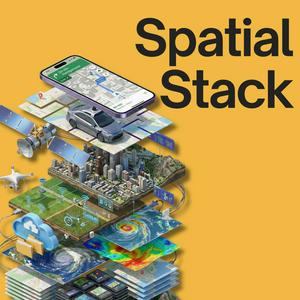
About Spatial Stack with Matt Forrest
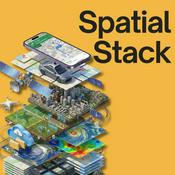
Welcome to The Spatial Stack, where modern geospatial technology takes center stage. Our episodes feature interviews with leading experts, insightful discussions on the integration of AI and big data in spatial tech, and case studies on groundbreaking projects worldwide. Tune in to stay ahead in the rapidly evolving world of geospatial technology!
Podcast websiteListen to Spatial Stack with Matt Forrest, Prof G Markets and many other podcasts from around the world with the radio.net app
Get the free radio.net app
- Stations and podcasts to bookmark
- Stream via Wi-Fi or Bluetooth
- Supports Carplay & Android Auto
- Many other app features
Get the free radio.net app
- Stations and podcasts to bookmark
- Stream via Wi-Fi or Bluetooth
- Supports Carplay & Android Auto
- Many other app features

Spatial Stack with Matt Forrest
Scan code,
download the app,
start listening.
download the app,
start listening.
 New Zealand