PodcastsBusinessTherapists Rising Podcast

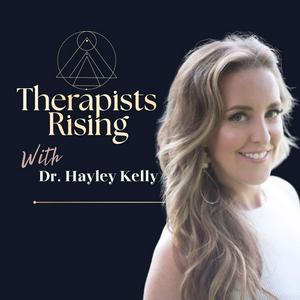
Therapists Rising Podcast

Dr. Hayley Kelly
Therapists Rising Podcast
Latest episode

248 episodes

  • Therapists Rising Podcast

    From 7 Enrolments to Six Figures: How a Vestibular Physio Built an Online Program from Scratch

    05/03/2026 | 1h 15 mins.
    Picture a physio who launched her first online program with seven people enrolled. Six of whom she already knew personally. A sales page with no checkout connected. A program she hadn't finished recording yet.
    That was Vicky Stewart's launch one.
    Her most recent launch just crossed six figures.
    Today's guest, Dr. Vicky Stewart, is a vestibular physiotherapist who spent years watching patients with chronic dizziness fall through the cracks of traditional healthcare. She built The Shift, a 10-week online group program, to reach the people her clinical hours never could. She didn't have a following, a marketing budget, or a polished funnel when she started. She had a clear problem, a willingness to start messy, and the psychological capacity to treat early results as data rather than verdicts.
    This conversation is about what it actually looks like to build something over time, across seven launches, when the numbers are small at first and the fear is loud throughout.
    HERE ARE THE 3 KEY TAKEAWAYS:
    1️⃣ Your First Launch Is Not a Verdict, It's a Data Point — Seven people enrolled, six of whom Vicky already knew. Most people would have interpreted that as proof the idea didn't work. Vicky interpreted it as proof of concept. If one person paid, others will too. That reframe, from verdict to data, is one of the most reliable predictors of whether a therapist keeps going or quietly shelves the whole thing.
    2️⃣ You Don't Need a Large Following to Fill a Program — Vicky built her early launches almost entirely through existing professional relationships, referrer networks, and speaking opportunities, including a keynote in Dubai, before she had any meaningful social media presence. The skills therapists already use to build referral networks in private practice transfer directly. You probably already have more reach than you think.
    3️⃣ Messy and Started Beats Perfect and Waiting, Every Single Time — Vicky launched her beta without a checkout page connected to her sales page. She was already in open cart week when she found out. She sorted it in real time, ran the program anyway, and built everything else from there. Seven launches later, she has a waitlist, a team member supporting her community, and her first six-figure result. None of that happens if she waits until she feels ready.
    YOU'LL ALSO HEAR:
    How Vicky's pricing evolved from $330 for her beta to $1,697 per enrolment, and what had to shift internally to make each price increase feel possible
    Why researching competitors actually made things harder, not easier, and what she decided to do instead
    What it looked like practically to build this while working four days a week with three kids at home
    The moment her husband took a redundancy and what that did to her approach going into her most recent launch
    Why she decided early on she was never going to dance on Instagram, and how she filled her program anyway
    The listener question that stopped me in my tracks: "If you'd waited until you felt completely ready, where would you be today?"
    What Vicky says is the one breadcrumb she'd leave anyone who is still sitting on their idea
    RESOURCES:
    Connect with Vicky Stewart:
    Website: dizzyresolve.com
    Instagram: @dizzyresolve
    YouTube: @dizzyresolve
    Therapists Rising Programs:
    Caseload to Course Bootcamp: therapistsrising.com/bootcamp
    The Incubator: therapistsrising.com/incubator
    Instagram: @dr.hayleykelly
    SUBSCRIBE & REVIEW: If you enjoyed this episode, please subscribe and leave a review on Apple Podcasts. Your reviews help other therapists find conversations that give them permission to start before they're ready.
  • Therapists Rising Podcast

    From Perinatal Psych to Florist: When Your "Side Idea" Becomes the One That Works with Carla Anderson

    19/02/2026 | 55 mins.
    Picture a psychologist with 25 years in perinatal mental health — burned out from holding space for loss and trauma for decades.
    She needed something that was just hers. No clinical notes, no disclosure risk, no empathy fatigue. She chose floristry.
    And then her perinatal colleagues found out. And asked her to bring it to conferences. Then to teach it online. Now she has a waiting list of clinicians who want in.
    Today's guest, Carla Anderson, is a clinical psychologist who built two very different streams inside one business — perinatal mental health training for healthcare clinicians, and floristry-based therapeutic programs for clinician self-care. She didn't plan it. She followed her gut. And the market responded in ways she didn't see coming.
    HERE ARE THE 3 KEY TAKEAWAYS:
    1️⃣ Your Burnout Might Be Pointing You Somewhere — Carla needed something that shut her brain off after 25 years of perinatal loss and trauma work. Floristry did that. What started as self-preservation became the foundation of an entirely new program. Your burnout isn't a problem to solve. Sometimes it's a signpost.
    2️⃣ The "Weird" Idea Is Often the One That Takes Off — Carla kept reverting to her safe perinatal niche because floristry felt too new, too hard to package. Then perinatal conferences kept asking her to run the floristry sessions. Fellow Incubator members asked when they could join. The market told her what it wanted — she just had to listen long enough to believe it.
    3️⃣ You Don't Have to Explain Everything Upfront — People come to Carla's workshops thinking it's about flower arranging. By the end they're doing deep reflective work through metaphor. You don't need a ten-paragraph explanation. You just need to get people in the room. The experience does the convincing.
    YOU'LL ALSO HEAR:
    Why healthcare clinicians (GPs, midwives, doctors) are desperately under-resourced when it comes to psychological support skills — and how Carla fills that gap
    What therapeutic horticulture actually is and the science behind why nature-based practices work
    How she structured her first beta launch (including the Valentine's Day flowers disaster that became an accidental metaphor)
    The internal flip-flopping between the safe niche and the exciting one — and how she finally stopped reverting
    What it looks like to let market feedback build your confidence instead of waiting for certainty first
    Why everything is figureoutable — including how to teach flower arranging online
    RESOURCES: Connect with Carla Anderson:
    Website: www.carlaandersoncliniciantraining.com
    Facebook & Instagram: @carlaandersoncliniciantraining
    LinkedIn: Carla Anderson
    Therapists Rising Programs:
    Caseload to Course Bootcamp: https://therapistsrising.com/bootcamp
    The Incubator: therapistsrising.com/incubator
    Instagram: @dr.hayleykelly
    SUBSCRIBE & REVIEW: If this episode made you look at your "just for me" hobby differently, subscribe and leave a review on Apple Podcasts. Your reviews help other therapists find conversations that give them permission to build something unexpected.
    You don't have to abandon what you're good at to build something new. You don't have to have it all figured out before you start. And you definitely don't have to ignore the thing that lights you up just because it doesn't fit the obvious mould.
    What if the thing you thought was just for you is exactly what other clinicians need? What opens up when you stop treating your own joy as a liability?
  • Therapists Rising Podcast

    Corporations Are Paying Psychologists to Teach Play - Here's Why It's Working

    11/02/2026 | 1h 4 mins.
    Picture a corporate wellness landscape where companies are tired of boring PowerPoint workshops but also can't justify wine tastings when burnout is a WHS compliance issue.
    There's a gap there. A big one.
    And what if you could fill it?
    Today's guest, Dr. Mitzi Liddle, is doing exactly that. She's teaching corporations about play and pleasure - yes, you read that right - as nervous system regulation tools. Not fluff. Not entertainment. Neuroscience-backed performance enhancement.
    And teams are actually booking it.
    HERE ARE THE 3 KEY TAKEAWAYS:
    1️⃣ Play Isn't Childish—It's a Nervous System Tool – When Mitzi started noticing corporate teams responded better to movement, music, and laughter than traditional lecture-style workshops, she followed that thread. Play and pleasure aren't frivolous—they're pathways to regulate your nervous system out of chronic stress and burnout. They bring you into your window of tolerance where creativity, energy, and clear thinking actually live.
    2️⃣ There's a Gap in Corporate Wellness (And You Can Fill It) – Organizations don't want boring PowerPoint workshops. But they also don't want wine tastings that waste time. They want something engaging AND evidence-based. Something that addresses real burnout while meeting psychological safety requirements. If you can position experiential work with neuroscience backing, you've found the sweet spot.
    3️⃣ Diversification Doesn't Mean Starting Over – Mitzi's been a psychologist for 20+ years. She didn't abandon her expertise—she expanded it. Corporate playshops for teams. Group programs for individual women. Both use the same foundation (play, pleasure, nervous system regulation) but serve different audiences. You don't need a brand new skill set. You need strategic positioning.
    YOU'LL ALSO HEAR:
    Why "playshops" get better engagement than traditional burnout prevention workshops
    How to position play and pleasure so corporations take it seriously (and pay for it)
    The neuroscience behind why these "soft" concepts actually work as performance tools
    What changes when you follow your energy instead of grinding through what you think you "should" do
    How Mitzi created her beta program fast—and what supported that momentum
    Why dabbling and experimenting is actually the path (not a failure to commit)
    The one piece of advice for therapists who want something different but feel stuck
    RESOURCES:
    Connect with Dr. Mitzi Liddle:
    Website: www.drmitziliddle.com.au
    Instagram: @drmitziliddle
    Therapists Rising Programs:
    The Incubator: therapistsrising.com/incubator
    The Collective Mastermind: therapistsrising.com/collective
    Instagram: @dr.hayleykelly
    SUBSCRIBE & REVIEW:
    If this episode made you rethink what's possible for your practice, subscribe and review on Apple Podcasts. Your reviews help other therapists discover conversations that challenge the status quo and open up new possibilities.
    You don't have to choose between engaging work and credible work. Between joy and professionalism. Between staying small and burning out.
    What if the thing that lights YOU up is exactly what your ideal clients need? What opens up when you give yourself permission to follow that?
  • Therapists Rising Podcast

    Stop Hunting for Ideas: The One Question That Actually Creates Clarity

    04/02/2026 | 18 mins.
    You've got the notebook. The voice memos. The Google Doc titled "possible program ideas" you haven't opened in weeks. You're not short on ideas. You're drowning in reasonable options.
    And somehow that feels worse than having no ideas at all.
    Because when you're stuck with multiple good directions and still can't get traction, it starts to feel like a you problem. Like you're overthinking it. Not ready. Not disciplined enough.

    Here's what you need to hear: You're not failing at this. You're misoriented. You're trying to choose before you're positioned to see clearly. And the question you're asking yourself is keeping you stuck.
    HERE ARE THE 3 KEY TAKEAWAYS:
    1️⃣ This Isn't Confusion - It's Misorientation – Your brain is doing exactly what it was trained to do: analyse before acting. But when there are multiple good options, analysis mode creates paralysis. Your nervous system reads commitment without clarity as threat, so you stay stuck in research mode. This isn't a motivation problem. It's a starting-point problem.
    2️⃣ You're Asking the Wrong Question – "What program should I create?" forces comparison, activates imposter syndrome, and assumes you need something novel. The better question: "What problem am I already solving repeatedly, whether I intend to or not?" This shifts you from ideation to pattern recognition, from theoretical planning to lived experience. Most therapists don't need a new idea - they need better visibility on work they're already doing.
    3️⃣ Depth Creates Blind Spots – If people keep bringing you the same problem without you marketing for it, that's data. But experienced therapists dismiss what feels familiar, obvious, or "too simple." The more expertise you have, the more invisible your skill becomes to you. You're not underestimating the work - you're underestimating yourself.
    YOU'LL ALSO HEAR:
    Why therapists trained to assess before acting get stuck when building programs
    The nervous system response that keeps you in "gathering information" mode
    How to recognize when you're dismissing your most obvious starting point
    Why confusion is often a sign of depth, not failure
    The one question that creates grounded momentum instead of endless scanning
    Why orientation matters more than urgency when building sustainable practices
    RESOURCES:
    Therapists Rising Programs:
    The Incubator: therapistsrising.com/incubator
    Instagram: @dr.hayleykelly
    SUBSCRIBE & REVIEW:
    If this episode reduced the frantic energy you've been carrying, subscribe and review on Apple Podcasts. Your reviews help other therapists find conversations that actually shift how they're thinking.
    Clarity doesn't come from choosing the best idea. It comes from standing in the right place to see what's actually there.
    You're not behind. You're just facing the wrong direction. What shifts when you ask a better question?
  • Therapists Rising Podcast

    Why Everything Just Changed for Therapists: Money, Burnout, and Technology Collide

    28/01/2026 | 47 mins.
    For 12 months, I've been warning you the traditional therapy model is breaking down. Some of you have been listening. But many have been waiting for clarity.
    Here's what you need to hear: The last eight weeks changed everything.
    November 2025: Australia restricted Better Access referrals. December 2025: Fifth consecutive year of US Medicare cuts. January 30, 2026: US telehealth flexibilities expire.
    While those policy changes hit, something else shifted: 1 in 8 young people now use AI chatbots for mental health advice. Corporate wellness budgets hit $53 billion with contracts being signed NOW for 2026-2027.
    This isn't slow erosion. This is all five forces reaching tipping points simultaneously. This is the convergence.
    HERE ARE THE 3 KEY TAKEAWAYS:
    1️⃣ Three Realities Converging Right Now – The math isn't working (Medicare cuts, Better Access restrictions, client affordability crisis). Your colleagues are planning exits (52% US therapists burned out, 29% considering leaving). Future clients expect something different (70% Gen Z prefers virtual, 1 in 8 young people use AI chatbots).
    2️⃣ Every Disrupted Profession Made This Mistake – Accounting got automated. Physical therapy faced reimbursement cuts. Personal training went digital. Each time, practitioners said "our profession is different." They were wrong. Pattern: professions split into commodity/premium tiers, early movers capture premium positioning, late movers compete on price.
    3️⃣ The Window to Move From Strength is Closing – Early adopters already generate diversified income. Early majority (you) see it's real but still research. Late majority arrives when landscape is occupied. Corporate contracts signing NOW. Course markets maturing NOW. Window open now—won't stay open.
    YOU'LL ALSO HEAR:
    Why research-mode therapists experience decision paralysis under cognitive load
    The Kodak lesson: Believing current preferences = permanent demand is fatal
    Accountants who automated vs. those stuck "selling time"
    PT practices that diversified early: 200-300% revenue growth vs. 3-6x valuations for traditional
    Why "AI can't replace us" is technically true but misses the point
    Technology adoption curve: Waiting for certainty means you're late
    Research Path vs. Action Path: Which are you choosing?
    RESOURCES:
    Data Sources:
    Medicare cuts: BellMedEx 2025
    Better Access: Australian Dept of Health
    AI adoption: Brown University School of Public Health
    Therapists Rising:
    The Incubator: therapistsrising.com/incubator
    Instagram: @dr.hayleykelly
    SUBSCRIBE & REVIEW:
    If this episode made you uncomfortable, subscribe and review on Apple Podcasts. Your reviews help therapists find honest conversations about what's happening in our profession.
    Therapists thriving in five years won't be ones who waited for perfect clarity. They'll be ones who moved with 80% information while they had stability.
    That window is open now. What will you do with it?
More Business podcasts
About Therapists Rising Podcast
Welcome to the Therapists Rising Podcast, where we share real, raw, and behind-the-scenes stories and lessons from Therapists who are thinking outside the traditional clinical box and choosing to do things differently in their careers. I’m your host, Dr. Hayley Kelly, and I myself have made the journey from a very experienced, but burnt out and unhappy, Clinical Therapist - to a successful entrepreneur who runs a business she loves, is thriving financially, and working and living life on her own terms. Join me, and be inspired, as I speak with other Therapists who too are broadening their horizons, and experiencing more abundance, joy, and fulfilment than ever before. Together we will laugh, soak up priceless wisdom and take actionable steps, to help you transition from clinical practice to non-clinical offerings, and diversify and amplify your income - all while honouring your wellbeing and having a work-life balance. If you’re ready to be inspired and take action on your dreams, then you’re in the right place, friend. This is the Therapists Rising Podcast.
Podcast website

Listen to Therapists Rising Podcast, Think Fast Talk Smart: Communication Techniques and many other podcasts from around the world with the radio.net app

Get the free radio.net app

  • Stations and podcasts to bookmark
  • Stream via Wi-Fi or Bluetooth
  • Supports Carplay & Android Auto
  • Many other app features