
Listen to this podcast in the app for free: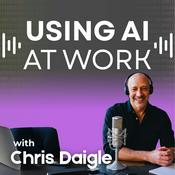 Download for free in the App Store
radio.net
Sleep timer
Save favourites
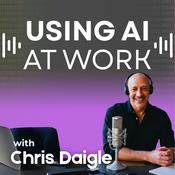
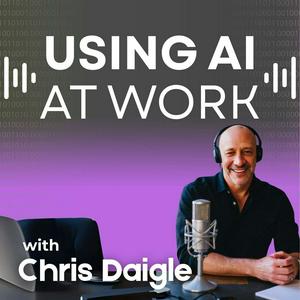
Using AI at Work: AI in the Workplace & Generative AI for Business Leaders
Chris Daigle
Latest episode
126 episodes
How to Use AI Roleplay to Improve Sales Conversations and Close More Deals with Paul Burani
19/10/2026 | 47 mins.What if your sales team could practice its toughest conversations before speaking to real customers? In this episode, Chris sits down with Paul Burani, Co-Founder and CRO of Atlas Primer, to explore how AI sales roleplay brings realistic practice and personalized feedback into sales training. They discuss how short, regular sessions help teams develop human skills, prepare for objections, and approach high-stakes conversations with greater confidence.
Paul explains how to tailor simulations to specific prospects, incorporate your sales methodology, and connect AI sales coaching to measurable business outcomes. He also shares his AI workflow for following up on stalled deals and the data privacy questions leaders should ask before adopting new tools. Listen to discover practical ways to strengthen your team’s skills and make better use of the time AI saves.
Chapters
(00:00) Introduction
(06:19) How Atlas Primer Builds Conversational Skills
(09:25) Getting Sales Teams to Embrace AI Coaching
(13:05) Building a Regular Sales Practice Habit
(14:24) Inside an AI Roleplay Training Session
(22:17) Preparing for Specific Prospects with LinkedIn
(24:13) Connecting Sales Training to Business Outcomes
(29:41) Adapting Sales Methodologies and Extending Coaching
(32:53) The Handoff: AI Follow-Ups for Stalled Deals
(36:13) Data Privacy Questions Every Leader Should Ask
(41:46) Reinvesting AI Time Savings Without Burning Out Teams
Resources:
🔎 Find Out More About Paul Burani:
LinkedIn:
https://www.linkedin.com/in/pburani linkedin.com
Atlas Primer:
https://atlasprimer.com/
Atlas Primer Roleplay:
https://roleplay.atlasprimer.com/ Atlas Primer
🛠 AI Tools and Resources Mentioned:
Gong:
https://www.gong.io/
OpenClaw:
https://openclaw.ai/
HubSpot:
https://www.hubspot.com/
Tableau:
https://www.tableau.com/
Microsoft Power BI:
https://www.microsoft.com/en-us/power-platform/products/power-bi
The AI-Driven Leader by Geoff Woods:
https://www.aileadership.com/book
Support the showWhy AI Adoption Fails Even When You Have the Right Tools with Rob Collie
12/10/2026 | 47 mins.What if your AI tools aren't underperforming because of the technology, but because they don't know your business? In this episode Chris sits down with Rob Collie, CEO of P3 Adaptive, former Microsoft Power BI developer, and author of Fair Game: Customizing AI to Your Business Is Easier Than You Think, to explore why buying ChatGPT or Claude subscriptions isn't enough to achieve meaningful enterprise AI adoption.
Rob explains the "knowledge cliff" that prevents generic AI tools from delivering reliable business results, why employees shouldn't be responsible for repeatedly teaching AI how their company works, and how leaders can build customized AI systems grounded in company knowledge. Through practical examples involving Claude Desktop, Claude Cowork, Notion, and AI-assisted workflows, they discuss context engineering, organizational knowledge, trusted sources of truth, and AI governance.
Listen to discover how leaders can move beyond AI experimentation and create systems their teams can actually trust and use.
Chapters:
(00:00) Why AI Needs Trusted Business Knowledge
(02:53) From Microsoft Power BI to the AI Revolution
(05:25) Why Buying AI Subscriptions Isn't Enough
(09:22) The Claude Desktop Experiment That Changed Everything
(11:46) The Knowledge Cliff: Why AI Doesn't Know Your Business
(14:16) Bot Sitting and the Hidden Cost of AI Adoption
(16:50) Why Business Leaders Must Own AI Context
(21:48) How to Customize AI with Claude Cowork
(24:12) Building a Personalized AI Editor
(39:24) Fair Game and the Future of Business AI
Resources:
🔎 Find Out More About Rob Collie
LinkedIn: https://www.linkedin.com/in/robcollie/
P3 Adaptive: https://p3adaptive.com/
Raw Data with Rob Collie Podcast: https://p3adaptive.com/rawdatapodcast/
The Goldilocks Altitude Newsletter (Substack): https://goldilocks1.substack.com/
Fair Game: Customizing AI to Your Business Is Easier Than You Think by Rob Collie: https://www.amazon.com/Fair-Game-Customizing-Business-Easier/dp/1615470948
🛠 AI Tools and Resources Mentioned:
ChatGPT (OpenAI): https://chatgpt.com/
Claude: https://claude.ai/
Microsoft Copilot: https://copilot.microsoft.com/
Notion: https://www.notion.so/
OpenAI Codex: https://openai.com/codex/
Model Context Protocol (MCP): https://modelcontextprotocol.io/
Support the showHow AI Security Helps Companies Adopt Generative AI Safely with Steven Walchek
05/10/2026 | 49 mins.How do you scale enterprise AI without exposing the sensitive data your business cannot afford to lose? In this episode Chris sits down with Steven Walchek, Founder and CEO of Liminal, to explore enterprise AI security, AI governance, data privacy, and how leaders can safely accelerate generative AI adoption.
Steven explains how enterprises can protect sensitive information before it reaches an LLM, why governance needs to enable AI adoption rather than block it, and how AI agents and tools like Claude Code are changing what teams can build and automate. He also shares practical AI use cases, including his Pocket Sales Engineer and AI-powered product prioritization, showing how non-engineers can turn ideas into working applications without writing code. Leaders should listen for a practical look at balancing AI security, governance, productivity, and innovation as generative AI spreads across the enterprise.
Chapters:
(00:00) Introduction
(03:47) The Data Privacy Risks Behind Generative AI
(07:13) How Enterprise AI Security and Governance Work
(10:29) Protecting Sensitive Data Before It Reaches an LLM
(18:22) How AI Coding Tools Are Changing Software Development
(23:16) A Crawl, Walk, Run Strategy for Enterprise AI Adoption
(28:52) Why AI Governance Should Enable Innovation, Not Block It
(31:53) AI Agents, Automation, and the Enterprise Complexity Problem
(37:30) Building a Pocket Sales Engineer With Generative AI
(42:44) How to Build AI Applications Without Writing Code
Resources:
🔎 Find Out More About Steven Walchek
Steven Walchek on LinkedIn
https://www.linkedin.com/in/swalchek/
Liminal
https://www.liminal.ai/
Liminal Resources and Blog
https://www.liminal.ai/resources/blog
🛠 AI Tools and Resources Mentioned:
ChatGPT
https://chatgpt.com/
Claude
https://claude.ai/
Claude Code
https://claude.com/product/claude-code
OpenAI Codex
https://openai.com/codex/
Perplexity
https://www.perplexity.ai/
Grok
https://grok.com/
Meta AI
https://www.meta.ai/
Gong
https://www.gong.io/
OpenClaw
https://github.com/openclaw/openclaw
Support the showHow AI Workflow Automation Changes the Way Your Business Works with Justin Watt
28/09/2026 | 51 mins.Why do companies invest in AI without changing how work gets done? In this episode Chris sits down with Justin Watt, co-founder and CEO of Switchboard, to examine why AI adoption often stalls after teams get access to tools. They explore the move from individual AI use to AI workflow automation that supports work across departments.
Justin explains why successful business process automation depends on clear handoffs, usable data, and the right permissions. He shares how simplifying a complicated proposal process created a practical opportunity for AI, then discusses how leaders can find a first use case and build the shared context needed for AI agents. Listen for a grounded approach to enterprise AI implementation that starts with the work your team actually does.
Chapters:
(00:00) Why AI Adoption Hasn’t Changed the Business
(02:23) From Individual AI Use to Team Workflows
(05:10) Where AI Workflow Automation Fits
(09:57) Finding the First Business Process to Automate
(16:12) Mapping How Teams Actually Work
(20:13) Choosing an Internal AI Implementation Lead
(24:42) Human Oversight for AI Agents
(30:01) Building Shared Context From Business Data
(36:15) AI Tools for Meetings and Delegation
(40:11) Using Claude Code for Business Workflows
(43:15) Automating Recurring Updates With an AI Skill
Resources:
🔎 Find Out More About Justin Watt
Switchboard:
https://www.withswitchboard.com/
Justin Watt on LinkedIn:
https://ca.linkedin.com/in/wattjustin
🛠 AI Tools and Resources Mentioned:
Granola:
https://www.granola.ai/
Claude, Claude Code, and Claude Cowork:
https://claude.ai/
ChatGPT and Codex:
https://chatgpt.com/ and https://openai.com/codex/
Grok Bot:
https://grok.com/
Notion:
https://www.notion.so
Support the showHow to Make Enterprise AI Adoption Successful: Inside the Chief AI Officer Role with Denis Romanovskiy
21/09/2026 | 50 mins.AI transformation does not start with a massive AI project. In this episode Chris sits down with Denis Romanovskiy, Chief AI Officer at SOFTSWISS, to explore what enterprise AI adoption looks like when someone is actually responsible for turning the technology into business results. Denis explains why the Chief AI Officer role sits at the intersection of technology, operations, change management, security, and employee enablement.
They discuss how companies can identify internal AI leaders, why Denis prefers measuring "economic effect" before chasing traditional ROI, and how small employee-led experiments can build momentum across an organization.
Denis also shares lessons from SOFTSWISS's company-wide AI hackathon, including how non-technical employees became active builders when given the right support. For leaders trying to move AI from scattered experimentation into everyday work, this conversation offers a practical look at building adoption, accountability, and human oversight at scale.
Chapters:
(00:00) Introduction
(01:54) What a Chief AI Officer Actually Does
(05:35) Why Businesses Need Clear AI Ownership
(07:26) Choosing the Right Internal AI Leader
(14:38) Measuring AI by Economic Effect, Not Just ROI
(19:45) How to Choose AI Use Cases That Build Momentum
(22:37) Turning an AI Hackathon Into a Business Tool
(27:34) Why Executive Support Drives AI Adoption
(29:16) What Non-Technical Employees Can Build With AI
Resources:
🔎 Find Out More About Denis Romanovskiy
LinkedIn: https://www.linkedin.com/in/dionique
SOFTSWISS:
https://www.softswiss.com
🛠 AI Tools and Resources Mentioned:
OpenAI:
https://openai.com
Anthropic:
https://www.anthropic.com
+ NotebookLM:
https://notebooklm.google
Support the show
More Business podcasts








Trending Business podcasts






















About Using AI at Work: AI in the Workplace & Generative AI for Business Leaders
On "Using AI at Work", your host Chris Daigle and his expert guests help business leaders, executives, and teams who want to turn artificial intelligence into a real competitive advantage. Each episode shares real-world AI applications and AI transformation stories from companies successfully using AI in the workplace to improve productivity, decision-making, and operations.You’ll hear from Chief AI Officers, innovators, and forward-thinking executives who are putting generative AI at work, from AI productivity tools and AI-powered workflows to non-technical AI training and workplace AI adoption strategies.We cover:AI for business leaders – how executives use AI to lead change and drive ROIGenerative AI tools – practical, easy-to-implement solutions for teamsAI automation in business – streamline operations without massive tech budgetsExecutive AI education – upskilling leaders and managers for the AI eraReal-world AI case studies – lessons learned from successful AI implementationAI in operations management – optimizing processes and reducing costsEthical AI in business – navigating responsible and effective AI useWhether you’re exploring AI adoption, leading AI-powered transformation, or looking for AI implementation guides, this podcast delivers a clear, non-technical roadmap to succeed in the AI-driven economy.New episodes weekly.Start learning how to put AI to work in your business today.
Podcast websiteListen to Using AI at Work: AI in the Workplace & Generative AI for Business Leaders, The Diary Of A CEO with Steven Bartlett and many other podcasts from around the world with the radio.net app
Get the free radio.net app
- Stations and podcasts to bookmark
- Stream via Wi-Fi or Bluetooth
- Supports Carplay & Android Auto
- Many other app features
Get the free radio.net app
- Stations and podcasts to bookmark
- Stream via Wi-Fi or Bluetooth
- Supports Carplay & Android Auto
- Many other app features

Using AI at Work: AI in the Workplace & Generative AI for Business Leaders
Scan code,
download the app,
start listening.
download the app,
start listening.
 New Zealand
