

Listen to this podcast in the app for free: Download for free in the App Store
radio.net
Sleep timer
Save favourites
54 episodes
Overcoming Childhood Guilt & Reparenting Your Inner Child
12/08/2026 | 25 mins.In this episode, Patrick Teahan, MSW explores the heavy burden of guilt carried by childhood trauma survivors. When growing up in a toxic or dysfunctional family, children are often trapped in no-win situations, blamed for things entirely out of their control, and expected to manage adult problems. This creates a deeply rooted sense of guilt that persists into adulthood, fueled by underlying, internalized shame.
Patrick breaks down the crucial difference between guilt and shame. Guilt focuses on the actions we feel we are failing to do, while shame provides the painful internal narrative that we are inherently selfish or bad for failing. This combination often leads survivors to cave in, self-sacrifice, and abandon their own boundaries to avoid making others uncomfortable.
To help break this cycle, this episode features two detailed reparenting roleplays that demonstrate how to communicate effectively with a wounded inner child.
Key Takeaways
Understanding the Guilt Trap: How early experiences of being helpless to fix a parent create lifelong patterns of over-responsibility and caving to external pressure.
Guilt Versus Shame: The distinct but connected ways guilt dictates our actions while shame attacks our core identity.
The Unchallenging Inner Adult: A look at how an underdeveloped inner adult agrees with the inner child's fears and fails to set boundaries with toxic family members.
The Empowered Inner Adult: Strategies for advocating for yourself, setting firm boundaries, and showing the inner child that it is safe to prioritize your own well-being over a toxic parent's comfort.
Protecting Your Peace: Why letting a narcissistic parent experience their own disappointment is a necessary step in protecting your present relationships and mental health.
Join the Healing Community!
Join the Monthly Healing Community Membership4 Reasons It Feels Like Failure
15/07/2026 | 20 mins.In this episode, Patrick Teahan, MSW, explores the hidden psychological barriers that prevent childhood trauma survivors from reaching their personal and professional goals. While often labeled simply as imposter syndrome, this struggle is rarely just a lack of confidence. Instead, it is a complex intersection of survival mechanisms, unresolved grief, and toxic family system dynamics. Patrick breaks down four specific patterns that keep survivors anchored in familiar dysfunction rather than risking the vulnerability required for success.
What You Will Learn:
The Suffering Trap: Understanding the paradox of having a high tolerance for familiar pain but a low tolerance for the new discomfort necessary for growth and change.
Perfectly Incapable: How toxic family branding and assigned roles (such as the scapegoat or the laborer) disconnect survivors from their true capabilities and establish invisible ceilings.
Can I Keep Up the Facade?: The pervasive anxiety that success is fragile and the distorted belief that anything less than perfect, unwavering effort makes you an imposter.
Why Bother?: How the heartbreak of not being seen or celebrated by an apathetic or abusive family of origin neutralizes the drive to achieve major life milestones.
Personal success is highly subjective, whether it means getting out of debt, pursuing an advanced degree, or simply living with more calmness instead of operating in messy survival mode. By recognizing how a wounded inner child confuses new discomfort with a literal threat to survival, survivors can begin to rewrite these outdated narratives. Healing involves seeking safe, external mirroring to build a grounded sense of self and reconnecting with your inherent capabilities.
Join the Healing Community!
Join the Monthly Healing Community MembershipWhen Therapy is Actually GOOD
08/07/2026 | 31 mins.In this episode, Patrick Teahan, MSW, steps away from the teleprompter to share real testimonials from his community about the life-changing impact of good therapy. While discussions around mental health often focus on poor fits or damaging experiences, Patrick highlights what it looks and feels like to find a safe and competent practitioner. He introduces a lighthearted analogy comparing a great therapist to a trusted mechanic, someone who understands the complex machinery of your history, manages your emotions with compassion, and is honest about the repairs needed to keep you moving forward.
By exploring stories of profound healing, Patrick unpacks how effective therapy directly counters the anti-process environment of a toxic family system.
Listeners will learn:
The Power of Pacing: How somatic experiencing helps trauma survivors slow down and realize that processing intense flashbacks is manageable and safe.
Autonomy Through Silence: Why a therapist who listens without judgment and pauses before responding builds client autonomy far better than one who immediately offers unsolicited advice.
Recalibrating the Nervous System: How childhood gaslighting miscalibrates bodily sensations and why effective therapy focuses on reconnecting with the physical body to disarm triggers.
Unlearning Toxic Narratives: The importance of an active therapist who challenges normalized family abuse, such as clearly identifying constant yelling as verbal abuse.
The Inner Circle Boundary: How to establish mental boundaries by reserving conflict and emotional bandwidth only for those in your deepest, most trusted inner circle.
Releasing the Burden of Fixing: Why realizing that you had nothing to work with regarding your family of origin removes the deep guilt and shame of not being able to save or change them.
Patrick also reflects on his own transformative experiences with his clinical mentor and details how finding a therapist who acts as a safe home base can radically alter your recovery trajectory. For those not yet ready for individual therapy or those seeking additional structured support, Patrick shares information about his healing membership and his recently published clinical assessment designed to measure toxic family environments.
Keywords: childhood trauma, trauma therapy, somatic experiencing, nervous system regulation, toxic family systems, inner child work, mental boundaries, family estrangement, trauma recovery, meaning making, boundary setting.
Join the Healing Community!
Join the Monthly Healing Community MembershipThe Mind of the Artist w/ William Todd Schultz
07/06/2026 | 1h 42 mins.In this episode, Patrick Teahan, MSW, is joined by personality psychologist William Todd Schultz to explore the complicated emotional landscape of family estrangement and how early childhood loss intersects with creative expression.
Todd specializes in profiles of artists and has published books such as Tiny Terror on Truman Capote, An Emergency in Slow Motion on Diane Arbus, Torment Saint on Elliott Smith, and The Mind of the Artist. Together, they detail how childhood trauma and the death of an estranged toxic family member elicit complex forms of grief. They introduce the concept of ambiguous loss and how individuals use creative mediums to process unresolved family systems issues.
The episode begins by unpacking a complex dynamic: the dual reality of an abusive sibling being both a perpetrator and a victim within a dysfunctional family hierarchy. Patrick and Todd use this concept to illustrate why survivors often experience a muted emotional response when an estranged family member physically passes, as the psychological passing of the relationship occurred long ago.
Listeners will learn:
Ambiguous Loss and Estrangement: What it truly means to experience the death of a toxic sibling and why a blank emotional response is a valid reaction to long-standing estrangement.
The Dysfunctional Hierarchy: A look at multigenerational trauma and how abusive family members are often both perpetrators and victims.
Creative Adaptation: How individuals with artistic inclinations use creative mediums to mentally conjure and process a lost relationship.
Resurrecting in Fantasy: The psychological process of resurrecting the deceased through art to form a new and manageable dynamic that buffers the trauma of the loss.
Historical Perspectives on Creativity: An exploration of the mid-century Berkeley psychological assessments on creative writers and how the field quantifies creative and psychological traits.
Patrick and Todd also provide insights into meaning-making and grief-related growth, encouraging listeners to understand how modern psychological frameworks apply to these complex forms of grief. By understanding how trauma shapes personality, survivors can begin to safely set boundaries and use creative outlets for self-preservation and healing.
Keywords: childhood trauma, family estrangement, ambiguous loss, creative expression, meaning-making, multigenerational trauma, grief-related growth, personality psychology, toxic family systems, boundary setting.
Join the Healing Community!
Join the Monthly Healing Community MembershipExplode or Shut Down? The 2 Types of Repressed Rage
19/05/2026 | 36 mins.In this episode, Patrick Teahan, MSW, explores the profound impact of rage as a byproduct of childhood trauma, detailing how unsafe environments force children to either weaponize or absorb intense emotional energy. He introduces the concept of inward and outward rage, moving beyond the stigma of "anger issues" to focus on the underground emotional deposits that develop when a child is erased, ignored, or exposed to volatility.
The episode begins by unpacking a complex dynamic: the four specific childhood situations that fuel adult rage. Patrick uses these roots to illustrate how survivors often struggle with a "well of childhood" that runs their present-day reactions, where symptoms like road rage or chronic exhaustion are actually valid byproducts of old injustices.
Listeners will learn:
The Four Situations of Rage: Why adults not doing the right thing, deep injustice, volatile or passive parenting, and being "erased" create a lifelong emotional burden.
Outward Rage (Fire at Will): The reality of being "wired for anger," characterized by a low threshold for frustration, self-righteousness, and the tendency for rage to come out sideways in adulthood.
Inward Rage (The Superhero Absorber): Exploring why some survivors never feel anger at all, instead acting like a "black hole" that absorbs dangerous energy at the expense of their own physical and mental health.
The Erasure Effect: What it truly means to be invisible as a child and how having your needs or feelings wiped out leads to a massive sense of adult injustice.
Situations Over Symptoms: Why understanding your story is more vital for recovery than simply managing symptoms, as the "what happened" is the source of the "what is felt."
Reclaiming and Releasing: How healing involves Jane-style pressure release for those with outward rage and Beth-style "reclaiming of the f-you" for those who have gone numb.
Patrick also provides a case study of two sisters to highlight how the same traumatic environment can produce polar opposite rage strategies. By understanding how these survival tactics were formed, listeners can begin to move toward a healthy middle ground where anger is a tool for advocacy rather than a source of shame or self-sabotage.
Keywords: childhood trauma, repressed rage, inward rage, outward rage, inner child work, emotional neglect, parentification, nervous system, toxic family systems, trauma recovery, justice-based anger.
Join the Healing Community!
Join the Monthly Healing Community Membership
More Education podcasts
 Learning English ConversationsEducation, Language Learning
 All Ears English PodcastBusiness, Education, Language Learning
 Everyday MāoriEducation, Language Learning
 anything goes with emma chamberlainEducation, Personal Journals, Self-Improvement, Society & Culture
 Know ThyselfEducation, Self-Improvement
 SOLVED with Mark MansonEducation, Self-Improvement
 Stand Up AgainEducation, Health & Wellness, Mental Health, Self-Improvement
 6 Minute EnglishEducation, Language Learning
 Keep The ChangeBusiness, Education, Self-Improvement
 The Mel Robbins PodcastEducation, Health & Wellness, Mental Health, Relationships, Self-Improvement, Society & Culture
Trending Education podcasts
 LATE BLOOMERSEducation, Self-Improvement
 Conversations with TylerEducation, Society & Culture
 The Daily StoicBusiness, Education, Self-Improvement, Society & Culture
 The Jordan Harbinger ShowBusiness, Education, Science
 Flower Farming in New ZealandBusiness, Education, Entrepreneurship, Tutorials
 Dreaming Spanish Podcast – Chats in Beginner SpanishEducation, Language Learning
 The Journey PodcastEducation, Self-Improvement
 The Dr. Lee Warren PodcastChristianity, Education, Health & Wellness, Life Sciences, Mental Health, Religion & Spirituality, Science, Self-Improvement
 Aware and AggravatedEducation, Health & Wellness, Mental Health, Self-Improvement
 The Gathering Room PodcastBusiness, Education, Entrepreneurship, Self-Improvement
 And Then It Hit Me with Cory AllenBusiness, Education, Entrepreneurship, Health & Wellness, Mental Health, Self-Improvement
 Platypus Economics with Justin WolfersBusiness, Courses, Education, Science, Social Sciences
 IELTS Energy English 7+Education, Language Learning
 THE ED MYLETT SHOWBusiness, Education, Entrepreneurship, Self-Improvement
 Pride and Prejudice by Jane Austen - Free AudiobookEducation, Fiction
 Unfiltered with Dave LeteleEducation, Health & Wellness, Self-Improvement
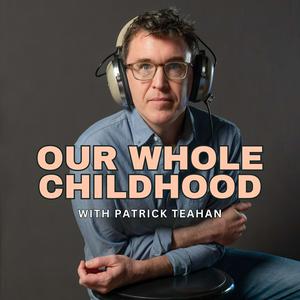
About Our Whole Childhood with Patrick Teahan
This is "Our Whole Childhood" - hosted by Patrick Teahan - where we discuss everything childhood trauma, from the issues that we experience, to the stuff that comes up in our families, and to the healing work that we're all trying to get done. No clinical jargon—just real, personal stories of growing up with childhood trauma and the journey to healing.Learn more at www.patrickteahan.com
Podcast websiteListen to Our Whole Childhood with Patrick Teahan, Learning English Conversations and many other podcasts from around the world with the radio.net app
Get the free radio.net app
- Stations and podcasts to bookmark
- Stream via Wi-Fi or Bluetooth
- Supports Carplay & Android Auto
- Many other app features
Get the free radio.net app
- Stations and podcasts to bookmark
- Stream via Wi-Fi or Bluetooth
- Supports Carplay & Android Auto
- Many other app features

Our Whole Childhood with Patrick Teahan
Scan code,
download the app,
start listening.
download the app,
start listening.
 New Zealand