

Listen to this podcast in the app for free: Download for free in the App Store
radio.net
Sleep timer
Save favourites
46 episodes
Okay, but how terrifying were terror birds?
08/10/2026 | 26 mins.E43. For millions of years, South America’s top predators weren’t cats or bears. They were birds, some taller than a person. Paleontologist Dr. Federico "Dino" Degrange of the Universidad Nacional de Córdoba joins us to ask whether terror birds really earned their name.
In this episode, you'll hear about:
The surprising weapon a terror bird actually used to bring down its prey
What left bite marks on one of the biggest terror birds ever found
Why the last terror bird standing was one of the smallest
All audio, video, and images in this episode are either original to Okay, But... Birds (© Okay Media, LLC) or used under license/permission from the respective rights holders. Media from the Macaulay Library is used courtesy of the Cornell Lab of Ornithology as follows:
Black-legged Seriema video contributed by Pablo Hernan Capovilla, ML662237304
Red-legged Seriema audio contributed by Matthew D. Medler, ML189557
Black-legged Seriema audio contributed by Steven L. Hilty, ML83854Okay, but what happens when a bird gets sick?
01/10/2026 | 33 mins.E42. Birds get sick too, and a lot of what happens next looks surprisingly familiar. Dr. Andrea Townsend of Hamilton College has spent two decades following American crows through outbreaks, and she walks Scott through what illness really does to a bird, from the family it belongs to down to the clever brain it depends on.
In this episode, you'll hear about:
The surprising way crows choose their partners, and what it costs them when disease comes around
What a stomach bug does to one of the cleverest birds you'll ever meet
Why going it alone can be the riskier move while a virus is spreading
All audio, video, and images in this episode are either original to Okay, But... Birds (© Okay Media, LLC) or used under license/permission from the respective rights holders. Media from the Macaulay Library is used courtesy of the Cornell Lab of Ornithology as follows:
American Crow video contributed by Jay McGowan, ML472843
Common Raven audio contributed by Gerrit Vyn, ML137574
Burrowing Owl audio contributed by Bob McGuire, ML188805Okay, but griffins, and ligers, and birds, oh my!
24/09/2026 | 32 mins.E41. Centaurs, mermaids, minotaurs: we have been inventing creatures that are two things at once for as long as we have told stories. Birds do it for real. Dr. Glaucia Del-Rio of the Florida Museum of Natural History studies two Amazonian antbirds that meet where a river runs out, and what their offspring say about where one species ends.
In this episode, you'll hear about:
Why a river can be an impossible barrier for a bird with perfectly good wings, and what researchers found when they carried birds out into the middle of one and let go
How to spot a hybrid antbird at a glance, once you know which colors belong to which parent
The German-Brazilian ornithologist an all-women expedition was named for, and the injury she dealt with herself, a long way from any hospital
All audio, video, and images in this episode are either original to Okay, But... Birds (© Okay Media, LLC) or used under license/permission from the respective rights holders. Media from the Macaulay Library is used courtesy of the Cornell Lab of Ornithology as follows:
Red-capped Manakin audio contributed by David L. Ross Jr., ML57360
Streak-headed Woodcreeper audio contributed by Ted Parker, ML21543
American Flamingo audio contributed by Gerrit Vyn, ML172484
Lawrence's Warbler (hybrid) audio contributed by Curtis Marantz, ML113786
Brewster's Warbler (hybrid) audio contributed by Curtis Marantz, ML76906
Additional photos and video courtesy of Glaucia Del-Rio: Marco Rego, Fabio Schunck, Luis Morais, and Angela Prochilo. Harlequin Antbird photo by Hector Bottai, via Wikimedia Commons, licensed CC BY-SA 4.0 (creativecommons.org/licenses/by-sa/4.0/).Okay, but... cranes!
17/09/2026 | 32 mins.E40. There are only 15 crane species on the planet, and 11 of them are in trouble. Dr. Andy Caven, Director of Central Flyway Programs for the International Crane Foundation, has spent his career on two of them: the sandhill cranes that pour into one stretch of Nebraska's Platte River every spring, and the whooping crane, which came back from the edge and is still nowhere near safe. Scott asks him what it actually takes to keep a bird like that on the landscape, and the answer runs through soggy grassland, private ranches, and one river worth fighting over.
In this episode, you'll hear about:
The number Andy gives for how many cranes stand on that stretch of river, which Scott makes him say twice
How a bird that was down to a couple of dozen individuals ended up stopping a dam
What a wet meadow is, and why one is so much easier to lose than to build back
All audio, video, and images in this episode are either original to Okay, But... Birds (© Okay Media, LLC) or used under license/permission from the respective rights holders. Media from the Macaulay Library is used courtesy of the Cornell Lab of Ornithology as follows:
Mallard audio contributed by Mike Andersen, ML136504
Wilson's Phalarope audio contributed by W. Douglas Robinson, ML474658841
Swamp Sparrow audio contributed by Wil Hershberger, ML94352Okay, but why does that bird look so rough?
10/09/2026 | 31 mins.E39. Every August the questions start: there is a cardinal at the feeder with no head feathers, and it looks terrible. Nothing is wrong with it. It is molting, which every bird does at least every year. Dr. Ryan Terrill of the San Diego Natural History Museum studies what a feather endures over a year and what it takes to replace one, and he makes the case that the few weeks a bird spends looking its worst may be the most consequential weeks it has.
In this episode, you'll hear about:
Why the cardinal at your feeder in late summer looks like it lost a fight
What a bird quietly gives up during the weeks it is growing new feathers
The hundreds of miles some birds fly for the sake of a new set of feathers
All audio, video, and images in this episode are either original to Okay, But... Birds (© Okay Media, LLC) or used under license/permission from the respective rights holders. Media from the Macaulay Library is used courtesy of the Cornell Lab of Ornithology as follows:
Northern Cardinal audio contributed by Wil Hershberger, ML191165
American Goldfinch audio contributed by Wil Hershberger, ML94457
Blue Jay audio contributed by Gaetan Dupont, ML173749
Herring Gull audio contributed by Sarah MacLean, ML165927
American Herring Gull video contributed by Steve Kelling, ML540908261
Snow Bunting audio contributed by Gerrit Vyn, ML130973
Red-tailed hawk audio contributed by David McCartt, ML229578
White-throated Sparrow audio contributed by Bob McGuire, ML219799
Great Hornbill audio contributed by Linda Macaulay, ML111527
Flightless Cormorant audio contributed by Linda Macaulay, ML237486
More Education podcasts
 Learning English ConversationsEducation, Language Learning
 Everyday MāoriEducation, Language Learning
 The Mel Robbins PodcastEducation, Health & Wellness, Mental Health, Relationships, Self-Improvement, Society & Culture
 Begin Again with Davina McCallEducation, Health & Wellness, Mental Health, Self-Improvement, Society & Culture
 anything goes with emma chamberlainEducation, Personal Journals, Self-Improvement, Society & Culture
 Keep The ChangeBusiness, Education, Self-Improvement
 Know ThyselfEducation, Self-Improvement
 SOLVED with Mark MansonEducation, Self-Improvement
 Kiwi English BoosterEducation
 6 Minute EnglishEducation, Language Learning
Trending Education podcasts
 Align with Jenna Zoe: The Human Design PodcastEducation, Life Sciences, Religion & Spirituality, Science, Self-Improvement, Spirituality
 Dreaming Spanish Podcast – Chats in Beginner SpanishEducation, Language Learning
 The Art of AccomplishmentBusiness, Education, Health & Wellness, Management, Mental Health, Self-Improvement
 Duolingo Spanish PodcastEducation
 Learn English with Coffee Break EnglishCourses, Education, Language Learning
 Aware and AggravatedEducation, Health & Wellness, Mental Health, Self-Improvement
 The Sabrina Zohar ShowEducation, Health & Wellness, Mental Health, Relationships, Self-Improvement, Society & Culture
 Blood WorkEducation, History, News, Politics
- Kiwi English BoosterEducation
 Knowledge for TeachersEducation
 This Naked Mind PodcastEducation, Self-Improvement
 Japanese podcast for beginners (Nihongo con Teppei)Education, Language Learning
 The Dr. Lee Warren PodcastChristianity, Education, Health & Wellness, Life Sciences, Mental Health, Religion & Spirituality, Science, Self-Improvement
 潘吉Jenny告诉你|学英语聊美国|开言英语 · PodcastEducation, Language Learning
About Okay, But... Birds
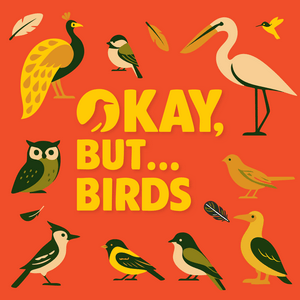
Hosted by evolutionary biologist Dr. Scott Taylor, Okay, But... Birds explores the drama, brilliance, and science behind bird life. Each snackable 30-minute episode blends smart storytelling, expert interviews, and a touch of humor to reveal how birds shape our world. No jargon. No binoculars required. Just real science, quirky insights, and bird-brained drama you’ll want to share at brunch. Because birds aren’t background. Birds are cool.
Podcast websiteListen to Okay, But... Birds, Learning English Conversations and many other podcasts from around the world with the radio.net app
Get the free radio.net app
- Stations and podcasts to bookmark
- Stream via Wi-Fi or Bluetooth
- Supports Carplay & Android Auto
- Many other app features
Get the free radio.net app
- Stations and podcasts to bookmark
- Stream via Wi-Fi or Bluetooth
- Supports Carplay & Android Auto
- Many other app features

Okay, But... Birds
Scan code,
download the app,
start listening.
download the app,
start listening.
 New Zealand