
Listen to this podcast in the app for free: Download for free in the App Store
radio.net
Sleep timer
Save favourites
332 episodes
#333 - Procrastination = Risk
19/10/2026 | 28 mins.Bill Kanasky, Jr., Ph.D. shares a couple of stories of recent attorney inquiries for litigation consulting services at the very last minute because approval was not received from the client until days before trial. When authority for litigation consulting services comes late, it limits, and sometimes even completely prevents, the services from being scheduled due to other obligations. Waiting until the eve of trial is a poor and risky strategy. Discussing litigation consulting options early and preparing well in advance of mediation and trial is critical to increasing the odds of better litigation outcomes. Watch the video of this episode: https://youtu.be/P7ChblG403c#332 - The Concept of Measurement Sensitivity in Jury Research
12/10/2026 | 24 mins.Bill Kanasky, Jr., Ph.D. discusses the concept of sensitivity in jury research. Bill explains that the quality of the stimuli shared with participants in the research may impact the level of confidence in the research results. For example, when being able to show video footage of the incident or video of witness deposition testimony, these are high sensitivity stimuli that increase the reliability of the mock juror feedback. In contrast, if you only have written descriptions of the incident or witness deposition transcripts, the feedback from the jurors on those less sensitive stimuli will limit, to some degree, the confidence in the results. However, if you don't have video testimony or video of the incident, it does not mean you cannot still test what you do have. Making short videos of defense witnesses is a way to fill a video deposition gap. On the plaintiff side, if there's no deposition video, using social media of the plaintiff or other similar public media available can provide some useful insights from mock jurors. Gathering feedback based on the documentation you do have is still useful while recognizing that what jurors will see at trial will include stimuli that you were not able to test in the jury research. Watch the video of this episode here: https://youtu.be/HoCn8-10UIg#331 - Using Early Jury Research to Guide Discovery
05/10/2026 | 43 mins.CSI Litigation Consultant Sarah Burton, Ph.D. joins Steve Wood, Ph.D. to discuss early jury research. Sarah shares details about a case in which she conducted a focus group very early in the case, while discovery was still open, to understand what jurors thought about an important piece of evidence that the defense was expecting to base their case on. And it turned out that this evidence was not important to the jurors - they understood the evidence, however, they were not persuaded by it which led the defense team to have to rethink their strategy for discovery and beyond. Early jury research can help guide and inform what the legal team focuses on that matters to jurors vs. what they may assume is important or relevant. Sarah and Steve also touch on how they handle angry witnesses. Lastly, Steve and Sarah talk about the Test/Retest focus group format and how it aids in testing whether liability should be admitted or not, testing specific pieces of evidence that may or may not come in, testing anchors and counter-anchors, and more. Watch the video of this episode: https://youtu.be/MEtNtkNpKi8#330 - Conducting Jury Research on Highly Sensitive Cases
28/09/2026 | 34 mins.CSI Litigation Consultant Linda Khzam, M.A. joins Steve Wood, Ph.D. to talk about jury research in highly sensitive cases, such as sexual abuse and molestation, child abuse, racially sensitive situations like police shootings, etc. Linda and Steve discuss the challenges that jurors have in evaluating the evidence in sensitive cases and how the jury research has to be approached in these types of cases. The way in which the case is presented becomes critical in cases with sensitive situations so testing how the case is framed in a focus group is critically important to understanding what may trigger jurors and to gauge their reactions to what is being presented, and how. Steve and Linda also share their experiences with how juror's beliefs, attitudes, and experiences affect their interpretation of the evidence and how those with strong perspectives can influence other jurors and those who are afraid to share their opinion are influenced by them. They also talk about how to manage juror reactions to sensitive details in these cases and the emotional toll it can take on jurors to hear, see, and discuss highly unsettling evidence and case facts. Watch the video of this episode: https://youtu.be/7kDHLUg5WGo#329 - Reptile Question Sequencing - The Risk Is In The Setup
21/09/2026 | 23 mins.Bill Kanasky, Jr., Ph.D. talks about a deposition topic that doesn't get enough attention: the question sequencing in a Reptile deposition. Bill describes how the setup questions that precede the transition point to Reptile/Edge questions lull the witness's brain into a state of safety which prevents them from recognizing the subtle transition to the dangerous Reptile/Edge questions. The witness's brain becomes comfortable with the basic, simple, fact-based questions being asked and doesn't realize when the questions change from safe to risky. Most attorneys prepare their witnesses for the "standard" Reptile safety questions. What's missing is that these Reptile questions about safety are actually the secondary threat - the setup questions are the primary threat and this is what witnesses need to understand and be prepared for. Detecting the transition to the risky Reptile questions is difficult, however, with neurocognitive training, can be done. Watch the video of this episode: https://youtu.be/vNjF1kqzS8U
More Business podcasts





Trending Business podcasts














About The Litigation Psychology Podcast
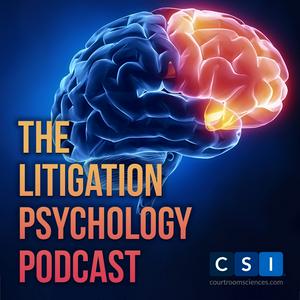
The Litigation Psychology Podcast presented by Courtroom Sciences, Inc. (CSI) is a podcast for in-house and outside defense counsel and insurance claims personnel about the intersection of science and litigation. We explore topics of interest to the defense bar, with a particular emphasis on subjects that don‘t get enough attention. Our hosts are experts in Clinical Psychology, Social Psychology, and scientifically-based jury research with a wealth of knowledge about psychology, science, jury research, human behavior, and decision making, which they apply in the context of civil litigation.
Podcast websiteListen to The Litigation Psychology Podcast, Think Fast Talk Smart: Communication Techniques and many other podcasts from around the world with the radio.net app
Get the free radio.net app
- Stations and podcasts to bookmark
- Stream via Wi-Fi or Bluetooth
- Supports Carplay & Android Auto
- Many other app features
Get the free radio.net app
- Stations and podcasts to bookmark
- Stream via Wi-Fi or Bluetooth
- Supports Carplay & Android Auto
- Many other app features

The Litigation Psychology Podcast
Scan code,
download the app,
start listening.
download the app,
start listening.
 New Zealand
