

Listen to this podcast in the app for free: Download for free in the App Store
radio.net
Sleep timer
Save favourites
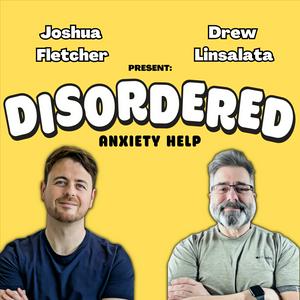
Disordered: Anxiety Help
Josh Fletcher and Drew Linsalata
Latest episode
179 episodes
Cognitive Reframing in Anxiety Disorders (Episode 176)
09/10/2026 | 40 mins.Send a question or comment via text message
Cognitive reframing in anxiety disorders is not about arguing with a thought until it loses. This week we take some of the most common phrases we hear in this community and look at them from a slightly different angle, without trying to prove them wrong or talk anyone into feeling safe.
We work through "I'm spiraling," "what if," "I'm back to square one," "I'm a burden to my family," and "what if I lose my progress," and talk about why a reframe you don't believe usually fails. We also get into why "here's an opportunity to practice" keeps coming up, how a panic attack on a treadmill can be described two very different ways, and a listener question about the highly sensitive person label and where sensitivity ends and anxiety begins. That part is our opinion, and we say so.
Plus Did It Anyway wins, including taking a feared migraine medication after hours of Reddit, and choosing not to Google a body symptom.
----
Want to talk about this episode, interact with us, and communicate with others that are sharing your experience? We're hanging out in the Disordered Community Space
https://disordered.fm/community
----
The Disordered Guide to Health Anxiety is available now:
https://www.disordered.fm/the-disordered-guide-to-health-anxiety/
---
Struggling with worry and rumination that you feel you can't stop or control? Check out Worry and Rumination Explained, a two hour pre-recorded workshop produced by Josh and Drew.
-----
Got questions or did it anyways to share? Send us an email or voicemail on our website.
https://disordered.fm
---
Disclaimer: Disordered is not therapy or a replacement for therapy. Listening to Disordered does not create a therapeutic relationship between you and the hosts or guests of the podcast. Information here is provided for psychoeducational purposes. As always, please consult your mental health and/or medical care providers. If you are having a mental health crisis, always reach out immediately for in-person help.Meditations on Anxiety Medications (Episode 175)
02/10/2026 | 41 mins.Send a question or comment via text message
175 episodes in, we're finally talking about medication. This week we get into questions we hear constantly: if I take medication for my anxiety, does that mean I'm failing, or that I'll never really recover? Is medication cheating? Is it evil? Is there even an answer to these questions?
We talk about why these questions don't even really hold up, why medication combined with therapy is genuinely the gold standard for treating some anxiety disorders, and why using meds to get to a place where you can do exposure work isn't cheating anyone. We also get into what "working" actually means, since everyone gets to define that differently, why informed consent conversations with your prescriber matter, and why the fear of taking a pill can become its own exposure. As always, we're sharing our own experiences and opinions here, not medical advice, so talk to your doctor or psychiatrist about your own treatment.
Plus Did It Anyway wins, including a 30 year avoidance of a trail beaten with a 15 minute timer, and a first train ride in three and a half months.
----
Want to talk about this episode, interact with us, and communicate with others that are sharing your experience? We're hanging out in the Disordered Community Space
https://disordered.fm/community
----
The Disordered Guide to Health Anxiety is available now:
https://www.disordered.fm/the-disordered-guide-to-health-anxiety/
---
Struggling with worry and rumination that you feel you can't stop or control? Check out Worry and Rumination Explained, a two hour pre-recorded workshop produced by Josh and Drew.
-----
Got questions or did it anyways to share? Send us an email or voicemail on our website.
https://disordered.fm
---
Disclaimer: Disordered is not therapy or a replacement for therapy. Listening to Disordered does not create a therapeutic relationship between you and the hosts or guests of the podcast. Information here is provided for psychoeducational purposes. As always, please consult your mental health and/or medical care providers. If you are having a mental health crisis, always reach out immediately for in-person help.Exposure Is Learning To Be Uncomfortable (Episode 174)
25/09/2026 | 46 mins.Send a question or comment via text message
Exposure isn't about proving you can sit in traffic, go to the supermarket, or make it through dinner with a friend. This week we talk about what exposure is actually for: practicing being uncomfortable, on purpose, without trying to fix or manage the feeling once it shows up.
We get into why the specific trigger, whether it's a bridge, a dentist's office, or a work presentation, barely matters compared to the discomfort underneath it, why reaching for certainty before you act keeps the cycle going, and why "I'm practicing with uncertainty" works better than trying to talk yourself into feeling safe first. We also talk about why sticking to the same few "safe" exposures can quietly become its own safety behavior, and why recovery is measured by what you still do, not by how anxious you feel doing it.
Plus Did It Anyway wins, including a clogged toilet on a school camping trip and a first exposure that ended in a panic attack anyway.
----
Want to talk about this episode, interact with us, and communicate with others that are sharing your experience? We're hanging out in the Disordered Community Space
https://disordered.fm/community
----
The Disordered Guide to Health Anxiety is available now:
https://www.disordered.fm/the-disordered-guide-to-health-anxiety/
---
Struggling with worry and rumination that you feel you can't stop or control? Check out Worry and Rumination Explained, a two hour pre-recorded workshop produced by Josh and Drew.
-----
Got questions or did it anyways to share? Send us an email or voicemail on our website.
https://disordered.fm
---
Disclaimer: Disordered is not therapy or a replacement for therapy. Listening to Disordered does not create a therapeutic relationship between you and the hosts or guests of the podcast. Information here is provided for psychoeducational purposes. As always, please consult your mental health and/or medical care providers. If you are having a mental health crisis, always reach out immediately for in-person help.Making It Right Once You're Better? (Episode 173)
18/09/2026 | 39 mins.Send a question or comment via text message
Once you're better, desensitized, and living your life again, a different feeling can show up: guilt over the years you lost, the plans you canceled, the people you pushed away. This week we talk about the urge to "make it right," and why that instinct deserves a closer look before you act on it.
We get into the difference between amends that actually help and rumination dressed up as responsibility, why some of that guilt simply has to be carried rather than fixed, and why the people around you sometimes owe you compassion instead of the other way around. We also talk about parents worried they've damaged their kids, what forgiving yourself actually looks like, and why living your life is often the only real answer.
Plus Did It Anyway wins, including a solo cabin trip across two countries and a pregnancy and postpartum period carried through serious health anxiety.
----
Want to talk about this episode, interact with us, and communicate with others that are sharing your experience? We're hanging out in the Disordered Community Space
https://disordered.fm/community
----
The Disordered Guide to Health Anxiety is available now:
https://www.disordered.fm/the-disordered-guide-to-health-anxiety/
---
Struggling with worry and rumination that you feel you can't stop or control? Check out Worry and Rumination Explained, a two hour pre-recorded workshop produced by Josh and Drew.
-----
Got questions or did it anyways to share? Send us an email or voicemail on our website.
https://disordered.fm
---
Disclaimer: Disordered is not therapy or a replacement for therapy. Listening to Disordered does not create a therapeutic relationship between you and the hosts or guests of the podcast. Information here is provided for psychoeducational purposes. As always, please consult your mental health and/or medical care providers. If you are having a mental health crisis, always reach out immediately for in-person help.CBT For Anxiety Disorders Explained (Episode 172)
11/09/2026 | 48 mins.Send a question or comment via text message
"I tried CBT and it didn't work" is a lot like saying "I tried food and it didn't work." CBT is a massive umbrella, and what you actually got depends heavily on which version of it you were given.
This week we break down what CBT for anxiety disorders actually looks like, from the older, content-driven approach built around thought challenging and thought replacement, to the third-wave, mindfulness and acceptance-based approach we rely on most, which is also CBT. We talk about why arguing someone out of a triggered state rarely works, where ERP, ACT, DBT, and metacognitive therapy all fit under the same umbrella, and what questions to ask a prospective therapist to find out what you're actually getting.
Plus Did It Anyway wins, including a solo trip to a music festival, an interoceptive exposure that turned into a massage, and studying through an OCD attack.
----
Want to talk about this episode, interact with us, and communicate with others that are sharing your experience? We're hanging out in the Disordered Community Space
https://disordered.fm/community
----
The Disordered Guide to Health Anxiety is available now:
https://www.disordered.fm/the-disordered-guide-to-health-anxiety/
---
Struggling with worry and rumination that you feel you can't stop or control? Check out Worry and Rumination Explained, a two hour pre-recorded workshop produced by Josh and Drew.
-----
Got questions or did it anyways to share? Send us an email or voicemail on our website.
https://disordered.fm
---
Disclaimer: Disordered is not therapy or a replacement for therapy. Listening to Disordered does not create a therapeutic relationship between you and the hosts or guests of the podcast. Information here is provided for psychoeducational purposes. As always, please consult your mental health and/or medical care providers. If you are having a mental health crisis, always reach out immediately for in-person help.
More Health & Wellness podcasts




Trending Health & Wellness podcasts




About Disordered: Anxiety Help
Disordered is the podcast that delivers real, evidence-based, actionable talk about anxiety disorders and anxiety recovery in a kind, compassionate, community-oriented environment. Josh Fletcher is a qualified psychotherapist in the UK. Drew Linsalata is a therapist practicing under supervision in the US. They're both bestselling authors in the anxiety and mental health space. Josh and Drew are funny, friendly, and they have a knack for combining lived experience, formal training, and professional experience in an encouraging, inspiring, and compassionate mental health message.
Podcast websiteListen to Disordered: Anxiety Help, The Imperfects and many other podcasts from around the world with the radio.net app
Get the free radio.net app
- Stations and podcasts to bookmark
- Stream via Wi-Fi or Bluetooth
- Supports Carplay & Android Auto
- Many other app features
Get the free radio.net app
- Stations and podcasts to bookmark
- Stream via Wi-Fi or Bluetooth
- Supports Carplay & Android Auto
- Many other app features

Disordered: Anxiety Help
Scan code,
download the app,
start listening.
download the app,
start listening.
 New Zealand