

Listen to this podcast in the app for free: Download for free in the App Store
radio.net
Sleep timer
Save favourites
27 episodes

From adversity to purpose | A story of hope
21/09/2026 | 29 mins.Philleen Dickson is the Ringa Tohutohu Matua – Māori Lead for Te Pou and in this episode she reflects on the impact of trauma, disconnection from whānau and culture, and the healing power of belonging. She explores how reconnecting with whakapapa, supportive relationships and lived experience shaped her path.
For clinicians and anyone supporting tamariki, taiohi and whānau, this episode is a moving reminder that sometimes the most transformative intervention is being the one safe person who listens, believes and sees potential beyond a diagnosis.Nothing for us without us | The voice of lived experience
07/09/2026 | 25 mins.What happens when we stop asking “What’s wrong with this young person?” and start asking “What’s happening around them?”
In this episode, we sit down with Tai Bennett, Youth Consumer Advisor at Whāraurau, to explore what it truly means to centre the voices of taiohi in mental health care. Drawing on both lived experience and professional expertise, Tai challenges us to reflect on power, trust, bias, and the assumptions we bring into our work.
Today's young people are growing up in a very different world, shaped by new pressures, changing environments, and complex systems. This conversation invites us to listen with curiosity and reconsider whose knowledge we value when supporting young people and their whānau.
From lived experience and cultural perspectives to trust, relationships, and genuine partnership, Tai reminds usof a simple but powerful principle: nothing for us without us.
Whether you're working directly with children and young people or helping shape services around them, this episode offers valuable insights into creating care that is more responsive, respectful, and centred on the voices of taiohi.Connecting research to action & the role of Vine
17/08/2026 | 31 mins.In this episode, we speak with Dr Charlotte Moore, Kaiwhakahaere of Vine (Violence Information Aotearoa). Charlotte shares the story behind Vine, how the organisation connects people with trusted research and resources, and why access to knowledge is critical for practitioners, policymakers and communities. The conversation also explores the wellbeing of children and young people and the ongoing debate surrounding youth access to social media.
Charlotte Moore is Kaiwhakahaere at Vine. Her PhD in sociology at Waipapa Taumata Rau | University of Auckland examined the National-led government’s social investment approach and its impact on social services in Aotearoa. She has also worked in research and violence prevention with WAVES Trust and contributed to national tangata whenua advisory and working groups across the family violence and sexual violence sectors.
Vine resources links:
https://vine.org.nz/news/youth-health-and-wellbeing-survey-2025-released
https://vine.org.nz/news/final-report-on-harm-young-new-zealanders-encounter-online-released-related-news-and-research
https://vine.org.nz/news/relationship-and-sexuality-education-media-research-resources-and-new-campaign
Follow Whāraurau
Stay up to date with our training opportunities, resources, and workforce updates.
LinkedIn: https://nz.linkedin.com/company/wh%C4%81raurau
Facebook: https://www.facebook.com/wharaurau/The Mental Health Foundation: Advocacy, wellbeing, and support
03/08/2026 | 23 mins.In this episode of Holding space, Shaun Robinson, Chief Executive of the Mental Health Foundation, discusses the Foundation’s work in advocacy, wellbeing promotion, and mental health support. He also explores the impact of social determinants such as housing, poverty, discrimination, and social connection on mental wellbeing, and highlights why improving mental health requires action far beyond clinical services.
Shaun Robinson is Chief Executive of the Mental Health Foundation. He describes himself as a father, partner, friend, gardener, amateur musician, sometimes surfer, mental health advocate, and organisational leader; he also lives with bipolar disorder. His career has spanned a wide range of issues from the care and protection of children to HIV/AIDS. Shaun is privileged to use his own lived experience and skills to contribute to improving the mental health and wellbeing of all people in Aotearoa.
Follow Whāraurau
Stay up to date with our training opportunities, resources, and workforce updates.
LinkedIn: https://nz.linkedin.com/company/wh%C4%81raurau
Facebook: https://www.facebook.com/wharaurau/OCD explained: Evidence-based approaches for young people
20/07/2026 | 31 mins.Obsessive-compulsive disorder (OCD) is often misunderstood and trivialised, yet it can have a profound impact on children, young people, and their whānau | family.
In this episode of the Holding space podcast, clinical psychologist Marthinus Bekker unpacks what OCD really is, and how obsessions and compulsions become a powerful cycle that’s difficult to break. We also explore common misconceptions of OCD, and the evidence-based approaches used to treat it, including exposure and response prevention (ERP), and the pioneering Bergen 4-day OCD treatment.
Marthinus Bekker is a clinical psychologist with experience across public, university, and private settings. He has worked in child adolescent & family services and inpatient and forensic services. He conducts clinical and neuropsychological assessments and provides cognitive, behavioural, and acceptance-based therapies, with a focus on dialectical behavioural therapy.
Follow Whāraurau
Stay up to date with our training opportunities, resources, and workforce updates.
LinkedIn: https://nz.linkedin.com/company/wh%C4%81raurau
Facebook: https://www.facebook.com/wharaurau/
More Health & Wellness podcasts
 ZOE Science & NutritionEducation, Health & Wellness, Nutrition, Science
 Nothing much happens: bedtime stories to help you sleepFiction, Health & Wellness
 Happy PlaceHealth & Wellness, Mental Health, Relationships, Society & Culture
 Maintenance PhaseEducation, Health & Wellness, History
 The ImperfectsEducation, Health & Wellness, Mental Health, Self-Improvement
 The High Performance PodcastEducation, Health & Wellness, Self-Improvement, Sports
 Daze of Our LivesEducation, Health & Wellness, Self-Improvement, Society & Culture
 On Purpose with Jay ShettyBusiness, Health & Wellness, Mental Health
 Get Sleepy: stories for sleepAlternative Health, Drama, Fiction, Health & Wellness, Kids & Family, Stories for Kids
 Huberman LabHealth & Wellness, Life Sciences, Science
Trending Health & Wellness podcasts
 The Specialist GPCourses, Education, Health & Wellness, Medicine
 The Dr Vonda ShowFitness, Health & Wellness, Medicine
 The Dr. Shannon ShowEducation, Fitness, Health & Wellness, Self-Improvement
 The Boundaries.me PodcastChristianity, Health & Wellness, Mental Health, Relationships, Religion & Spirituality, Society & Culture
 The Exam Room by the Physicians CommitteeArts, Food, Health & Wellness, Medicine, Nutrition, Science
 Clearer, not Louder with Beatrice KamauAlternative Health, Christianity, Education, Health & Wellness, Religion & Spirituality, Self-Improvement
 The One You Feed | Personal Growth, Emotional Resilience & PurposeBuddhism, Education, Health & Wellness, Mental Health, Religion & Spirituality, Self-Improvement
 Savage LovecastHealth & Wellness, Relationships, Sexuality, Society & Culture
 How Do You Cope?Health & Wellness, Mental Health, Society & Culture
 WTF is AuDHD?Health & Wellness, Mental Health, Personal Journals, Society & Culture
 ADHD Wise Squirrels for late-diagnosed adults with ADHD.Business, Entrepreneurship, Health & Wellness, Mental Health, Personal Journals, Society & Culture
 The Proof with Simon HillEducation, Health & Wellness, Nutrition, Self-Improvement
 TED HealthHealth & Wellness
About Holding space
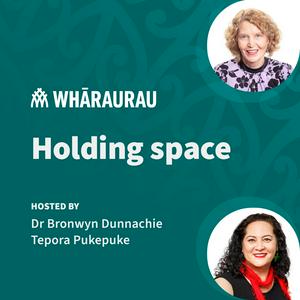
Holding space is a podcast from Whāraurau. In each episode, we sit down with people from across the infant, child, and adolescent mental health and addiction sector, and related sectors, to korero about the work, the challenges, and the heart behind supporting our tamariki and rangatahi. Join us as we hold space for honest conversations, shared learning, and collective growth. This podcast is hosted by Dr. Bronwyn Dunnachie and Tepora Pukepuke.
Podcast websiteListen to Holding space, ZOE Science & Nutrition and many other podcasts from around the world with the radio.net app
Get the free radio.net app
- Stations and podcasts to bookmark
- Stream via Wi-Fi or Bluetooth
- Supports Carplay & Android Auto
- Many other app features
Get the free radio.net app
- Stations and podcasts to bookmark
- Stream via Wi-Fi or Bluetooth
- Supports Carplay & Android Auto
- Many other app features

Holding space
Scan code,
download the app,
start listening.
download the app,
start listening.
 New Zealand