

Listen to this podcast in the app for free: Download for free in the App Store
radio.net
Sleep timer
Save favourites
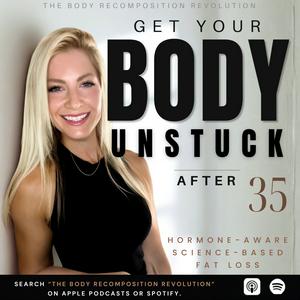
The Body Recomposition Revolution | Fat Loss and Strength for Women 35+
RAC Fitness - Robyn Creary
Latest episode
106 episodes
How Do You Reverse Diet After Eating Too Little? - Day 68
21/08/2026 | 22 mins.Can eating more fix a slow metabolism? What is reverse dieting, how do you reverse diet after eating too little, and how can you increase calories without gaining fat? In Day 68 of the Body Recomposition Revolution, we're talking about reverse dieting, metabolic adaptation, low energy availability, chronic dieting, under-eating, hormones, metabolism, muscle loss, and weight gain.
I share my own experience increasing my intake by roughly 800 calories per day, initially gaining weight, then eventually eating dramatically more while sleeping better, recovering better, training harder, and building more muscle.
We also look at research showing that increasing energy intake can improve reproductive function in exercising women with menstrual dysfunction. But here's the important distinction: eating more doesn't magically cause fat loss, and reverse dieting isn't a metabolism hack. The goal is to adequately fuel everything you're asking your body to do.
Today's 3 RAC Recomp Targets:
Track your calories for 7 days and find your daily average
Track your steps for 7 days to understand your actual activity.
Complete two 30–45 minute Zone 2 sessions this week.
🥗 Eating too little, eating too much, or have no clue? Email racrecomposition@gmail.com for a custom macro formulation based on your body, activity, and body-recomposition goals.
💪 Need the workouts too? Join the RAC Recomp Collective for progressive monthly strength training inside the RAC app for $29.99/month.Join the RAC Recomp Collective
📲 Follow @RACFitness_ on Instagram for daily body recomposition education and episode takeaways.
🎧 Follow + rate The Body Recomposition Revolution on SpotifyHow to Fix Your Metabolism After Eating Too Little LEA pt 2 - Day 67
20/08/2026 | 15 mins.Can eating too little damage your hormones or metabolism? How do you reverse low energy availability, increase calories after dieting, and lose body fat without sacrificing muscle?
short LEA questionnaire posted on insta RACfitness_
In Day 67 of the Body Recomposition Revolution, we're answering the question that naturally follows yesterday's episode: If I've been under-eating and over-exercising, did I permanently screw up my hormones or metabolism?
Good news: your body adapts in both directions.
A calorie deficit does not automatically damage your hormones. You can absolutely eat in a strategic calorie deficit and lose body fat. The problem is when a controlled fat-loss phase becomes chronic under-fueling relative to how much exercise and activity you're asking your body to support.
Research and clinical guidelines show that improving energy availability can help reproductive function recover. For women with functional hypothalamic amenorrhea, the Endocrine Society recommends correcting the energy imbalance by increasing calories, improving nutrition, decreasing exercise, or some combination of the three.
So where do you start?
If you estimated your TDEE yesterday, compare that with what you're actually eating and how much activity you're doing. Maybe you need more food, less exercise, or both. If increasing calories feels intimidating, you can do it gradually. There isn't anything magical about adding exactly 50 calories per week. The goal is to adequately fuel your body again.
And yes, the scale might increase. That doesn't automatically mean something has gone wrong. In cases of significant energy deficiency, some weight gain may actually be part of recovery.
The body-recomposition goal is NOT:
eat less → plateau → eat even less → add cardio → repeat
It's to fuel enough to train, train to build muscle, use an appropriate calorie deficit when fat loss is the goal, and remember that more restriction does not always mean more progress.
TARGETS
CHECK YOUR PROGRESS: Weigh yourself, measure your waist at your belly button, and take a progress picture. We're looking for trends, not obsessing over one number. If the scale isn't useful for you, skip it and use your measurement and photo.
PROTECT YOUR SLEEP: Put your phone away 30–60 minutes before bedtime tonight.
BREAK UP YOUR SITTING: Take a 5-minute movement break every 1–2 hours you're sitting. The goal is movement, not sneaking another cardio workout into your day.
🥗 Love training but have no idea how much you should actually be eating to support your body and your goals? I offer custom macro formulations based on your body, activity level, and body-recomposition goals.
NEED HELP FIGURING OUT HOW MUCH YOU SHOULD EAT? Email me: racrecomposition@gmail.com
💪 Need the strength-training side handled too? Ready to build muscle while losing fat? Join the RAC Recomp Collective for progressive monthly strength-training programs inside the RAC app for $29.99/month. JOIN THE RAC RECOMP COLLECTIVE
📲 Follow @RACFitness_ on Instagram for the daily infographics, research takeaways, and evidence-based body recomposition strategies for women 35+.
🎧 Doing the 90-Day Body Recomposition Revolution with me? Follow the show and leave a rating so you don't miss the next episode.
FOLLOW + RATE THE BODY RECOMPOSITION REVOLUTION ON SPOTIFYAm I Eating Enough to Lose Weight? Hormones, Metabolism & LEA - Day 66
19/08/2026 | 16 mins.What happens to your hormones when you don’t eat enough? Can eating too little affect your metabolism, period, estrogen, progesterone, thyroid hormones, recovery, and ability to build muscle? In Day 66 of the Body Recomposition Revolution, we’re talking about low energy availability (LEA) and why eating too little relative to how much you exercise can eventually work against your body-recomposition goals.
Low energy availability is not simply being in a calorie deficit. It happens when the energy you’re taking in compared with the energy you're expending through exercise leaves too little energy for everything else your body needs to do.
We break down how prolonged, problematic low energy availability can affect reproductive hormone signaling, ovulation, estrogen and progesterone, T3 thyroid signaling, leptin, cortisol, recovery, and performance. And surprisingly, you can still have a period while reproductive function is already being affected.
We also look at fascinating research in trained women showing that just 10 days of low energy availability reduced muscle protein synthesis. That's a pretty important finding when your entire goal is to lose fat while maintaining or building muscle.
But here's the distinction I don't want you to miss:
A calorie deficit does NOT automatically damage your hormones.
You can absolutely lose body fat intentionally. The problem is when eat less + exercise more becomes chronic under-fueling.
And this is only Part 1. Tomorrow we're answering the question you might already be asking: If I've been under-eating for years, did I damage my hormones or metabolism, and can I reverse it?
3 DAILY RAC RECOMP TARGETS
TARGET 1: SPREAD OUT YOUR PROTEIN No saving all your food for one giant dinner. Aim for 30–40g of protein at 3–4 meals throughout the day.
TARGET 2: FIND YOUR TDEE Search for a free TDEE calculator and estimate how many calories your body burns per day. You don't need to treat that number as perfect. Today, we're just getting a starting point.
TARGET 3: PRE-LOG TOMORROW Tonight, enter tomorrow's three main meals into your food tracker. You don't need every snack planned. Get breakfast, lunch, and dinner in so you know roughly where your calories and macros are headed.
💪 Want the workouts handled for you? Ready to build muscle while losing fat? Join the RAC Recomp Collective for progressive monthly strength-training programs inside the RAC app. $29.99/month, billed monthly, cancel anytime.
🥗 Not sure how much you should actually be eating? Get a custom RAC macro formulation built around your body, activity, and body-recomposition goals. Email racrecomposition@gmail.com.
📲 Want the visuals and daily takeaways? Follow @RACFitness_ on Instagram for evidence-based body recomposition strategies for women 35+.
🎧 Following the 90-Day Body Recomposition Revolution? Follow the show on Spotify so tomorrow's Part 2 lands right in your feed.
FOLLOW THE BODY RECOMPOSITION REVOLUTION ON SPOTIFYWho Do I See for Perimenopause? Do I Need Hormone Testing? - Day 65
18/08/2026 | 15 mins.How Do I Know If I’m in Perimenopause? Do I Need Hormone Testing or HRT?
How do you know if you’re in perimenopause, do you need hormone testing, and what doctor should you see for perimenopause or HRT? In Day 64 of the Body Recomposition Revolution, we’re answering the question that comes after learning about estrogen, progesterone, testosterone, menopause and HRT: Okay...now where do I actually start?
We break down why your symptoms, menstrual changes and medical history may tell your provider more than one random hormone test, why you often do not need hormone labs to identify routine perimenopause, and why ACOG does not recommend routine hormone testing before starting hormone therapy for typical menopause symptoms.
You’ll also learn who to call first, when a menopause specialist or endocrinologist may make sense, what to ask an HRT or hormone optimization clinic, why you should be cautious about chasing arbitrary “optimal” hormone levels, and the simple roadmap for getting help:
SYMPTOMS → PROVIDER → EVALUATION → TESTING IF NEEDED → TREATMENT IF NEEDED → FOLLOW-UP
The goal isn’t to ask, “Which hormones should I take?”
It’s to ask, “What am I experiencing, what could be causing it, and what am I actually trying to improve?”
TODAY’S 3 RAC RECOMP TARGETS
1. TRACK: Write down your 3 biggest symptoms today and rate each from 1–10.
2. PRE-LOG: Log tomorrow’s food tonight so you go into the day with a plan instead of trying to piece your nutrition together as you go.
3. NO NAKED CARBS: Pair your carbohydrates with a source of protein.
💪 Want me to take the guesswork out of your strength training? APP
Follow @RACFitness_ for the episode infographics, body recomposition education, and evidence-based fitness strategies for women 35+.Does HRT Help You Lose Weight? Belly Fat, Muscle & Menopause - Day 64
17/08/2026 | 14 mins.Does HRT help with weight loss, belly fat or muscle gain during perimenopause and menopause? And what’s the difference between estrogen, progesterone, testosterone, patches, pills and pellets?
In Day 64 of the Body Recomposition Revolution, we break down the treatment options women hear about constantly but rarely get explained simply.
We cover estrogen, progesterone, testosterone, HRT, patches vs. pills, testosterone pellets and non-hormonal options, plus why progesterone is generally needed with systemic estrogen if you have a uterus.
And because this is a body recomposition podcast, we answer the big question: Will HRT actually help you lose belly fat, build muscle or look more toned?
HRT is not a weight-loss treatment. But treating disruptive symptoms like hot flashes and night sweats may help you sleep, recover, train and feel better, which can make the habits that change your body easier to maintain.
TODAY’S 3 RECOMP TARGETS
🥩 PROTEIN: Hit 30–40g at each meal.
💪 STRENGTH: Complete one resistance-training session in the next 3 days.
📝 SYMPTOMS: Write down what you’re experiencing. Better data helps you make better decisions.
WANT THE WORKOUTS?
Ready to build muscle while losing fat? Join the RAC Recomp Collective
DON’T KNOW YOUR MACROS?
Stop guessing. Get your Custom Macro Formulation → racrecomposition@gmail.com
WANT THE QUICK VERSION?
Follow @RACFitness_ on Instagram for research-backed body recomposition tips for women 35+.
⭐ Learned something? Follow the show + tap the stars it helps another woman find it
More Fitness podcasts
 That Triathlon Life PodcastFitness, Health & Wellness, Running, Sports, Swimming
 自习室 STUDY ROOMFitness, Health & Wellness, Personal Journals, Society & Culture, Sports, Wilderness
 Mind Pump: Raw Fitness TruthFitness, Health & Wellness
 Optimal Health Daily - Fitness and NutritionFitness, Health & Wellness
 Perform with Dr. Andy GalpinFitness, Health & Wellness, Science
- The Body Recomposition Revolution | Fat Loss and Strength for Women 35+Fitness, Health & Wellness
Trending Fitness podcasts
About The Body Recomposition Revolution | Fat Loss and Strength for Women 35+
If you’re a woman 35+ trying to lose fat and build muscle but it still feels impossible, it’s not. You’re not broken; you need this simplified, science-backed full framework.
I’m Robyn Creary, mom of three, former teacher, trainer, and women’s body composition coach. I’ve experienced my own full-body transformation and helped many women 35+ transform theirs by simplifying fat loss and muscle building into a step-by-step, science-backed process, so you can stop guessing and start executing.
Start with Day 1 and follow on Spotify to complete the full 90-Day Body Recomposition System.
For the workouts that go with everything you’re learning here, join RAC Collective. It’s my workout app with beginner, intermediate, and advanced programs for home or gym training.
https://www.trainerize.me/profile/racfitnessmn/?planGUID=2e2dba89a93e4acdb840fd9fa8e25d40
No extremes. No confusion. Just a plan you understand and can finally execute.
Follow on Instagram @racfitness_ for free, simple tools. Listen here for the full system.
Podcast websiteListen to The Body Recomposition Revolution | Fat Loss and Strength for Women 35+, That Triathlon Life Podcast and many other podcasts from around the world with the radio.net app
Get the free radio.net app
- Stations and podcasts to bookmark
- Stream via Wi-Fi or Bluetooth
- Supports Carplay & Android Auto
- Many other app features
Get the free radio.net app
- Stations and podcasts to bookmark
- Stream via Wi-Fi or Bluetooth
- Supports Carplay & Android Auto
- Many other app features

The Body Recomposition Revolution | Fat Loss and Strength for Women 35+
Scan code,
download the app,
start listening.
download the app,
start listening.
 New Zealand