
Listen to this podcast in the app for free: Download for free in the App Store
radio.net
Sleep timer
Save favourites
52 episodes
Understanding Birth Trauma with Dr. Melanie Jackson
22/10/2026 | 1h 20 mins.🎙️ One in three women describe their birth as traumatic, but the trauma often isn’t about what happened. In this episode with Dr Melanie Jackson, we unpack what actually causes birth trauma and what would prevent it, in light of the NSW birth trauma inquiry and rising caesarean rates.
🧠 We discuss why “birth trauma” and “obstetric violence” are contested, and why trauma can be physical, psychological, or both.
💬 Why women with identical births on paper can have very different outcomes, and how the role of listening to the mother’s needs plays a huge role.
🤝 Designing care that actually protects women: knowing what you want before you walk in, why continuity of care is the strongest predictor of low trauma, choosing a care provider whose approach aligns with yours, and why “going with the flow” in a hospital means a medicalised birth by default.
🛡️ How to protect the birth space with eye covers, headphones, and a support person who can say no for you, why a partner may not be your best advocate, and more.
⚖️ Why presenting one option isn’t informed consent, how coercion shows up in routine practice, and what a recent Australian Supreme Court case reveals about vaginal examinations and consent.
🌱 Plus the first weeks postpartum, why debriefing isn’t a formula (and who should lead it), and how birth stories evolve over time.
All references are in the full article available on my Substack and Patreon.
🔵 Arc Woman™ content is protected by copyright and trademark laws. Reuse or repurposing requires written consent. This podcast is not a replacement for medical advice.
Advertising Inquiries: https://redcircle.com/brandsYour Loser Boyfriend Is Ruining Your Health
15/10/2026 | 50 mins.🎙️ Your boyfriend could be hurting your health, and science backs it up. We’ll break down how a typical heterosexual relationship, from moving in to midlife, can cost women sleep, money, and well-being. Everything here is based on real research, not just opinions.
🛒 Stage one: moving in. First, we discuss the “split everything 50/50” talk, even though it rarely works out that way. Studies show women lose sleep sharing a bed with a guy (and often sleep better with their dog). We also look at new research on women doing all the emotional work, and the burnout it causes.
🏠 Stages two and three, long-term and kids. We cover the 7 extra hours of housework a week, kinkeeping, sleep divorce, and the mental load of noticing and checking.
🩺 Here’s the tough midlife truth: If a woman gets seriously sick, she’s six times more likely to be left than a man. Older women also face a bigger super gap and more housing insecurity.
🛠️ We talk fixes, too: split bills fairly, try the Fair Play method, use separate blankets before separate rooms, let snorers face the music, and more.
💛 Not all men are like this of course, but also no gold stars for the bare minimum. This is a love letter to the men who show up, and a wake-up call for the women whose partners don’t.
All references are in the full article available on my Substack: substack.com/@arcwoman and Patreon: patreon.com/arcwoman
🔵 Arc Woman™ content is protected by copyright and trademark laws. Reuse or repurposing requires written consent. This podcast is not a replacement for medical advice.
Advertising Inquiries: https://redcircle.com/brandsYour Vibrator Is Less Regulated Than a Teddy Bear
09/10/2026 | 47 mins.🧸 A teddy bear for a one-year-old must meet at least five safety standards before it can be sold in Australia. Vibrators, on the other hand, have no such requirements. In this episode, we look at the rules for children's toys compared to those for vibrators and dildos, and explore why sex toy regulation is an overlooked women's health issue.
⚖️ We compare how Australia, the US, EU, and UK handle sex toy regulations. Why Australia has no mandatory chemical limits or lab testing for sex toys, how the "therapeutic claim trapdoor" lets the industry dodge TGA oversight by never mentioning health, why "medical grade" is the sex toy equivalent of "all natural," and how the EU caps phthalates at 0.1% by law.
🧬 We discuss why no study has ever measured how much phthalate a person absorbs from an inserted toy and the limited research about phthalates, heavy metals like cadmium, and what's still untested, from silicone to jelly to TPE.
🦠 What about hygiene? HPV DNA can be found on porous toys even after cleaning. We talk through the link between shared and uncleaned toys and bacterial vaginosis, and 18,500 vibrator injuries in US emergency departments over two decades. Plus connected toys, data privacy, and the hacked app cases.
🛒 Learn which materials to favour, red flags for plasticisers, how to clean and store your toys, what to ask brands, and how to report an unsafe product to the ACCC (or your local equivalent) so the regulation conversation actually moves.
All references are in the full article available on my Substack and Patreon.
🔵 Arc Woman™ content is protected by copyright and trademark laws. Reuse or repurposing requires written consent. This podcast is not a replacement for medical advice.
Advertising Inquiries: https://redcircle.com/brandsPresentations of Autism Women with Adelle Sushames
28/09/2026 | 1h 27 mins.🎙️ In this episode I'm joined by Adelle Sushames, clinical psychologist, late-diagnosed AuDHDer, and founder of Nurture Clinical Psychology a specialist in diagnosing and supporting autistic women and girls across the lifespan. This one is personal for me, and I think a lot of you are going to hear yourselves in this conversation.
🧠 We cover why the diagnostic criteria were built on young white boys, what the female presentation of autism actually looks like, why girls become expert maskers before anyone even suspects a diagnosis, and how perimenopause can completely flip the way autism and ADHD show up in your day-to-day life.
⚡ Adelle breaks down the colour wheel model of autism, why high/low functioning language causes harm, what misdiagnoses women receive most often before getting an accurate one, and why "everyone's a little bit autistic" is not the supportive statement people think it is.
🩺 We also get into autistic burnout versus depression, spoon theory, the upcoming NDIS changes and what they mean for women with level one diagnoses, self-identification, and what Adelle wants every woman to know in the week after she receives a positive diagnosis.
Find Adelle at neurodivergentally.com and @neurodivergent_aly on Instagram. Her card decks NDM and Spoon Thieves and Spoon Savers are available on her website and work across all ages.
arcwoman.com.au
🔵 Arc Woman™ content is protected by copyright and trademark laws. Reuse or repurposing requires written consent. This podcast is not a replacement for medical advice.
Advertising Inquiries: https://redcircle.com/brandsEndometriosis: The Science, The Gaslighting & What's Actually Coming with Alice Molloy
23/09/2026 | 1h 9 mins.🔬 In this episode I'm joined by Alice Molloy endometriosis researcher at the University of Edinburgh, research technician on the landmark Endo1000 project, and someone who started reading peer-reviewed papers at 16 from her post-surgery bed because no one would tell her what was happening in her own body.
🧬 We get into the full science, the three subtypes of endometriosis, why lesions manufacture their own local estrogen supply, progesterone receptor loss, how the immune system is actively recruited to protect lesions instead of clearing them, and why the co-occurrence of autoimmune conditions, histamine intolerance, and gut dysfunction is mechanistically predictable.
⚡ Alice breaks down what's actually coming in treatment the precision peptide just approved by the FDA for human trials, dichloroacetate and the Epic 2 randomised trial currently underway at Edinburgh, the androgen biomarker finding showing a specific 11-ketotestosterone signature in over 95% of endometriosis patients, and where the saliva microRNA test actually sits in the peer review process.
📰 We also talk about The Telegraph's "disability is trendy" article, why online chronic illness communities are a survival mechanism not a lifestyle choice, and what nine years average diagnostic delay becomes for women of colour.
Find Alice at @earthwithalice on Instagram and TikTok, and @wombdecoded for the fully referenced science content. Support or join the Endo1000 project at endo1000.com
arcwoman.com.au
🔵 Arc Woman™ content is protected by copyright and trademark laws. Reuse or repurposing requires written consent. This podcast is not a replacement for medical advice.
Advertising Inquiries: https://redcircle.com/brands
More Health & Wellness podcasts








Trending Health & Wellness podcasts













About The Arc Woman Podcast
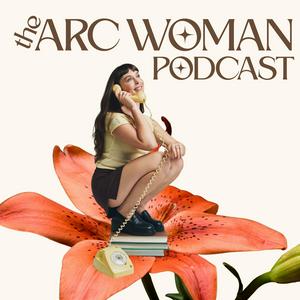
The Arc Woman Podcast is an exploration of woman kind. Here we discuss what it is to be a woman in the modern world while utilising ancient and modern modalities in tandem to create a bounty of health for the body, mind and spirit.
Podcast websiteListen to The Arc Woman Podcast, On Purpose with Jay Shetty and many other podcasts from around the world with the radio.net app
Get the free radio.net app
- Stations and podcasts to bookmark
- Stream via Wi-Fi or Bluetooth
- Supports Carplay & Android Auto
- Many other app features
Get the free radio.net app
- Stations and podcasts to bookmark
- Stream via Wi-Fi or Bluetooth
- Supports Carplay & Android Auto
- Many other app features

The Arc Woman Podcast
Scan code,
download the app,
start listening.
download the app,
start listening.
 New Zealand
